
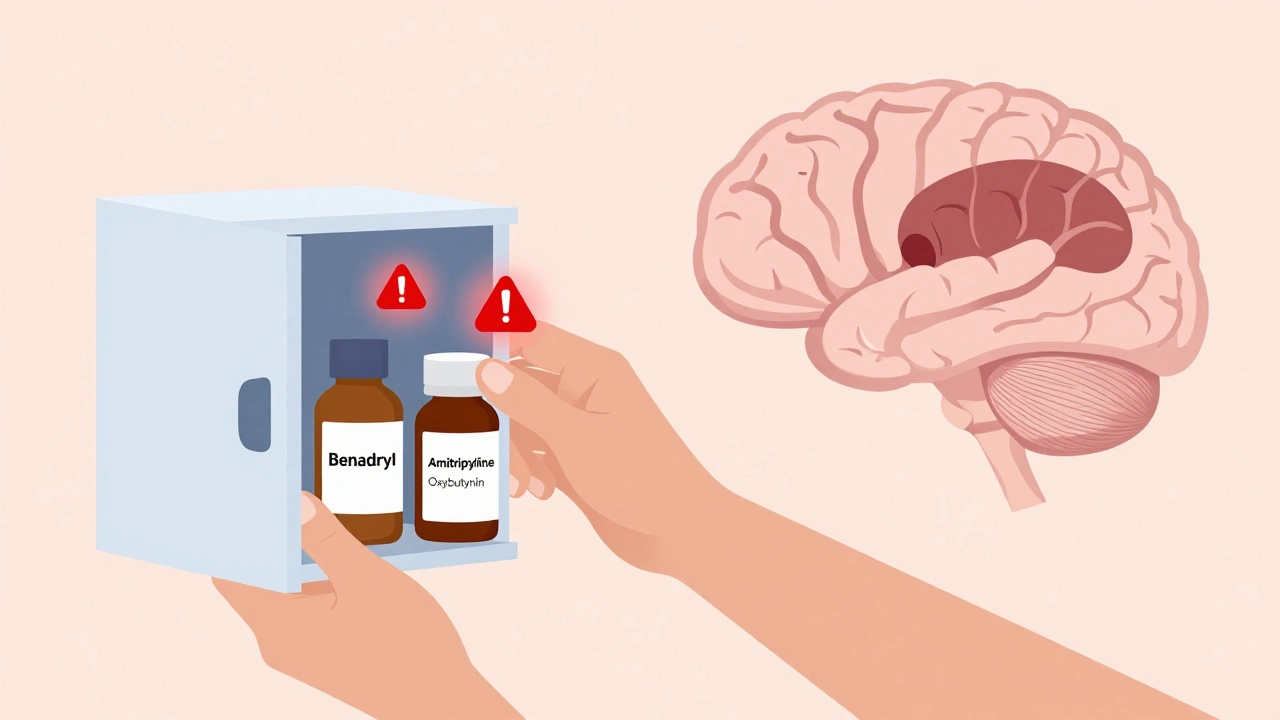
For years, many older adults took medications like Benadryl for allergies, amitriptyline for depression, or oxybutynin for an overactive bladder without thinking twice. These drugs worked. They helped with sleep, reduced bladder spasms, and eased nerve pain. But now, a growing body of evidence shows something troubling: long-term use of these common medicines may be quietly speeding up memory loss and increasing the risk of dementia.
What Are Anticholinergic Medications?
Anticholinergic medications block acetylcholine, a chemical in your brain and body that helps nerves communicate. This sounds bad, but it’s not always a problem. In fact, blocking acetylcholine is how these drugs work - they calm overactive muscles, reduce saliva, and stop involuntary contractions. That’s why they’re used for conditions like Parkinson’s, urinary incontinence, chronic pain, allergies, and even insomnia.
But here’s the catch: not all anticholinergics are the same. Some barely cross into the brain. Others slip right through the blood-brain barrier and start interfering with memory circuits. Drugs like diphenhydramine (Benadryl), oxybutynin (Ditropan), and amitriptyline (Elavil) are strong offenders. They’re not rare - about 10-15% of adults over 65 in the U.S. take at least one of them regularly. That’s 15 to 20 million people.
The Link to Dementia Isn’t Theoretical - It’s Measurable
It’s not just a theory. Studies using brain scans show real, physical changes. People taking high-anticholinergic drugs for years had 0.5% to 1.2% more brain volume loss each year in areas tied to memory - the hippocampus and amygdala. Their brains also burned less glucose, a sign of reduced activity. This isn’t normal aging. This looks like early Alzheimer’s pathology.
A 2019 study tracking over 3,400 people for more than a decade found that those who took anticholinergics for more than 1,095 total daily doses - roughly three years of daily use - had a 49% higher risk of developing dementia. Even taking them for just a few months added a small but real increase in risk. And it wasn’t just one drug. The more drugs you took, the higher the risk. This is called anticholinergic burden.
There’s also a dose-response pattern. The stronger the drug’s effect on acetylcholine, the worse the cognitive impact. Tricyclic antidepressants like amitriptyline carried the highest risk - 29% higher dementia odds. Bladder drugs like oxybutynin and solifenacin followed close behind. But trospium, another bladder medication, showed no increased risk. That’s important. Not all anticholinergics are equal.

Why This Matters More Than You Think
Most people don’t realize they’re on anticholinergic medications. Many take them over the counter. Diphenhydramine is in sleep aids, cold medicines, and allergy pills. People think it’s harmless because it’s available without a prescription. But if you’re over 60 and taking it every night for sleep, you’re exposing your brain to a known cognitive risk.
Even doctors aren’t always aware. A 2021 survey found that only 37% of primary care physicians routinely check for anticholinergic burden in older patients - even though 89% knew it was a risk in theory. That gap between knowledge and action is dangerous. Patients aren’t warned. Medication labels often don’t mention cognitive side effects, even though EU regulations require it since 2017. Only 42% of patient leaflets include this warning.
And the damage might not be reversible. One Reddit user shared that their mother’s memory scores dropped from 28 to 22 over three years on amitriptyline. After stopping the drug, her score stabilized - but never went back up. That’s not temporary confusion. That’s lasting harm.
What Can You Do?
You don’t have to stop everything overnight. But you do need to ask questions.
- Know what you’re taking. Look up every pill in your medicine cabinet. Use the Anticholinergic Cognitive Burden (ACB) scale. If a drug scores 2 or 3, it’s high risk.
- Ask your doctor: Is this necessary? For depression, SSRIs like sertraline are just as effective and don’t block acetylcholine. For overactive bladder, mirabegron works without anticholinergic effects. For insomnia, cognitive behavioral therapy is safer than sleeping pills.
- Don’t quit cold turkey. Stopping suddenly can cause withdrawal - sweating, nausea, heart palpitations. Work with your doctor to taper off slowly, over 4 to 8 weeks.
- Use tools. Some electronic health records now include anticholinergic burden calculators. Ask if yours does.
The American Geriatrics Society’s Beers Criteria® already says: avoid strong anticholinergics in older adults. That’s not a suggestion. It’s a guideline based on hard evidence.

What’s Changing Now?
Regulators are catching up. The FDA added stronger warnings to 14 anticholinergic drugs in 2020. The European Medicines Agency restricted seven bladder drugs for elderly patients in 2021. Pharmaceutical companies are responding - seven new bladder treatments and three new antidepressants are in late-stage trials, all designed to avoid crossing into the brain.
The Alzheimer’s Association estimates that cutting anticholinergic use could prevent up to 15% of dementia cases each year - that’s over half a million people globally. That’s not a small number. It’s one of the most preventable causes of cognitive decline we know.
And research is still moving forward. The PREPARE trial, launched in 2022, is following 3,000 people with a genetic risk for Alzheimer’s to see if stopping anticholinergics slows memory loss. Results won’t come until 2027, but the early signs are already clear: less exposure = better brain health.
Bottom Line: This Isn’t About Fear - It’s About Choice
Some people still need these drugs. Parkinson’s patients can’t always switch. Chronic pain sufferers may have no other options. But for millions of others - the ones taking Benadryl for sleep, oxybutynin for nighttime leaks, or amitriptyline for mild depression - there are safer alternatives.
It’s not about avoiding all medication. It’s about asking: Is this the best choice for my brain?
If you’re over 60 and on any of these drugs, talk to your doctor. Bring a list. Ask about alternatives. Ask about your anticholinergic burden. You might be surprised by how many options exist - and how much your brain could thank you for it.
Do all anticholinergic drugs cause dementia?
No. Not all anticholinergic drugs carry the same risk. Some, like glycopyrrolate, barely enter the brain and have little to no cognitive impact. Others, like amitriptyline, oxybutynin, and diphenhydramine, strongly affect brain function and are linked to higher dementia risk. The Anticholinergic Cognitive Burden (ACB) scale ranks drugs from 0 (no risk) to 3 (high risk). Stick to drugs with a score of 1 or lower when possible.
Can stopping anticholinergic drugs improve memory?
In many cases, yes - but not always fully. Studies show that cognitive decline often stabilizes after stopping these drugs, and some people regain partial function. However, if brain changes have already occurred over years of use, full recovery isn’t guaranteed. The earlier you stop, the better your chances. Waiting until memory problems appear reduces the potential benefit.
Is it safe to stop taking anticholinergics on my own?
No. Stopping suddenly can cause withdrawal symptoms like increased heart rate, sweating, nausea, confusion, or even seizures in rare cases. Always work with your doctor to taper off slowly. A gradual reduction over 4 to 8 weeks is usually recommended to avoid these risks.
What are safer alternatives to common anticholinergic drugs?
For overactive bladder: mirabegron (Myrbetriq) instead of oxybutynin. For depression: SSRIs like sertraline or escitalopram instead of amitriptyline. For insomnia: cognitive behavioral therapy (CBT-I) instead of diphenhydramine. For allergies: non-sedating antihistamines like loratadine or cetirizine. These alternatives avoid blocking acetylcholine in the brain.
How do I check if my medication has anticholinergic effects?
Search for the drug name + "ACB score" or "anticholinergic burden." The University of Eastern Finland and the American Geriatrics Society have public lists. You can also ask your pharmacist or use apps like Medscape or Epocrates, which include anticholinergic risk ratings. If you’re unsure, bring your full medication list to your doctor for review.
Are over-the-counter sleep aids dangerous for older adults?
Yes, especially those containing diphenhydramine or doxylamine. These are among the most common anticholinergics used by seniors and are linked to increased dementia risk with long-term use. Even one pill a night for years adds up. Safer options include melatonin (short-term), CBT for insomnia, or addressing underlying causes like sleep apnea or anxiety.
Why don’t doctors always warn patients about this?
Many doctors know the risk, but they’re under time pressure and often assume patients won’t understand or will stop taking necessary meds. Patient leaflets frequently omit cognitive warnings, and medical training doesn’t always emphasize anticholinergic burden. But awareness is growing. The American Geriatrics Society now recommends routine screening for older adults - and more tools are being built into electronic health records to help doctors spot the risk.
Can younger people be affected too?
The strongest evidence is in people over 60, but some studies suggest even middle-aged adults (50-65) who take high-burden anticholinergics for years may have subtle memory changes. While dementia risk is lower in younger people, cognitive slowing and brain changes have been observed. The longer you’re exposed, the greater the potential impact - so caution applies across age groups.


val kendra
December 4, 2025 AT 01:53Isabelle Bujold
December 4, 2025 AT 06:58Ollie Newland
December 5, 2025 AT 08:04Michael Feldstein
December 7, 2025 AT 02:39Benjamin Sedler
December 7, 2025 AT 12:50Heidi Thomas
December 8, 2025 AT 03:15Alex Piddington
December 9, 2025 AT 09:26Libby Rees
December 10, 2025 AT 20:46Dematteo Lasonya
December 11, 2025 AT 10:27George Graham
December 12, 2025 AT 09:25