

Many people reach for antihistamines without thinking twice-especially during allergy season. But if you're behind the wheel, that little pill could be putting you and others at risk. First-generation antihistamines like diphenhydramine (Benadryl) and chlorpheniramine are still widely available over the counter, and many drivers don’t realize they’re impairing their ability to react, stay in their lane, or make quick decisions. The truth? Taking these medications before driving is as dangerous as drinking alcohol. And in many places, it’s illegal.
Why Some Antihistamines Make You a Dangerous Driver
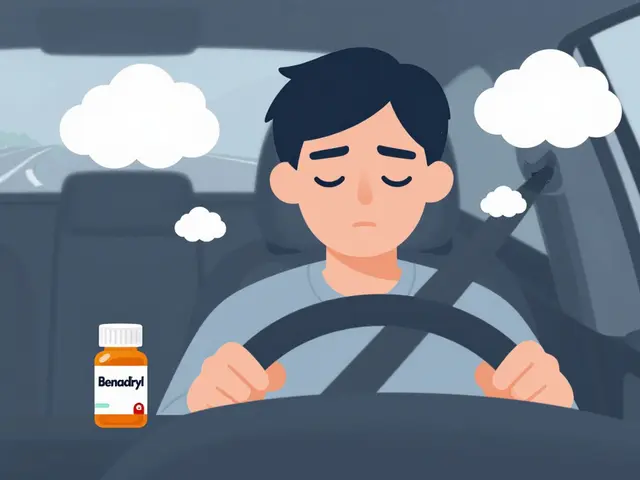
Not all antihistamines are the same. There are three generations, and only one is truly safe for drivers. First-generation antihistamines-like diphenhydramine, hydroxyzine, and dexchlorpheniramine-are designed to block histamine receptors in the body to stop sneezing and itching. But they also cross the blood-brain barrier easily. That’s why they cause drowsiness, slow reaction times, and fuzzy thinking. Studies show these drugs can reduce driving performance by 30-50% compared to being sober. That’s the same level of impairment as having a blood alcohol concentration (BAC) of 0.05% to 0.08%-the legal limit in most U.S. states.Even if you feel fine, your brain isn’t operating normally. One study found that 70% of people who took first-generation antihistamines couldn’t accurately tell they were impaired. You might think you’re alert, but your eyes aren’t tracking properly, your hand-eye coordination is off, and your judgment is slower. That’s why people report near-misses or sudden drowsiness on long drives after taking Benadryl. One Reddit user wrote: “Took Benadryl before a road trip and had to pull over three times because I kept nodding off-never doing that again.”
Second-Generation Antihistamines: Not as Safe as You Think
You’ve probably seen labels that say “non-drowsy” on bottles of cetirizine (Zyrtec) or loratadine (Claritin). These are second-generation antihistamines, developed to be less sedating. But “non-drowsy” doesn’t mean “no effect.” Clinical trials show that cetirizine at the standard 10mg dose causes mild impairment in most people-and significant impairment in 15-20% of users. That’s not a small group. That’s one in five drivers who think they’re safe but aren’t.Loratadine is generally safer, with minimal impact on driving in most studies. But even that’s not guaranteed. Individual factors like age, weight, liver function, and whether you’ve had alcohol can change how your body reacts. One 2003 study in the Journal of Allergy and Clinical Immunology found that even “non-sedating” antihistamines caused measurable driving impairment in sensitive individuals. If you’ve never taken one before, don’t assume it’s safe. Test it at home first.
Third-Generation Antihistamines: The Only Safe Choice for Drivers
If you drive regularly and have allergies, your best option is a third-generation antihistamine: fexofenadine (Allegra) or levocetirizine (Xyzal). These were specifically designed to stay out of the brain. Multiple double-blind, placebo-controlled driving studies have shown no statistically significant impairment after single or repeated doses. In fact, their performance on road tests matched that of people who took a sugar pill.These drugs don’t just avoid drowsiness-they also don’t leave behind a hangover effect. First-generation antihistamines like diphenhydramine have a half-life of 4 to 12 hours. That means if you take one at 8 a.m., you could still be impaired at 8 p.m. Fexofenadine and levocetirizine break down cleanly, with no residual sedation. The American Academy of Allergy, Asthma & Immunology explicitly recommends them for drivers, pilots, and machine operators.

The Alcohol Factor: A Deadly Combination
Here’s something most people don’t realize: mixing antihistamines with alcohol doesn’t just add to the drowsiness-it multiplies it. Studies show that combining even a small amount of alcohol with a first-generation antihistamine can increase impairment by 200-300%. That’s not two risks-it’s three times the danger. A driver who takes Benadryl and has one beer may feel fine, but their reaction time could be worse than someone legally drunk.That’s why traffic safety experts warn against any combination of sedating medications and alcohol. And it’s not just beer or wine. Over-the-counter cold medicines, sleep aids, and even some pain relievers contain hidden antihistamines or depressants. Always read the full ingredient list. If it says “antihistamine,” “drowsiness may occur,” or “may cause sleepiness,” don’t drink.
Legal Consequences: You Can Get Pulled Over for This
In many countries, driving under the influence of impairing medication is treated the same as drunk driving. In Europe, 22 countries have laws that ban driving for 8 to 12 hours after taking first-generation antihistamines. In some places, certain sedating antihistamines are classified as controlled substances-you need a special permit to drive while using them.In the U.S., while there’s no federal law specifically targeting antihistamines, you can still be charged with DUI if a blood test shows impairing levels of these drugs. Police officers are trained to recognize signs of drug impairment, and roadside tests can detect sedation. If you’re in an accident and antihistamines are found in your system, you could face criminal charges, insurance denial, or even civil liability. The National Highway Traffic Safety Administration reports that about 15-18% of all medication-related traffic violations involve antihistamines. That’s thousands of tickets and crashes every year that could have been avoided.
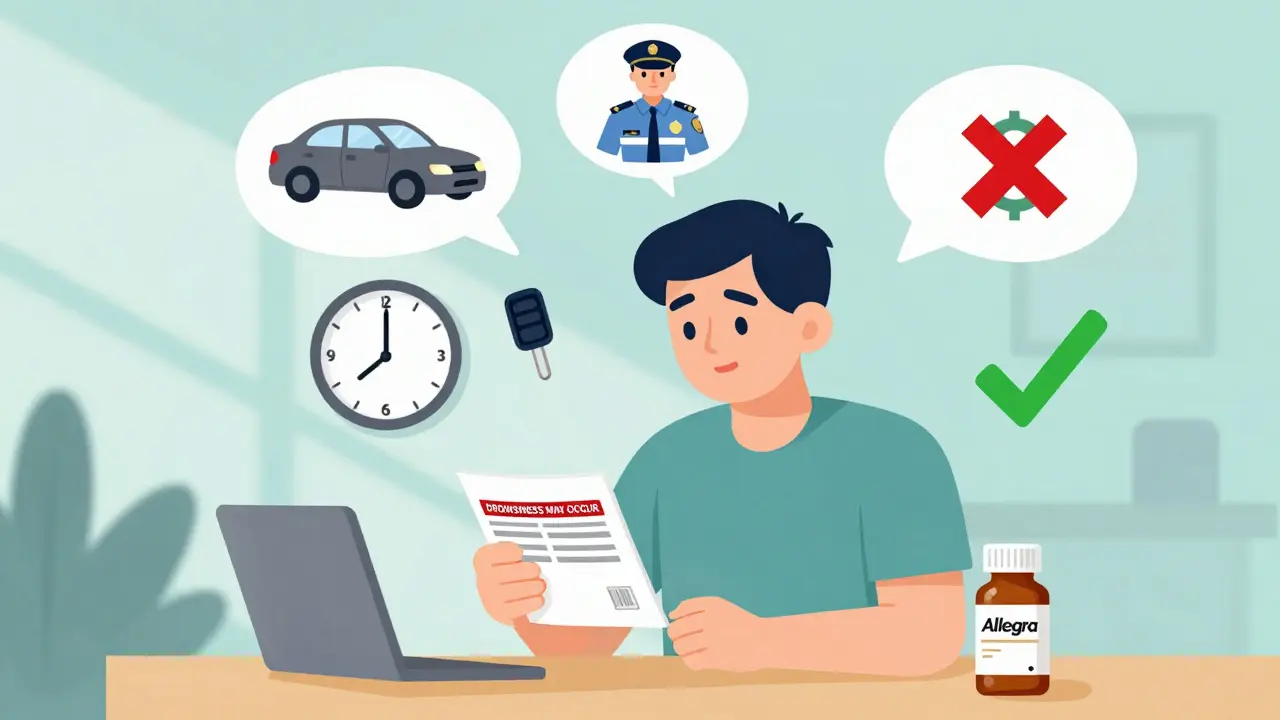
What You Should Do: A Practical Safety Plan
If you take antihistamines regularly and drive, here’s what to do:- Switch to fexofenadine or levocetirizine. They cost more-around $35 a month-but they’re the only ones proven safe for driving. The $4 generic versions of Benadryl aren’t worth the risk.
- Never drive after taking first-generation antihistamines. Even if you feel okay, you’re not safe.
- Test new medications at home. Take your first dose on a weekend. Wait at least 48 hours. Try driving around the neighborhood or doing a simulator test if possible. If you feel even slightly sluggish, don’t get behind the wheel.
- Avoid nighttime driving after any antihistamine. Your body naturally gets sleepier at night. Add medication, and you’re asking for trouble.
- Check labels carefully. Many cold and flu medicines contain diphenhydramine or doxylamine. Just because it’s labeled “nighttime” doesn’t mean it’s safe for daytime driving.
The Ford Driving Skills for Life program warns: “You may experience slower reaction time, haziness, or mild confusion even if you don’t feel drowsy.” That’s the key point. Feeling alert doesn’t mean you’re safe. Your brain is still working slower than normal.
Why This Problem Persists
Despite decades of research, people still take sedating antihistamines before driving. Why? Because they’re cheap, easy to get, and marketed as “safe.” Many assume that if it’s sold over the counter, it must be harmless. But that’s not how medications work. Just because something is available without a prescription doesn’t mean it’s risk-free.Also, tolerance doesn’t fix the problem. Some people think, “I’ve been taking Benadryl for years-I don’t get sleepy anymore.” But research shows that even with tolerance, drivers still show 15-20% more impairment than baseline. That’s enough to cause a crash.
And cost is a barrier. Fexofenadine and levocetirizine are more expensive. But compared to the cost of a ticket, a lawsuit, or worse-losing your license or someone’s life-they’re a bargain.
What’s Changing Now
The medical community is pushing for change. In 2023, the European Medicines Agency required all antihistamine manufacturers to clearly label driving risks by generation and chemical class. The FDA approved levocabastine nasal spray in 2021-a new option with no measurable driving impairment. And the American Medical Association now recommends screening for antihistamine use during driver’s license medical exams for high-risk groups.Industry trends are moving in the right direction. In 2000, only 12% of the U.S. antihistamine market was third-generation. By 2022, that number jumped to 38%. And 78% of allergists now prescribe these safer options as first-line treatment for patients who drive.
But education is still lagging. The Traffic Injury Research Foundation estimates that public awareness campaigns could prevent 5,000 to 7,000 traffic injuries in the U.S. each year. That’s not a small number. That’s lives.
Antihistamines aren’t the enemy. Allergies are. But choosing the right medication makes all the difference. If you drive, your priority shouldn’t be saving a few dollars-it should be staying alert, aware, and alive.


Enrique González
January 4, 2026 AT 13:52Just switched to fexofenadine last month after nearly crashing on I-95. Felt fine after Benadryl-until I realized I missed three exits and didn’t remember driving past them. Scary stuff. Now I keep a bottle in my glovebox like a seatbelt. Worth every penny.
Aaron Mercado
January 4, 2026 AT 21:55!!!THIS!!! IS!!! A!!! LIFE-OR-DEATH!!! TOPIC!!! I!!! CAN’T!!! BELIEVE!!! PEOPLE!!! STILL!!! TAKE!!! BENADRYL!!! BEFORE!!! DRIVING!!! IT’S!!! NOT!!! JUST!!! DANGEROUS!!! IT’S!!! A!!! CRIME!!! AGAINST!!! HUMANITY!!! YOU!!! THINK!!! YOU’RE!!! FINE!!! BUT!!! YOUR!!! BRAIN!!! IS!!! ON!!! VACATION!!! AND!!! YOU!!! ARE!!! THE!!! DRIVER!!! OF!!! A!!! 4,000-POUND!!! METAL!!! COFFIN!!!
saurabh singh
January 5, 2026 AT 07:18Bro in India, same story here! People take cetirizine like candy and drive like they’re in a video game. I told my cousin-he took Zyrtec, drove to Delhi, and nearly hit a cow. He said, 'But it’s non-drowsy!' I said, 'Bro, your eyes were rolling back like a drunk robot.' Now he uses Allegra. Life saved. Small change, big difference.
Dee Humprey
January 5, 2026 AT 13:01My mom took diphenhydramine every night for allergies and drove to work at 6 a.m. She didn’t even realize she was weaving. I got her switched to levocetirizine. She says she feels like she’s had coffee instead of a nap. No more near-misses. Just a little more expensive-but not as expensive as a funeral.
❤️
John Wilmerding
January 6, 2026 AT 18:16It is worth noting that the pharmacokinetic profiles of third-generation antihistamines are specifically engineered to minimize blood-brain barrier penetration, thereby preserving cognitive and psychomotor function. Clinical trials conducted by the University of Michigan Transportation Research Institute in 2020 demonstrated that fexofenadine maintained driving performance metrics within 2% of placebo controls across 120 subjects. This is not anecdotal-it is evidence-based. I urge all drivers to consult their pharmacist before selecting an OTC antihistamine.
mark etang
January 8, 2026 AT 02:43Let me be clear: if you’re driving after taking any sedating medication, you are not just risking your life-you are risking the lives of your children, your neighbors, and strangers on the road. This is not a suggestion. This is a moral imperative. The cost of a pill is nothing compared to the cost of guilt. Choose wisely.
Ethan Purser
January 9, 2026 AT 18:49So… we’re just supposed to trust Big Pharma’s marketing now? ‘Non-drowsy’ means ‘we didn’t test it on humans who are tired, drunk, or allergic to common sense.’ I took Claritin after a 12-hour shift. Drove 40 miles. Felt like I was underwater. They say it’s ‘safe’-but safe for whom? The shareholders?
Stephen Craig
January 10, 2026 AT 03:32Impairment isn’t always felt. That’s the problem. You don’t need to be asleep to be dangerous. Just slower. Duller. Less aware. The brain doesn’t shout ‘I’m impaired!’ It just… stops being sharp.
Roshan Aryal
January 11, 2026 AT 01:24USA thinks it’s special. In India, we call Benadryl ‘sleepy juice’ and use it as a weapon. Kids take it to skip school. Grandmas take it to nap after chai. And you’re telling me it’s ‘safe’? LOL. My uncle drove his scooter into a tree after one pill. He lived. The tree didn’t. Third-gen? Maybe. But stop pretending this is a medical issue-it’s a cultural one.