

When you’re fighting cancer, the last thing you should be worrying about is how to pay for treatment. But for too many people, the cost of care is a constant, crushing burden-so much so that doctors now call it financial toxicity. It’s not just about bills piling up. It’s about choosing between buying medicine and paying rent, skipping doses to stretch out prescriptions, or quitting your job because you can’t afford to keep working. This isn’t a rare problem. It’s happening to nearly half of all cancer patients.
What Exactly Is Financial Toxicity?
Financial toxicity isn’t a medical term you’ll find in old textbooks. It was first named in 2013 by researchers at Duke University, and since then, it’s become a standard part of cancer care discussions. The National Cancer Institute defines it simply: problems a patient has related to the cost of medical care. But that definition doesn’t capture the full weight of it. It’s the $1,200 monthly copay for an immunotherapy drug that eats up your entire paycheck. It’s the $300 gas bill just to get to weekly chemotherapy appointments. It’s the lost wages from missing work because you’re too sick-or because you’re sitting in a hospital waiting room for hours. It’s the sleepless nights worrying about how you’ll pay your mortgage after your insurance deductible resets. Studies show that between 28% and 48% of cancer survivors face measurable financial hardship. But when you ask patients how they feel, that number jumps to 73%. Why? Because money stress isn’t just about numbers-it’s about shame, fear, and helplessness.Who Gets Hit Hardest?
Not everyone feels the same financial pressure. Some groups are far more vulnerable. Low-income patients, especially women with breast cancer, can spend up to 98% of their annual income on treatment. That’s not a typo. For many, cancer doesn’t just steal their health-it steals their financial future. Younger patients under 65 are at higher risk too. They’re more likely to be working, raising kids, and carrying student loans. They haven’t had time to build savings. And they’re often underinsured, stuck with high-deductible plans that leave them paying thousands before coverage kicks in. Patients with metastatic cancer face the worst of it. Their treatment doesn’t end after six months. It goes on for years-or for life. Drugs like pembrolizumab or nivolumab can cost over $150,000 a year. Even with insurance, out-of-pocket costs can hit $10,000 or more annually. And then there’s the insurance gap. People with Medicare are often surprised to find that their plan doesn’t cover everything. Half of Medicare beneficiaries with cancer spend more than 10% of their income just on out-of-pocket cancer costs. That’s more than most people spend on housing.How Financial Toxicity Hurts Your Health
You’d think that if you’re sick, you’d do anything to get better. But money changes that. Studies show that patients who are financially stressed are more likely to:- Skip or delay doses of their cancer drugs
- Refuse recommended treatments because they can’t afford them
- Delay follow-up scans or lab tests
- Stop taking pain medication because it’s too expensive

What’s Driving These Costs?
Cancer care has become one of the most expensive areas of medicine-and it’s getting worse. New treatments like immunotherapy, targeted therapies, and CAR-T cell therapy are revolutionary. But they’re also incredibly costly. A single course of some newer drugs can cost more than $500,000. Even generic chemotherapy drugs have seen price hikes of 300% over the past decade. Insurance plans have changed too. More people are on high-deductible health plans. That means you pay more upfront before your insurance helps. Coinsurance rates have climbed. Copays for oral cancer drugs (pills you take at home) are often higher than for IV treatments given in a clinic-even though the pills are just as effective. And then there’s the hidden stuff: transportation, childcare, home care, special diets, wigs, compression garments. These aren’t covered by insurance. But they’re necessary. And they add up fast.What Can You Do? Practical Steps to Reduce Financial Stress
You don’t have to face this alone. There are real, proven ways to cut costs and get help.Ask for a Financial Navigator
Most major cancer centers now have financial navigators-trained professionals who help patients understand costs, find aid, and apply for programs. They’re not social workers. They’re experts in insurance, copay assistance, and patient support programs. Ask your oncology team: “Do you have a financial counselor I can meet with?” If they say no, ask for a referral to a nonprofit like the Patient Advocate Foundation or CancerCare.Apply for Copay Assistance Programs
Most drug manufacturers offer copay cards or patient assistance programs. These can reduce your monthly cost from $10,000 to $0-or close to it. In 2022 alone, pharmaceutical companies provided over $12 billion in help to 1.8 million cancer patients. But here’s the catch: you have to apply. Many patients don’t know these exist. Start with the drug’s manufacturer website. Search “[Drug Name] patient assistance program.” You can also use sites like NeedyMeds.org or the PAN Foundation to find help.Check for State and Federal Aid
Some states have passed laws to help. California’s 2022 Cancer Drug Affordability Act requires drugmakers to disclose pricing and justify cost increases. Other states offer prescription assistance funds. Medicaid may cover more than you think-if you qualify. Even if you’re above the income limit, some states have “spend-down” programs that let you qualify by spending down excess income on medical bills.Ask About Clinical Trials
Participating in a clinical trial can mean free access to cutting-edge drugs. Many trials cover all treatment costs, including travel and lodging. Don’t assume you’re not eligible. Ask your doctor: “Are there any trials that might be right for me?” Even if you’re not in the running, the financial support alone can be life-changing.Negotiate Your Bills
Hospitals and clinics often have charity care programs or payment plans. Don’t wait for a bill to become a collection notice. Call before it’s due. Say: “I’m on a fixed income. Can we set up a payment plan? Is there any discount available?” Many hospitals will reduce bills by 30-50% if you ask.Look Into Non-Medical Support
CancerCare and the American Cancer Society offer free rides to treatment, lodging near hospitals, and even help with groceries or utility bills. These aren’t luxury services-they’re survival tools.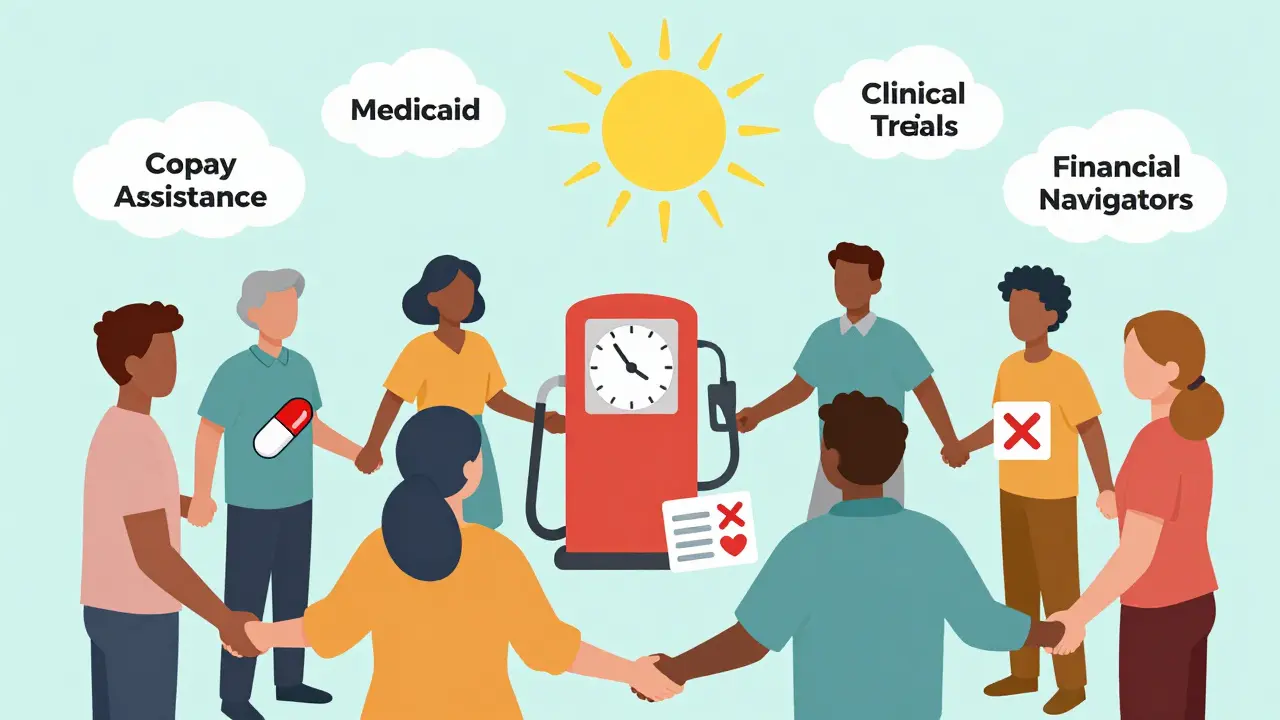
What’s Changing in Cancer Care?
The tide is turning. More hospitals are screening patients for financial distress during checkups. The National Comprehensive Cancer Network now includes financial toxicity in its standard survivorship guidelines. AI tools are being tested to predict who’s at risk before they hit crisis mode. One study showed AI could identify patients likely to face financial hardship with 82% accuracy by looking at their income, insurance, treatment type, and location. Legislation is moving too. The Cancer Drug Parity Act, reintroduced in 2023, would require insurers to charge the same copay for oral and IV cancer drugs. Right now, oral drugs often cost more-punishing patients who prefer to take pills at home. The American Cancer Society has committed $15 million to research and support programs between 2023 and 2025. That’s a signal: this is no longer a hidden problem. It’s a public health crisis.Final Thoughts: You’re Not Alone
Cancer is hard enough. You shouldn’t have to choose between your health and your home. Financial toxicity is real, widespread, and treatable-with the right support. If you’re struggling, don’t wait. Don’t feel ashamed. Reach out. Ask for help. Talk to your nurse, your social worker, your pharmacist. Use the tools that exist. Apply for every program you qualify for. Your life is worth more than a bill. And there are people ready to help you fight-not just the cancer, but the cost too.What is financial toxicity in cancer care?
Financial toxicity is the financial burden and emotional distress caused by the cost of cancer treatment. It includes out-of-pocket expenses like copays, deductibles, and medications, as well as indirect costs like lost wages, travel, and childcare. It’s recognized by the National Cancer Institute as a serious side effect of cancer care that affects quality of life and treatment adherence.
How common is financial toxicity among cancer patients?
Studies show that between 28% and 48% of cancer survivors face measurable financial hardship, and up to 73% report feeling financial stress. About 13% of non-elderly patients spend at least 20% of their income on cancer care, while half of Medicare beneficiaries with cancer spend over 10% of their income on out-of-pocket costs.
Can financial toxicity affect cancer treatment outcomes?
Yes. Patients experiencing financial stress are more likely to skip doses, delay treatments, or stop taking medications altogether. This leads to worse health outcomes, faster cancer progression, and lower survival rates. Financial toxicity is linked to higher rates of depression, anxiety, and poor physical health.
Are there programs to help pay for cancer treatment?
Yes. Drug manufacturers offer copay assistance programs that can reduce out-of-pocket costs to $0. Nonprofits like the Patient Advocate Foundation and CancerCare provide financial aid, transportation, and housing help. State programs and Medicaid may also cover additional expenses. Financial navigators at cancer centers can help you apply.
What should I do if I can’t afford my cancer meds?
Don’t stop taking your medication without talking to your doctor. Contact your oncology team and ask for a financial navigator. Search for the drug’s manufacturer patient assistance program online. Use NeedyMeds.org or the PAN Foundation to find aid. You can also ask your pharmacy or hospital about discount programs or payment plans.
Is financial toxicity getting worse?
Yes. New cancer drugs are more effective but far more expensive. Insurance plans are shifting more costs to patients through higher deductibles and copays. By 2025, 75% of NCI-designated cancer centers are expected to have formal financial toxicity screening programs-up from 35% in 2022-showing how urgent the problem has become.


Sarthak Jain
December 15, 2025 AT 13:21yo this hit different. i got my bro through chemo last year and man, the copay for that one pill was like $800/month. we had to pawn his gaming rig just to keep him on meds. no one talks about this shit until you’re drowning in it. thanks for laying it out like this.
Edward Stevens
December 17, 2025 AT 06:07Oh wow, so the cancer industry finally admitted it’s a money grab? Shocking. Next they’ll tell us oxygen is overpriced. At least the pharmaceutical CEOs can sleep easy knowing their yachts are fully stocked with caviar while patients skip doses. 🙃
Dwayne hiers
December 18, 2025 AT 10:55Financial toxicity isn’t just a buzzword-it’s a systemic failure in oncology care delivery. The current fee-for-service model incentivizes volume over value, and oral oncolytics are particularly predatory due to lack of parity with IV administration. Copay accumulator programs and tiered formularies exacerbate this. Patients need embedded financial navigators, not afterthoughts.
Thomas Anderson
December 18, 2025 AT 19:12Just call your hospital’s billing office and ask for a discount. Most will knock off 40% if you just say you’re struggling. No magic trick, just talking.
Rulich Pretorius
December 19, 2025 AT 21:53This is the quiet epidemic no one wants to name. We treat cancer like a technical problem-fix the cells, kill the tumor-but we ignore the human condition that holds the body together. When a man chooses between insulin and rent, it’s not medicine that’s failing. It’s the moral architecture of our society. We’ve outsourced compassion to nonprofits because profit can’t be taxed out of existence.
Daniel Wevik
December 21, 2025 AT 03:07For anyone reading this: ask for the financial navigator. Seriously. They’re not there to upsell you-they’re there to save your life from bankruptcy. I’ve seen them get a patient’s $12k monthly bill reduced to $50. Just say the words: ‘I can’t afford this.’ They’ve heard it a thousand times. They know how to help.
Natalie Koeber
December 21, 2025 AT 10:24Of course this is happening. Big Pharma owns Congress. The FDA approves drugs based on shareholder reports, not survival stats. And don’t get me started on the ‘clinical trials’-they’re just testing ground for billionaires to profit off dying people. You think they care if you live? They care if your insurance pays. Wake up.
Jonny Moran
December 23, 2025 AT 06:37As someone from South Africa, I’ve seen how this plays out differently here. In the U.S., you’re drowning in bills but at least you have options-copay cards, nonprofits, navigators. In many places, you just… don’t get treated. This post is a lifeline. Share it. Everywhere.
Rich Robertson
December 24, 2025 AT 17:01My cousin got diagnosed last year. She’s a single mom, worked retail, had Medicaid. They told her the drug cost $150k/year. She cried in the parking lot. Then she found a patient assistance program-zero out-of-pocket. She didn’t know it existed. Neither did her oncologist. That’s the problem. Knowledge is the real treatment.
jeremy carroll
December 25, 2025 AT 02:16hey everyone-i’m not a doctor or anything, but i just wanna say this: you’re not alone. i know it feels like the whole world is stacked against you, but there are people who care. reach out. call the numbers. fill out the forms. it’s a pain, but it’s worth it. you matter. your life matters. keep going.
Sinéad Griffin
December 25, 2025 AT 14:11THE GOVERNMENT IS LYING TO YOU!!! 🚨 Big Pharma + Insurance = The Cancer Cartel 🩸💸 They want you sick and broke so you keep buying their drugs! Watch the documentary ‘The Price of Life’ on YouTube-IT’S ALL FAKE! They’re injecting you with nano-chips to track your spending! 😱
Wade Mercer
December 26, 2025 AT 04:15People need to stop blaming corporations and start taking personal responsibility. If you can’t afford treatment, maybe you shouldn’t have had kids. Or bought a house. Or gotten cancer. This isn’t a right-it’s a privilege. You think the system’s broken? You broke it by living.
Alexis Wright
December 26, 2025 AT 06:49Let’s be brutally honest: this isn’t about ‘financial toxicity’-it’s about capitalism’s inevitable collapse under the weight of its own greed. Cancer is just the most visible symptom. We’ve turned human suffering into a spreadsheet. The real question isn’t how to pay for treatment-it’s why we let this system exist in the first place. The answer? Because it’s profitable. And we’re all complicit.
Daniel Thompson
December 27, 2025 AT 19:23I’m a hospital administrator. I see this every day. The truth is, most financial navigators are underpaid, overworked, and under-resourced. We have the tools-but not the funding. The system isn’t broken. It’s intentionally designed this way. And yes, I’m sorry.
Tim Bartik
December 29, 2025 AT 14:44Y’all need to stop whining and get a real job. If you can’t afford chemo, maybe you shouldn’t have moved to a city with 12k rent. America is the land of opportunity-unless you’re too lazy to work overtime. Also, why are you even having cancer? Should’ve eaten less sugar and done more pushups. #MakeAmericaHealthyAgain