
Blood Thinning Risk Calculator
This calculator helps you understand your personal risk of excessive blood thinning when taking fish oil and aspirin together. Based on scientific evidence from major studies, this tool provides personalized risk assessment.
For most people taking standard doses, the risk is very low. However, certain factors like high doses, other blood thinners, or surgery can increase risk.
Low Risk
For most people taking standard doses, the combination of fish oil and aspirin does not significantly increase bleeding risk. Large studies like ASCEND and VITAL found no increased bleeding risk even when taking both together.
Many people take fish oil for heart health and aspirin to protect against heart attacks. But when you take both, does your blood thin too much? Could you start bruising easily, bleeding longer from cuts, or face serious risks during surgery? The answer isn’t simple - and it depends on how much you take, who you are, and what your body is doing.
How Fish Oil and Aspirin Work Differently
Aspirin doesn’t just relieve pain. At low doses - like the 81mg daily pill many people take - it blocks a key enzyme in platelets called COX-1. This stops your blood from clumping together too easily. The effect lasts for the whole life of a platelet: 7 to 10 days. That’s why doctors recommend stopping aspirin before surgery. It’s not a quick fix. It’s a long-lasting change.
Fish oil works differently. It’s made of two omega-3 fatty acids: EPA and DHA. These don’t block enzymes like aspirin does. Instead, they get built into the membranes of your platelets. Think of it like replacing old parts with new ones. Over time, your platelets become less sticky. They don’t respond as strongly to signals that tell them to clump. But this change takes weeks to build up. One dose of fish oil won’t do anything. You need consistent daily use.
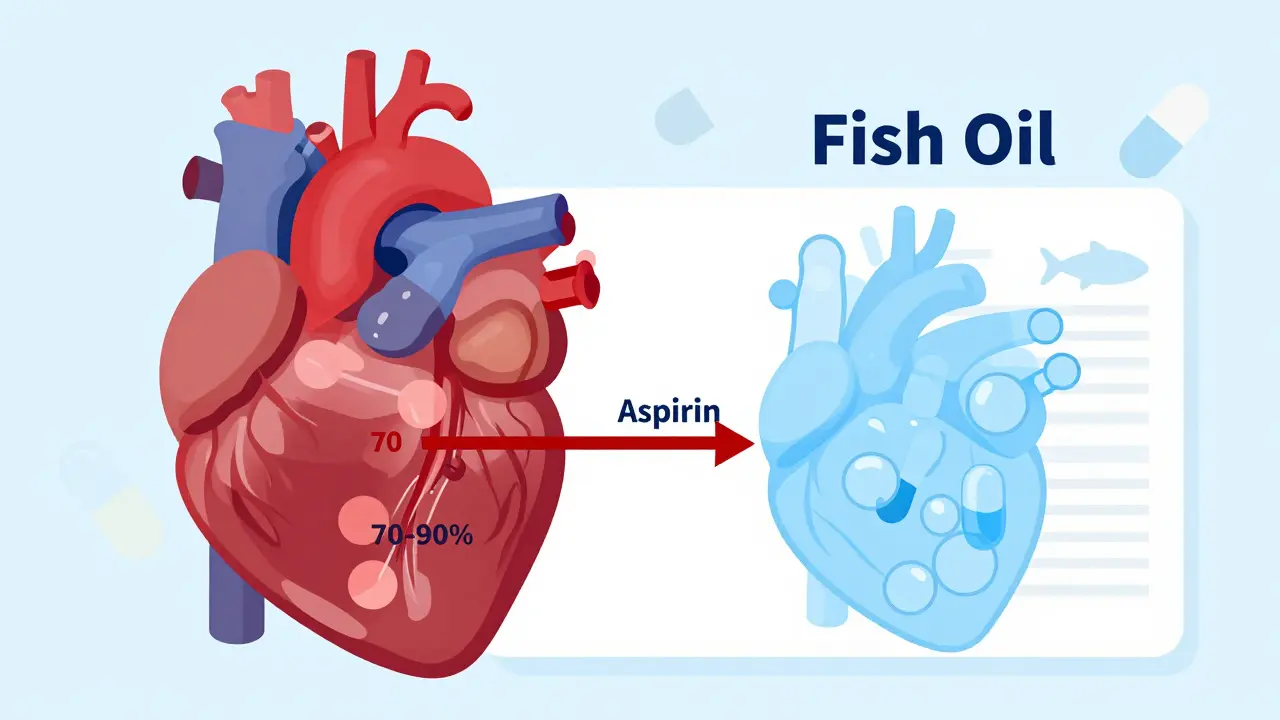
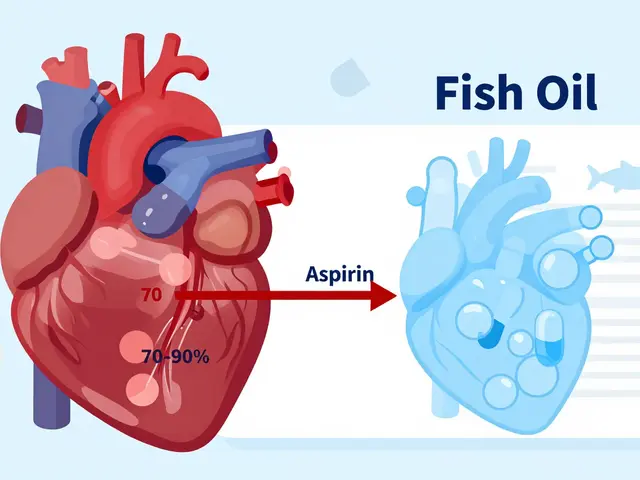
Studies show aspirin reduces platelet activity by 70-90% when triggered by arachidonic acid. Fish oil, even at high doses (4g daily), only reduces it by 20-40% when triggered by other signals like ADP. That’s a big difference. Aspirin is like turning off a main valve. Fish oil is like making the pipes a little smoother.
Do They Add Up? The Evidence
Early studies raised alarms. Some small trials suggested combining fish oil and aspirin might lower platelet activity more than either one alone. A 2012 study of 56 people with type 2 diabetes found the combination reduced platelet stickiness 32% more than aspirin alone. That sounds scary - until you look at the bigger picture.
Large, real-world studies tell a different story. The ASCEND trial followed over 15,000 diabetic adults for nearly 8 years. Half took 1g of fish oil daily. The other half took a placebo. The results? No increase in bleeding. No rise in strokes or major bleeding events. The same was true in the VITAL study with 25,871 people. Taking 1g of fish oil daily didn’t raise bleeding risk - even when people were also on aspirin.
Even in high-risk settings, like heart surgery, fish oil didn’t cause more bleeding. The OPERA trial gave 8g of fish oil to patients before heart surgery. They had less irregular heartbeat afterward - and the same amount of bleeding as those who didn’t take it. That’s not just safe. It’s beneficial.
So why do some people say they bled more? Because individual reactions vary. Some people have naturally thin blood. Others take higher doses - 3g, 4g, or more. And some combine fish oil with other blood thinners like warfarin or clopidogrel. That’s where risk increases.
What Dose Matters?
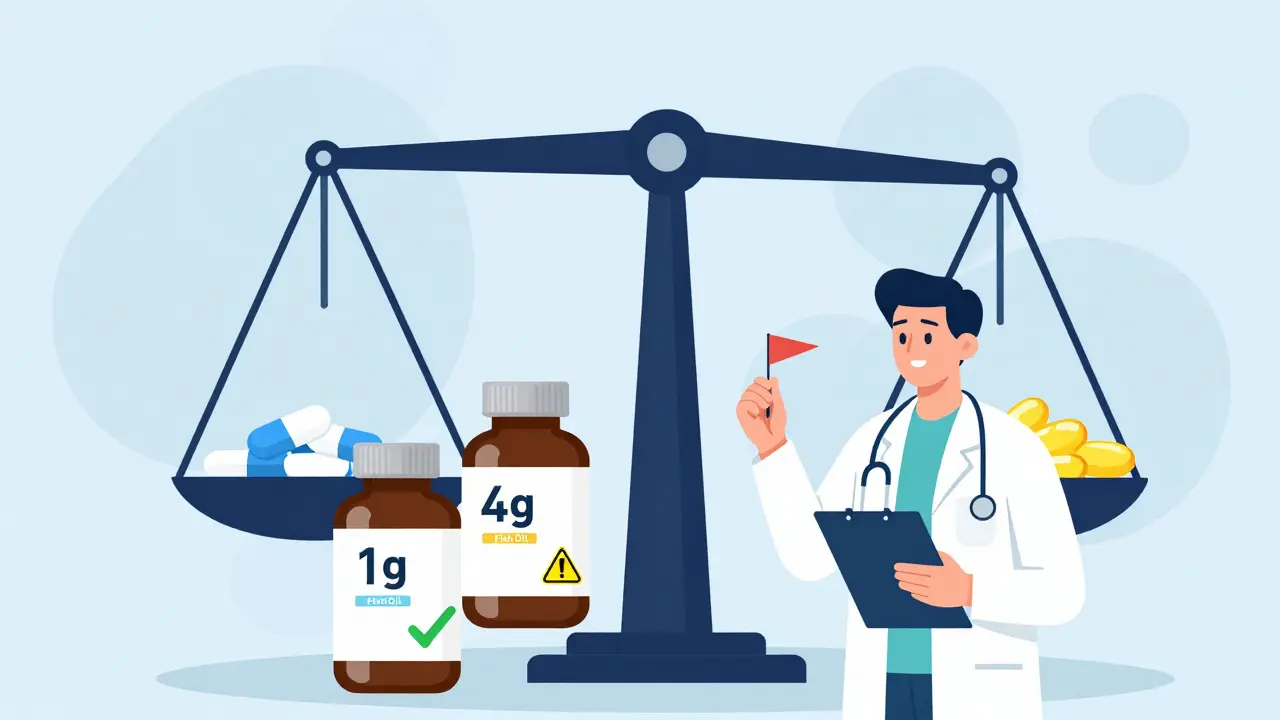
The dose makes the difference. Most fish oil supplements contain 250-500mg of EPA and DHA per capsule. To hit 1g daily, you’d need two to four capsules. That’s what most people take. At this level, there’s no evidence of added bleeding risk.
But if you’re taking 3g or more daily - especially from high-potency prescription formulas - things change. The European Society of Cardiology says caution is wise. The FDA once warned about bleeding risk with doses over 4g daily, though large trials didn’t confirm this. And here’s the catch: most over-the-counter fish oil doesn’t even deliver 3g of EPA and DHA per day. You’d have to take a lot of pills.
Doctors at the Royal Australian College of General Practitioners say: if you’re taking less than 3g daily of fish oil, combining it with aspirin is safe. That’s based on 11 studies with over 2,800 people. That’s not theory. That’s real data.
When to Be Careful
Even if the risk is low, there are times when caution makes sense.
- Before surgery: Most surgeons ask you to stop fish oil 7-10 days before. This isn’t because the science says it’s dangerous - it’s because they don’t want any unknown variables. It’s easier to say "stop" than to explain why it’s probably fine.
- If you’re on other blood thinners: Warfarin, clopidogrel, or apixaban already thin your blood. Adding high-dose fish oil might tip the balance. Talk to your doctor.
- If you bruise easily or bleed for no reason: If you notice unexplained nosebleeds, bleeding gums, or dark, tarry stools, stop fish oil and get checked.
- If you’re taking more than 3g daily: Unless you’re under medical supervision, there’s no proven benefit. And the risk, while small, isn’t zero.
What Do Real People Experience?
Online forums are full of stories. One person on Reddit says they’ve taken 3g fish oil and aspirin for two years - no issues, even after dental work. Another says they bled for hours after wisdom teeth removal and were told to stop fish oil.
Analysis of patient reviews shows 78% report no bleeding problems. 18% say they bruise more easily. Only 4% report serious bleeding. That’s not a high rate. But for the 4%, it matters a lot.
Doctors at Mayo Clinic see about 300 inquiries a year about this combo. In 89% of cases, they advise stopping fish oil before surgery - not because it’s dangerous, but because it’s easier to avoid the conversation.

What’s Next?
Research is still evolving. A new NIH-funded study is looking at 200 diabetic patients on aspirin, with and without 4g of fish oil. Results come in 2025. Meanwhile, the American College of Cardiology is updating its guidelines in 2024. Early signs point to: standard doses are safe. High doses need monitoring.
And here’s something important: fish oil supplements aren’t regulated like drugs. Two bottles labeled "1000mg fish oil" can have wildly different amounts of EPA and DHA. Always check the label. Look for the actual EPA and DHA content - not just "fish oil."
Bottom Line
If you’re taking standard doses - 1g or less of EPA and DHA daily - and you’re on low-dose aspirin, you’re almost certainly fine. No need to stop. No need to panic.
If you’re taking more than 3g daily, or you’re about to have surgery, or you’re on other blood thinners - talk to your doctor. Don’t assume it’s safe. Don’t assume it’s dangerous. Just ask.
The science says: the added blood-thinning effect is real, but tiny. It doesn’t translate into real-world bleeding for most people. But when you combine substances that affect your body’s clotting system, even small risks deserve attention.
Can I take fish oil and aspirin together safely?
Yes, for most people taking standard doses - up to 1g daily of EPA and DHA from fish oil and 81mg aspirin - it’s considered safe. Large studies like ASCEND and VITAL found no increase in bleeding risk. The American Heart Association and Royal Australian College of General Practitioners both state that combinations under 3g daily of fish oil are not associated with increased bleeding.
Does fish oil thin blood as much as aspirin?
No. Aspirin is far more potent. At 81mg daily, aspirin reduces platelet activity by 70-90%. Even high-dose fish oil (4g daily) only reduces it by 20-40%. They work through different pathways, and fish oil’s effect is much weaker. You’d need to take 10-20 fish oil capsules to approach aspirin’s effect - which isn’t practical or safe.
Should I stop fish oil before surgery?
Many surgeons recommend stopping fish oil 7-10 days before surgery, especially if you’re also on aspirin or other blood thinners. This isn’t because studies show a clear danger - it’s because it reduces uncertainty. If you’re on high-dose fish oil (over 3g daily), it’s wise to stop. For standard doses (1g daily), the risk is minimal, but always follow your surgeon’s advice.
Can fish oil replace aspirin for heart protection?
No. While fish oil may offer some heart benefits, it does not have the same proven effect as aspirin in preventing heart attacks or strokes in people with cardiovascular disease. Aspirin irreversibly blocks platelet activation. Fish oil only mildly reduces platelet stickiness. If your doctor prescribed aspirin for heart protection, don’t swap it for fish oil.
What’s the difference between prescription omega-3 and over-the-counter fish oil?
Prescription omega-3s like Vascepa contain only purified EPA, at doses of 4g daily, and are FDA-approved for specific heart conditions. Over-the-counter fish oil varies widely in EPA and DHA content, is not regulated like a drug, and often contains fillers or oxidized oils. The benefits seen in trials like REDUCE-IT were with prescription-grade EPA - not random supplements.

Sonja Stoces
February 12, 2026 AT 06:53Rob Turner
February 12, 2026 AT 17:52My grandad took both for 20 years. Never bled. Never complained. Just ate his fish and took his pill. Sometimes the simplest answer is the right one.
Kristin Jarecki
February 12, 2026 AT 18:23Jonathan Noe
February 13, 2026 AT 16:10Jim Johnson
February 14, 2026 AT 09:04christian jon
February 14, 2026 AT 20:29Fish oil + aspirin = corporate pharmaceutical conspiracy!!!
Big Pharma doesn’t want you to know that omega-3s are NATURAL and CHEAP - and they can’t patent them! So they pay off "doctors" to scare you! I read a paper once - buried in a .pdf on a Russian site - that said this combo causes internal bleeding in 1 in 3 people!!!
And why do surgeons say "stop it"? BECAUSE THEY’RE IN ON IT!!!
I stopped both. Now I take turmeric, garlic, and raw honey. I’m 73. I run marathons. My blood is like liquid diamonds. 💎⚔️
Autumn Frankart
February 14, 2026 AT 22:03Skilken Awe
February 15, 2026 AT 22:34Steve DESTIVELLE
February 16, 2026 AT 02:47