
High-Altitude Sedative Risk Calculator
Enter Your Travel Details
Your Oxygen Risk Assessment
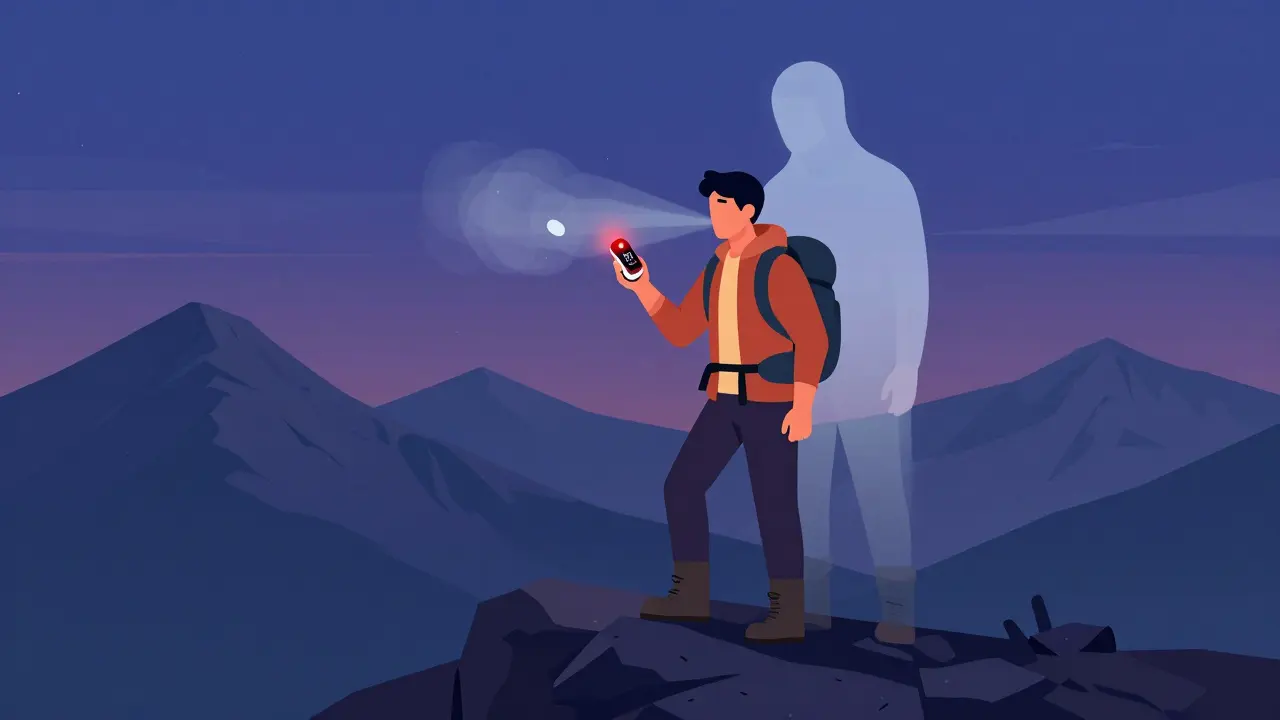
When you’re climbing a mountain, hiking in the Andes, or flying into a high-altitude city like Cusco or Lhasa, your body is already under stress. The air is thinner. Oxygen levels drop. Your breathing changes. And if you’re also taking a sedative-whether it’s a sleeping pill, a drink of alcohol, or a prescription benzodiazepine-you’re putting yourself at serious risk.
Why High Altitude Alone Is Enough to Disrupt Breathing
At 2,700 meters (9,000 feet) and above, nearly 75% of travelers experience irregular breathing patterns at night. This isn’t just discomfort-it’s your body struggling to adapt. The air pressure drops about 6.5% for every 1,000 meters you climb. That means less oxygen in every breath. Your brain normally responds by telling you to breathe faster and deeper. But at altitude, this response gets mixed up. You hyperventilate, blow off too much carbon dioxide, and then your body shuts down breathing briefly-sometimes for 10 or 15 seconds at a time. This is called periodic breathing. It’s normal at high altitude, but it’s fragile.
When you add a sedative, you’re not just helping yourself sleep-you’re silencing the very system your body needs to survive. Sedatives suppress the brain’s drive to breathe. That’s fine at sea level. At altitude, it’s dangerous.
Sedatives That Are Dangerous at High Altitude
Not all sedatives are the same, but most are risky. Here’s what the science says:
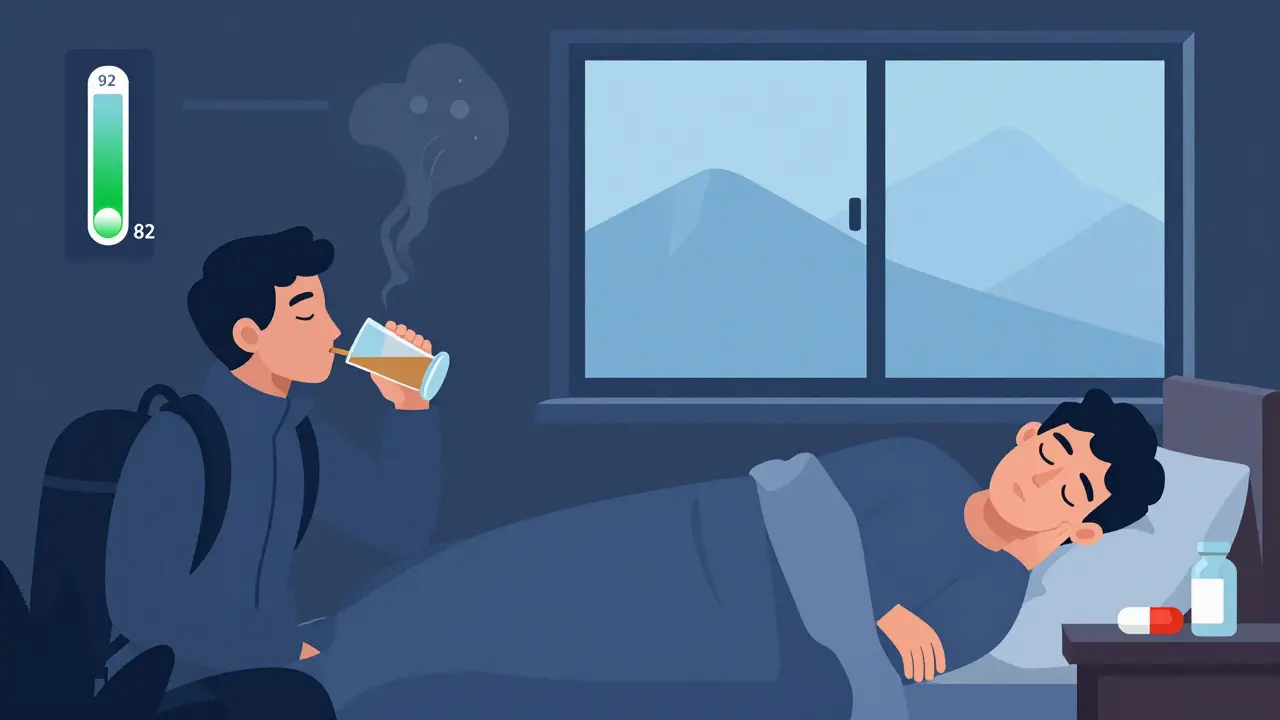
- Alcohol: Even one drink reduces your body’s ability to respond to low oxygen by 25%. A 1998 study found it drops nighttime oxygen levels by 5-10%. That’s enough to trigger or worsen altitude sickness. Many travelers report headaches turning into nausea and vomiting after just two beers at 3,500 meters.
- Benzodiazepines (like diazepam, lorazepam, alprazolam): These are common anxiety and sleep meds. Studies show they reduce ventilation by 15-30% at altitude. One traveler at 4,200 meters saw their oxygen saturation plunge from 88% to 76% after taking 0.5 mg of lorazepam. That’s a medical emergency.
- Opiates (like codeine, oxycodone, morphine): These are the most dangerous. At 4,500 meters, even therapeutic doses can drop oxygen saturation below 80%. That’s below the level considered safe for prolonged exposure.
The CDC, Cleveland Clinic, Healthdirect Australia, and the Wilderness Medical Society all agree: avoid these drugs when ascending to high altitude. They don’t just make you sleepy-they make you hypoxic.
What About Sleeping Pills? Are Any Safe?
Not all sleep aids are created equal. The CDC Yellow Book 2024 offers a rare exception: zolpidem (Ambien), at a low dose of 5 mg, has been studied and found to cause only a 2.3% drop in oxygen saturation at 3,500 meters-far less than benzodiazepines. It’s short-acting, clears from your system in 6-8 hours, and doesn’t strongly suppress the hypoxic ventilatory response.
But even zolpidem isn’t risk-free. One Reddit user at 4,000 meters reported oxygen saturation dropping to 79% after taking a single 5 mg tablet. That’s dangerously low. If you use it, never take it before hiking, driving, or any activity requiring alertness. Wait at least 8 hours after taking it before doing anything physically demanding.
Another option is melatonin. Small studies suggest 0.5-5 mg may help with sleep without depressing breathing. It’s not officially recommended by the CDC for altitude, but it’s not banned either. Some trekkers swear by it. No major studies show harm, and it doesn’t interfere with oxygen uptake like other sedatives.
What Should You Do Instead?
If you’re struggling to sleep at altitude, don’t reach for a pill. Try these proven, safer methods:
- Acetazolamide (Diamox): This is the gold standard. It’s not a sedative-it’s a diuretic that helps your body adapt faster. It reduces periodic breathing and improves oxygen saturation. The CDC recommends 125 mg twice daily starting one day before ascent.
- Slow ascent: Give your body time. Don’t go from sea level to 3,500 meters in one day. Sleep at 2,500 meters for a night, then go higher. This cuts your risk of altitude sickness in half.
- Hydrate: Dehydration makes everything worse. Drink water constantly. Avoid caffeine and alcohol.
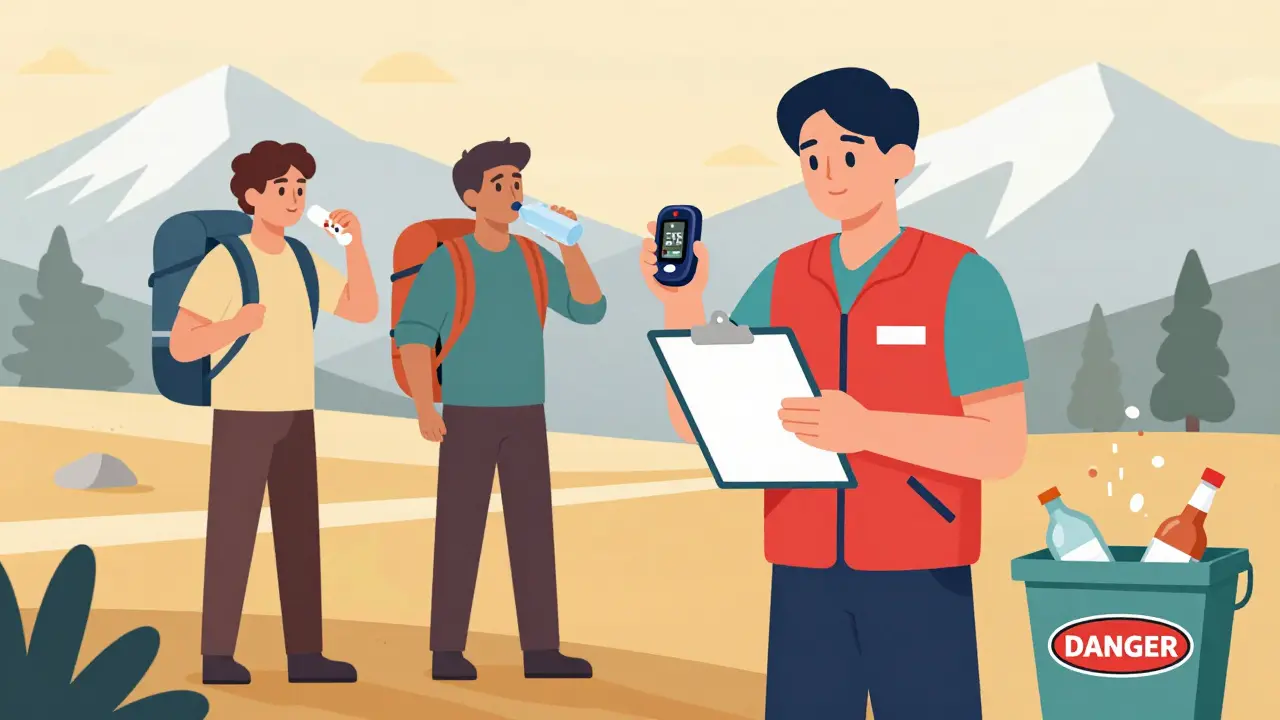
- Use a pulse oximeter: These devices are cheap, portable, and life-saving. A normal oxygen level is above 90%. If yours drops below 85% at rest, you’re in danger. Many guides now carry them. You should too.
Real Stories From the Field
People don’t always listen until something bad happens.
On SummitPost, a hiker named MountainMedic87 wrote: “I took lorazepam to sleep at 4,200 meters. Woke up gasping. My girlfriend had to wake me because my lips were blue. SpO2 was 76%. We descended immediately.”
A 2021 survey of 1,247 trekkers found that 68% who drank alcohol during acclimatization reported worse symptoms than those who didn’t. Meanwhile, a 2023 survey showed that 41% of high-altitude travelers still drink alcohol when they arrive-despite knowing the risks.
Professional guides know better. According to the International Federation of Mountain Guide Associations, 89% of certified guides ban sedatives entirely during acclimatization phases. They’ve seen too many near-misses.
The Bigger Picture: Why This Isn’t Just About Sleep
Altitude sickness isn’t just a headache. It can turn into high-altitude pulmonary edema (HAPE) or cerebral edema (HACE)-both life-threatening. Sedatives don’t just make sleep worse. They make death more likely.
The global high-altitude travel market is growing. Over 3 million people now visit elevations above 3,500 meters every year. Yet, only 8% of travelers even think to check their oxygen levels. Sales of portable pulse oximeters jumped 22% in 2023. That’s a sign people are starting to get it.
But awareness isn’t enough. You need action. If you’re planning a trip to the mountains, talk to a travel medicine specialist at least 4-6 weeks before you go. Don’t rely on your family doctor. They may not know the specifics of altitude physiology.
Bottom Line: Don’t Risk It
High altitude isn’t a place to experiment with sleep aids. Your body is already fighting for oxygen. Adding a sedative is like turning off the alarm in a burning building. It might feel nice at first, but it’s deadly.
Forget alcohol. Skip the sleeping pills. Avoid benzodiazepines and opiates entirely. If you must use something, choose melatonin or acetazolamide. And always, always carry a pulse oximeter. Your life might depend on it.
There’s no shortcut to acclimatization. No pill that replaces time. The mountains don’t care how tired you are. They only respond to patience, preparation, and respect.
Can I drink alcohol at high altitude if I only have one drink?
No. Even one drink reduces your body’s ability to respond to low oxygen by about 25%. That’s enough to worsen altitude sickness, lower your oxygen saturation by 5-10%, and increase your risk of developing serious complications like HAPE. The CDC and other medical authorities strongly advise avoiding alcohol entirely during the first 48 hours at altitude.
Is melatonin safe to use at high altitude?
Current evidence suggests melatonin is likely safe. Small studies show no significant respiratory depression, and some indicate it may even slightly improve oxygenation. While the CDC hasn’t formally endorsed it for altitude-related sleep issues, it’s considered a low-risk alternative to sedatives. Doses of 0.5-5 mg taken at bedtime are commonly used by travelers with no adverse effects reported.
What’s the safest sleep aid for high altitude?
The safest approach is no sedative at all. But if you need help sleeping, acetazolamide (Diamox) is the most effective-it improves oxygen levels and reduces breathing irregularities. If you must use a hypnotic, zolpidem 5 mg has the best safety profile among prescription options, but only if you allow 8+ hours for it to wear off and avoid any physical activity afterward. Melatonin is the safest over-the-counter option.
Can I use my anxiety medication (like Xanax) at high altitude?
No. Xanax (alprazolam) and other benzodiazepines suppress the brain’s response to low oxygen, which can lead to dangerous drops in blood oxygen levels. Even if you’ve used them safely at sea level, altitude changes how your body reacts. The CDC, Wilderness Medical Society, and other authorities explicitly warn against using benzodiazepines at high altitude. Talk to your doctor about alternatives before your trip.
Why do some people say they slept fine with a sleeping pill at altitude?
Some people may not notice symptoms right away. Oxygen levels can drop silently-without dizziness or headache. A pulse oximeter is the only way to know for sure. Many who report “fine sleep” after taking sedatives later develop altitude sickness or require emergency descent. Anecdotes aren’t evidence. Science shows sedatives increase risk. Don’t rely on personal stories.

Lisa McCluskey
January 31, 2026 AT 13:10Been to Cusco twice. First time I had a glass of wine after arriving. Woke up feeling like my lungs were full of cotton. Second time I skipped it, used melatonin, and slept like a rock. No headaches. No panic. Just quiet breathing. Don't overthink it.
Russ Kelemen
February 1, 2026 AT 16:34It’s not just about sedatives-it’s about how we treat our bodies when we’re out of our element. We fly into high-altitude cities like they’re just another airport, then wonder why we feel like we’re drowning in thin air. The real issue isn’t the pill, it’s the arrogance of thinking we can outsmart evolution. Your body knows what it needs. Listen to it.
April Allen
February 2, 2026 AT 18:03Acetazolamide isn’t just a diuretic-it’s a carbonic anhydrase inhibitor that induces a mild metabolic acidosis, which stimulates the peripheral chemoreceptors to increase minute ventilation. This directly counteracts the hypoxic ventilatory depression seen at altitude. Zolpidem’s minimal effect on HVR (hypoxic ventilatory response) is well-documented in controlled hypobaric chamber studies. Melatonin’s GABAergic activity is too weak to suppress respiration, unlike benzodiazepines which bind allosterically to GABA-A receptors and blunt central respiratory drive. Bottom line: pharmacology matters. Don’t guess.
Kathleen Riley
February 4, 2026 AT 17:26It is imperative to underscore, with the utmost gravity, that the ingestion of pharmacological agents which exert depressant effects upon the central nervous system, under conditions of hypobaric hypoxia, constitutes an act of profound physiological negligence. One does not merely 'risk' health- one invites the specter of catastrophic respiratory failure. The sanctity of biological autonomy must not be compromised by the illusion of convenience.
Beth Cooper
February 5, 2026 AT 19:34LOL you guys are so scared of a little wine. My friend took Xanax at 4500m and slept like a baby. His oximeter was at 82% but he said he felt great. Maybe your body just adapts? Maybe Big Pharma is scaring you so you keep buying their 'safe' meds? Also, why do we need a pulse oximeter? Sounds like a surveillance tool.
Donna Fleetwood
February 6, 2026 AT 09:59You got this. Seriously. The mountains aren’t out to get you-they’re just asking you to slow down. I used to think I could power through with a glass of wine and a sleeping pill. Then I got to 4000m and felt like I was suffocating in my own bed. Changed everything. Now I drink water, take melatonin, and just breathe. It’s not glamorous. But it works. You’re stronger than you think.
Melissa Cogswell
February 6, 2026 AT 19:49I’ve used zolpidem 5mg at 3800m twice. First time, woke up with a pounding headache. Second time, I had a pulse ox on my finger-SpO2 dropped to 81% within 45 minutes. I took a walk outside, breathed deeply, and it climbed back to 88%. I don’t use it anymore. Melatonin’s been fine. I don’t even need it most nights. Just give it time.
Diana Dougan
February 8, 2026 AT 01:32So you're telling me I can't have my Ativan to sleep at 3000m? Bro I've been doing this for 15 years. I'm fine. You're just scared because you've never been up there. Also, why is everyone obsessed with oximeters? It's not like they're gonna save you if you get HAPE. Just go down. Duh.
Bobbi Van Riet
February 9, 2026 AT 06:26I used to be the person who thought alcohol helped me sleep at altitude-until I woke up gasping in the middle of the night on a trek in Nepal. My guide just looked at me and said, 'You think you're sleeping? Your body is screaming.' I started taking melatonin-3mg-and honestly, it’s been a game changer. No weird dreams, no grogginess, no panic. I didn’t even realize how much better I slept until I stopped. And hydration? I used to think it was just 'drink more water' advice. Turns out, if you’re dehydrated, your blood thickens, your heart works harder, and your oxygen delivery tanks. I carry a 1L bottle everywhere now. It’s not sexy, but it’s survival.
Holly Robin
February 10, 2026 AT 05:11THEY WANT YOU TO TAKE DIAZEPAM BECAUSE THEY’RE SELLING OXIMETERS. WHY DO YOU THINK THE CDC PUSHES THIS? THEY MAKE MONEY OFF YOUR FEAR. I took 2mg of Xanax at 4200m and my SpO2 was 89%. I felt AWESOME. The 'science' is funded by pharmaceutical companies who hate natural sleep. Melatonin? It’s just a hormone. Your body makes it. Why pay for a pill? Just go to bed early. And stop buying gadgets. The mountain doesn’t care about your numbers.
Shubham Dixit
February 10, 2026 AT 07:38In India, we climb mountains like Khardung La at 5600m every year. We don't use any pills. We drink warm ginger tea, chew raw garlic, and sleep early. Our ancestors didn't need oximeters. You Americans think everything needs a chemical fix. You're weak. We respect the altitude. You try to control it. That's why you get sick. Your science is good, but your mindset is broken.
Blair Kelly
February 11, 2026 AT 05:30That post was flawless. Every word mattered. No fluff. No filler. Just cold, hard physiology. The fact that people still drink alcohol at altitude after reading this is a national disgrace. This isn't 'personal choice.' It's reckless endangerment. If you're dumb enough to take a benzodiazepine at 4000m, you don't deserve to come back. Period.
Rohit Kumar
February 12, 2026 AT 16:31There is a deep philosophical truth here: modern humans have forgotten how to listen to their bodies. We are conditioned to fix, to suppress, to medicate. But the mountain does not negotiate. It only responds to humility. The sedative is not the enemy-the arrogance is. We treat altitude like a problem to be solved, not a force to be honored. The real solution is not melatonin or acetazolamide. It is silence. Stillness. Patience. The body knows. We have simply stopped hearing it.
Rob Webber
February 14, 2026 AT 00:18My cousin died at 4500m in Peru. He took a sleeping pill. Said he was 'just trying to rest.' They found him with his oxygen saturation at 67%. No one even noticed until morning. That’s not an accident. That’s a choice. And now his wife won’t sleep in the same room alone. So don’t say 'it’s just one drink.' It’s not. It’s a funeral waiting to happen.
calanha nevin
February 14, 2026 AT 19:23The data is clear. The consensus is global. The warnings are unambiguous. To disregard this guidance is not merely inadvisable-it is a violation of basic physiological literacy. The human respiratory system is exquisitely calibrated to ambient oxygen tension. Pharmacological suppression of chemoreceptor sensitivity in hypoxic environments is not a benign act-it is a deliberate induction of respiratory compromise. The burden of proof lies not with the medical authorities, but with the individual who chooses to defy them. The mountains do not forgive ignorance. They only record the consequences.