You might think that the more companies selling the same generic drug, the lower the price will go. It sounds like basic math: more supply and more competition equals cheaper meds. But in the world of generic drug competition is the process where non-branded versions of a drug enter the market after patent expiration, theoretically driving down costs through competitive pressure. In reality, the relationship between the number of competitors and the price you pay at the pharmacy is far from a straight line. Sometimes, adding a third or fourth competitor does almost nothing to the price, while other times, it triggers a price collapse.
The Non-Linear Drop: When Does Price Actually Fall?
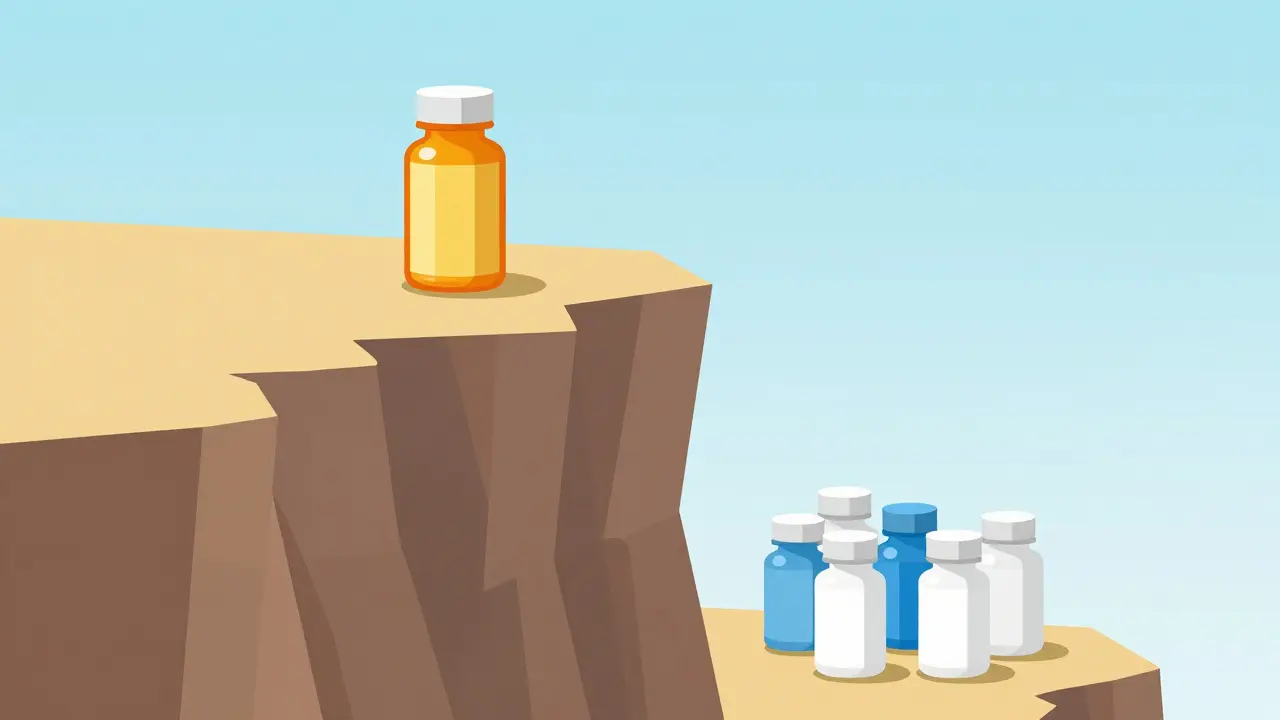
The biggest price drop usually happens the moment the first generic hits the shelf. According to data from the FDA, a single generic competitor can slash prices by 30% to 39% compared to the original brand name. If a second player enters, that drop often hits around 54%. But the real "cliff" happens when the market becomes crowded. When six or more competitors enter the fray, prices for many drugs plummet by as much as 95%.
However, this isn't a guarantee for every medication. The speed and depth of these cuts depend on how easy it is for a new company to start making the drug. For simple pills, the drop is steep. For complex medications, the curve is much flatter because the cost of entering the market is so high that a few big players can maintain a comfortable price point without fearing a newcomer.
The Mutual Forbearance Trap
Have you ever wondered why some prices stay high even when there are plenty of options? There is a weird phenomenon called "mutual forbearance." This happens when companies realize that if they start a price war, everyone loses. Instead of fighting for every single customer, they tacitly agree to keep prices stable, often hovering just below a government-mandated price cap.
Take the statin market in Portugal as an example. Even with multiple generic versions of cholesterol medication available, prices stayed suspiciously close to the regulatory ceiling. Because these companies face each other across multiple different drug markets, they develop a sort of "truce." They know that if they undercut a rival in one drug, that rival will just retaliate in another. The result? The competition exists on paper, but the prices don't actually budge.
| Number of Generic Competitors | Estimated Price Reduction | Market Dynamic |
|---|---|---|
| 1 Competitor | 30% - 39% | Initial Market Shock |
| 2 Competitors | ~54% | Increased Pressure |
| 6+ Competitors | Up to 95% | Commoditization |
The Paradox of the Brand Name
Common sense says a brand-name company should lower its price to keep customers when generics arrive. But sometimes, they do the opposite. In a study of 27 originator drugs in China, researchers found a "paradox of generic drug competition." While most brand companies lowered prices slightly, some actually raised their prices after generics entered the market.
Why would they do that? It's a strategy based on perceived quality. The brand company bets that a certain percentage of patients will be scared to switch to a generic and will stick with the "gold standard" regardless of the cost. By raising the price, the brand company makes up for the loss in market share by making more profit from the loyalists who remain.
Why Some Generics Are Harder to Make
Not all generics are created equal. While a simple chemical compound is easy to copy, "complex generics"-like those with advanced delivery systems-are a different story. To get these approved, companies have to prove "sameness" across critical quality attributes. This requires expensive bridging studies that most small labs simply can't afford.
This creates a "complexity advantage." When only two or three giant firms have the technical skill to make a complex generic, they effectively control the market. Even if the law allows ten companies to enter, the actual barriers to entry act as a shield, keeping prices higher than they would be for a simple tablet.
The Role of Middlemen and Policy Shifts
It's not just about the manufacturers. Pharmacy Benefit Managers (or PBMs) play a massive role. In the U.S., these middlemen handle the vast majority of pharmaceutical purchasing. Because they negotiate bulk deals, a brand company might not lower its official list price, but the PBM gets a deep rebate. This means the "market price" is hidden from the public, making it harder to see if competition is actually working.
New laws are also changing the game. The Inflation Reduction Act introduced the Medicare Drug Price Negotiation Program. While this sounds good for consumers, it creates a new problem for generic companies. If the government negotiates a very low "Maximum Fair Price" for a brand-name drug, generic manufacturers might decide it's not profitable enough to enter that market at all. We could end up with a situation where there are too few generics because the price ceiling is too low to attract new investors.
Stability vs. Savings: The Trade-off
While we all want the lowest price, there is a hidden danger in having only one or two generic suppliers. If a factory in India or China has a quality issue or a natural disaster, the supply chain snaps. When a drug has only one generic source, a factory shutdown leads to a nationwide shortage.
Interestingly, markets with a robust number of competitors (three or more) are significantly more resilient. Data shows that drugs with multiple manufacturers experienced about 67% fewer shortages than single-source generics. So, while five competitors might not lower the price as much as six, having that fifth company is a safety net that ensures you can actually find the medicine on the shelf.
Does more generic competition always mean lower prices?
Generally, yes, but it follows a curve of diminishing returns. The biggest drop happens with the first two competitors. After that, price cuts continue but at a slower pace, and in some cases, "mutual forbearance" can cause prices to stabilize even when many competitors exist.
What is an "authorized generic"?
An authorized generic is a brand-name drug that is sold without the brand label. The original company often releases these to capture some of the generic market share before other generic competitors can fully enter, which can influence how pricing fluctuates during the transition period.
Why do some brand-name prices go up when generics appear?
This is the "paradox of generic competition." Brand companies may raise prices to recoup lost revenue from patients who switch to generics, targeting a smaller, loyal group of users who perceive the brand as higher quality.
How do complex generics differ from standard ones?
Complex generics involve difficult formulations or delivery methods (like inhalers or long-acting injections). Because they require more expensive testing to prove they are identical to the original, fewer companies can afford to make them, leading to less competition and higher prices.
Does the number of competitors affect drug shortages?
Yes. More competitors usually mean a more stable supply chain. Drugs with three or more generic manufacturers are far less likely to experience shortages than those relying on a single supplier.
What This Means for the Future
As we move toward more biologics and biosimilars, the old rules are changing. The 85% price reduction we see with simple pills might not happen with complex biologics because the cost to develop them is astronomical. For the average person, this means that while the number of "competitors" will still matter, the type of competitor and the regulatory hurdles they face will be the real drivers of what you pay at the counter.