
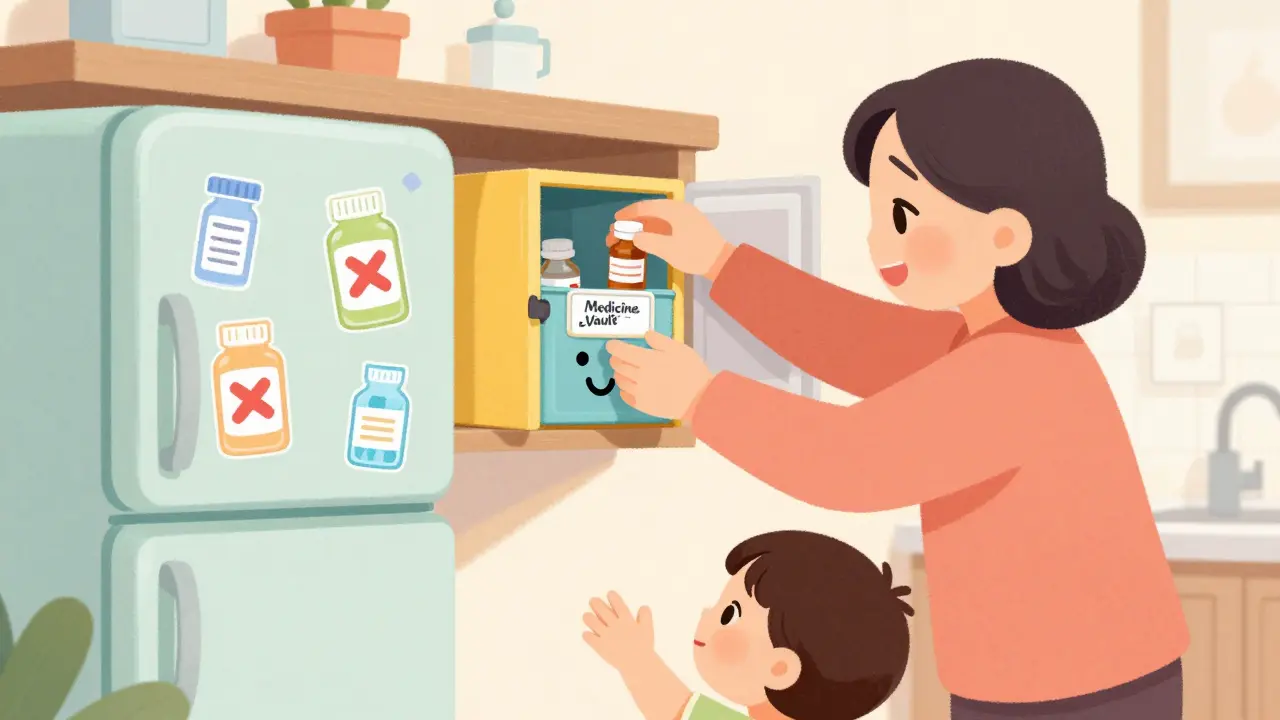
Every year, pediatric medication safety becomes more urgent-not because kids are getting into more drugs, but because the people caring for them are taking more. Grandparents and other caregivers are now raising 13% of U.S. children, and many of them take four or more prescription pills a day. That mix-daily meds and young hands-is dangerous. In nearly 4 out of 10 cases where a child ends up in the ER after swallowing medicine, it’s because a grandparent’s pills were left out in the open.
Why Grandparents Are at the Center of This Problem
It’s not about being careless. It’s about habits formed over decades. Many grandparents grew up in a time when medicine was kept on the nightstand, in a drawer, or even in a purse. They didn’t have childproof caps, and they didn’t think about kids being curious. Today, those same habits put children at risk. A 3-year-old can climb onto a dresser. A 4-year-old can open a pill bottle if it’s been moved to a weekly sorter. And 30% of kids that age can crack child-resistant packaging in under five minutes.
Grandparents also take more meds than parents. On average, caregiving grandparents take 4.7 daily prescriptions. Parents? Around 2.1. That means more bottles, more chances for mix-ups. And 29% of them transfer pills into non-childproof containers-like pill organizers or empty candy jars-because they’re easier to handle. What seems practical to them is a hazard to a grandchild.
What Actually Works: The PROTECT Strategy
The CDC and the Consumer Healthcare Products Association didn’t just hand out pamphlets. They built a real, tested plan called Up & Away and Out of Sight. And it works. In one study, after just one 15-minute conversation with a health educator, grandparents who had been storing meds in the bathroom or on the nightstand jumped from 39% safe storage to 78% in just a few months.
Their method? Simple, specific, and non-judgmental.
- Lock it up. Keep all meds in a locked cabinet, drawer, or box. Not just any cabinet-something out of reach and out of sight. At least 4 feet high. A simple latch that needs 15 pounds of force to open stops 95% of kids under 5.
- Keep it original. Never move pills into a pill organizer, empty jar, or snack container. The bottle itself has the name, dose, and expiration date. It also has the child-resistant cap. If you’re struggling to open it, ask your pharmacist for an easy-open cap or a bottle opener.
- Put it away after use. Don’t leave meds on the counter after giving them. Don’t stash them in your purse. Even if you’re just going to the living room, lock them up first.
And here’s the key: don’t just tell them. Show them. Bring a lockbox. Help them install it. Let them practice opening and closing the child-resistant cap. Most grandparents can’t do it right on the first try. Only 54% get it right without help.
How to Talk to Grandparents Without Offending Them
One of the biggest barriers? Grandparents feel blamed. They’ve raised kids before. They know how to care for others. When someone says, “You need to lock your meds,” it can sound like, “You’re not fit to care for your grandchild.”
The best approach? Focus on teamwork. Say: “We’re all trying to keep the kids safe.” Use phrases like:
- “Let’s make sure our grandkids never mistake medicine for candy.”
- “I know you’ve got a lot on your plate-let’s find a way to make this easier.”
- “I heard about a little lockbox that fits right on the shelf. Want to try one?”
Studies show that when caregivers hear messages framed around protecting the family-not fixing a mistake-they’re 3 times more likely to change their behavior. And 87% of grandparents say they care deeply about keeping kids safe. They just need clear, kind guidance.
Make It a Family Routine
The safest homes aren’t the ones with the fanciest locks. They’re the ones with a routine.
Start with a 3-step “Safety Talk” that every grandparent can learn in under a minute:
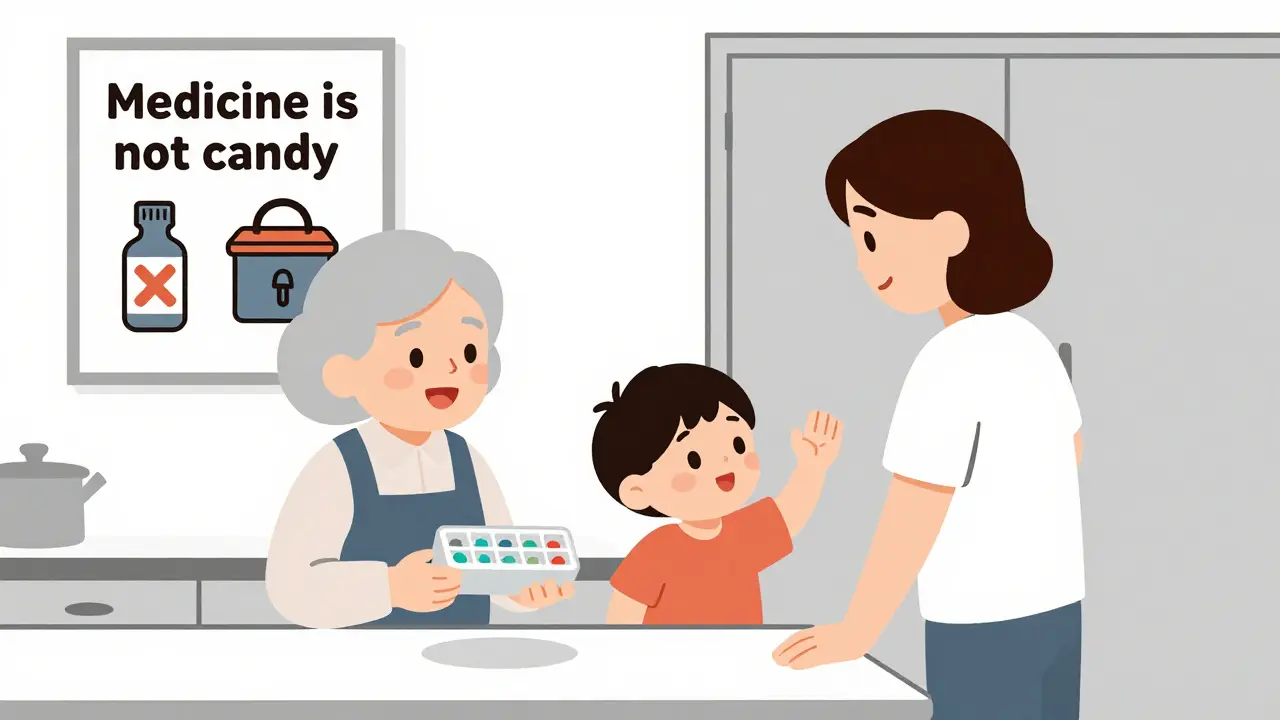
- “Medicine is not candy.” Say it like you’re teaching them not to touch the stove.
- “Only adults give medicine.” Reinforce that even if a grandparent says, “Here, try this,” it’s not okay.
- “If you find medicine, tell an adult immediately.” Make sure kids know what to do-no fear, no guilt.
Then, make it visual. Hang a poster on the fridge. Draw pictures with your grandchild: a medicine bottle with a red X, a locked box with a happy face. Let them help pick out the lockbox. Let them name it. “This is the Medicine Vault.” Kids love being part of the solution.
Also, set up a system between parents and grandparents. Who stores meds? Where? What’s the emergency number? Only 38% of families do this. That’s too low. Send a quick text: “Just to confirm-we keep meds locked in the top closet, right? Here’s the Poison Control number: 1-800-222-1222.”
Practical Tools You Can Use Today
You don’t need a big budget. You need simple tools:
- Lockboxes: A small plastic or metal box with a key or combination costs $10-$20. Many pharmacies give them out free through the PROTECT campaign.
- Cabinet locks: Adhesive locks that stick to the inside of a cabinet door. No drilling. Easy to install. Available at hardware stores.
- Medication disposal bags: These turn pills into sludge so they can’t be pulled out and swallowed. Drop them in the trash. No flushing.
- Refill reminders: Use a calendar or a simple app. Set a monthly alert: “Go through meds. Toss expired ones.”
And if a grandparent has arthritis or trouble opening bottles? Ask the pharmacist for an easy-open cap or a bottle opener. They’re free. And if they’re worried about forgetting doses? Use a pill dispenser with alarms. But keep it locked.
What to Do If Something Goes Wrong
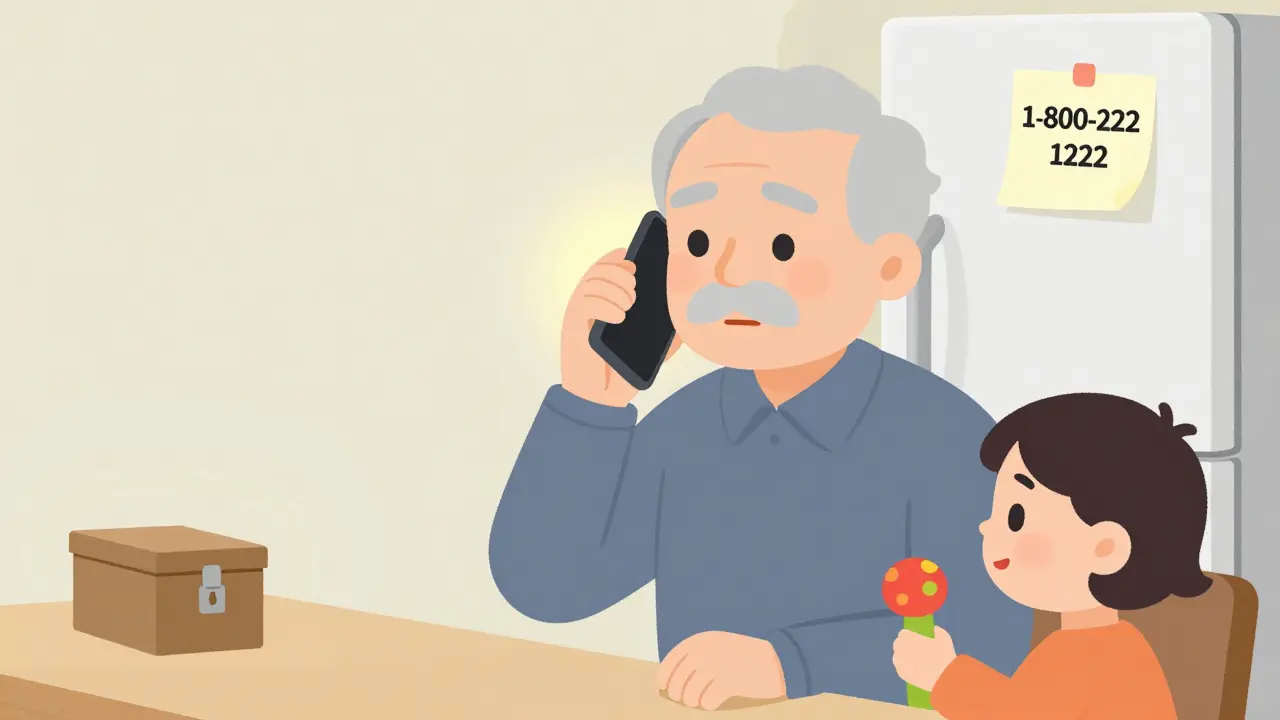
Even with all the best habits, accidents happen. That’s why every caregiver needs to know one number: 1-800-222-1222. It’s the Poison Control hotline. Call it. No waiting. No judgment. Even if you’re not sure.
Don’t wait for symptoms. Don’t try to make the child vomit. Don’t give milk or charcoal. Just call. They’ll walk you through what to do. And they’re available 24/7.
Keep that number on the fridge. Write it on a sticky note. Save it in your phone. Tell every grandchild: “If you ever find medicine and you’re not sure, call this number. I’ll answer.”
What’s Changing in 2026
The rules are catching up. In 2023, the American Geriatrics Society added pediatric medication safety to its official guidelines for senior care. That means doctors are now supposed to ask: “Do you care for young children?” during annual check-ups.
Pharmacies are rolling out free lockboxes. The CDC’s new Grandparent Guardian digital toolkit has videos in 8 languages showing how to lock up meds. And a new NIH trial is testing a mobile app that sends gentle reminders before holidays or visits-when risks spike.
But the biggest change? The conversation. More families are talking about it. More grandparents are saying: “I didn’t know. Now I get it.”
Final Thought: It’s Not About Perfection
You don’t have to be flawless. You just have to be consistent. One locked box. One conversation. One number saved in your phone. That’s enough.
Grandparents want to keep their grandkids safe. They just need to know how. And you can help them learn.
Why do grandparents keep medicine on the nightstand or in their purse?
Many grandparents grew up in a time when medicine wasn’t seen as dangerous. They kept pills where they were easy to reach-on the nightstand, in a purse, or in a drawer. They didn’t have child-resistant caps, and they didn’t think kids could get into them. Now, with more children living with or visiting grandparents daily, those old habits are risky. A 2023 study found that 12% of daily caregiving grandparents still keep prescriptions on nightstands or dressers, and 31% carry them in purses. The fix isn’t about blame-it’s about making it easy to change. A simple lockbox or high cabinet solves both the access and memory issues.
Can child-resistant caps really be opened by kids?
Yes. The term “child-resistant” doesn’t mean “child-proof.” It means the cap is hard for most children under 5 to open-but not impossible. Consumer Product Safety Commission tests show that 30% of 4-year-olds can open these caps in under 5 minutes. That’s why moving pills to a non-childproof container like a weekly pill sorter is dangerous. Even if the cap is locked, if the bottle is out, a child can find it. The safest option is to keep pills in their original container, locked away, and out of sight.
What should I do if my grandchild swallows medicine?
Call Poison Control immediately at 1-800-222-1222. Don’t wait for symptoms. Don’t try to make them vomit. Don’t give them milk or syrup of ipecac. Just call. The experts on the line will guide you step by step. They’ve handled thousands of cases and know exactly what to do based on the medicine, the amount, and the child’s age. Keep that number saved in your phone, posted on the fridge, and told to every grandchild: “If you find medicine, tell an adult-and call this number.”
How can I help a grandparent who says, “I’m careful-I don’t leave medicine out”?
Start by asking, “Where do you keep your meds right now?” Many people think they’re being careful if they only leave a bottle out for a few minutes. But if it’s on the counter while they’re cooking, or in a purse during a visit, it’s still accessible. Offer to help them find a better spot. Bring a small lockbox. Say, “Let’s try this for a week.” Often, the problem isn’t intention-it’s routine. A new habit takes a few tries. And if they’re resistant, frame it as teamwork: “We’re both trying to keep the kids safe. Let’s make sure we’re both on the same page.”
Are there free resources for grandparents to get safe storage tools?
Yes. The PROTECT Initiative, led by the CDC and the Consumer Healthcare Products Association, gives away free lockboxes and educational materials at pharmacies, senior centers, and health fairs. Many major pharmacy chains-like CVS, Walgreens, and Rite Aid-offer them at no cost to customers over 60. Ask your pharmacist. You can also request them online through the Up & Away website. Some local health departments and AARP chapters provide them too. And if you’re worried about cost, remember: a $15 lockbox prevents an ER visit that can cost over $1,000.

Chris Beeley
February 20, 2026 AT 04:16Let me tell you something about this so-called 'PROTECT Strategy'-it’s a Band-Aid on a hemorrhage. The real issue isn’t that grandparents store meds on nightstands; it’s that our entire healthcare system has abandoned intergenerational care as a structural problem. We’ve outsourced caregiving to seniors on fixed incomes while simultaneously flooding them with polypharmacy, then act shocked when they forget which bottle is which. This isn’t about childproof caps-it’s about a society that doesn’t value elders or children equally. The CDC’s 15-minute chat? Cute. But where’s the funding for home visits? Where’s the subsidized lockboxes in rural counties? Where’s the policy that mandates pharmacists to audit medication storage during senior wellness checks? Without systemic intervention, we’re just rearranging deck chairs on the Titanic. And don’t get me started on the 'Medicine Vault' branding-that’s marketing masquerading as public health.
Danielle Gerrish
February 20, 2026 AT 06:43I’ve been there. My mom-78, diabetic, on five meds-used to keep her insulin in her purse because she ‘didn’t trust the cabinet.’ I bought her one of those fancy lockboxes with the LED light. She cried. Not because she was mad, but because she said, ‘No one’s ever asked me if I could open it.’ So I sat with her for an hour. We practiced. I showed her how to use the keychain opener. Now she calls me every Sunday to tell me she locked it up. It’s not about blame. It’s about being there. And if you’re not willing to sit there with them? Then yeah, you’re part of the problem. Stop lecturing. Start listening.
Courtney Hain
February 20, 2026 AT 16:55Okay, but have you considered that the real threat isn’t grandpa’s pills-it’s the pharmaceutical industry? Did you know that 73% of medications given to seniors are off-label? That’s right-doctors prescribe them for ‘off-label use’ and then slap on child-resistant caps like it’s a magic fix. Meanwhile, the FDA approves these drugs without testing for pediatric exposure risk. And now they want us to lock them up? What if the lockbox itself is made of BPA plastic? What if the combination lock has a backdoor? I’ve read studies-this whole ‘lock it up’ campaign is a distraction. The real solution? Ban all non-essential prescriptions for seniors. Or better yet-defund Big Pharma. But no, we’d rather make grandma feel guilty while the CEOs cash in.
Michaela Jorstad
February 22, 2026 AT 11:48Thank you for writing this. Truly. I’m a nurse, and I’ve seen too many ER visits where a grandparent says, ‘I didn’t think he’d get to it.’ They’re not careless-they’re overwhelmed. I always say: ‘You’re not failing. You’re just tired.’ So I bring a free lockbox to every home visit. I say, ‘Let’s put it here-where it’s easy for you AND safe for them.’ I don’t lecture. I don’t judge. I just say: ‘You’re doing better than you think.’ And you know what? Most of them cry. Not because they’re guilty-but because someone finally saw them. You’re not alone. And you’re not failing. Keep going.
Arshdeep Singh
February 23, 2026 AT 03:54Bro, you’re missing the point. Grandparents aren’t the problem. The system is. You think they want to leave pills on the counter? Nah. They’re tired. They’re lonely. They’re trying to be useful. But society tells them: ‘You’re too old to drive. Too old to work. Too old to be trusted.’ So they hold onto their meds like a lifeline. And now you want them to lock it away? Like it’s a weapon? That’s not safety-that’s isolation. What we need is community. A neighbor who checks in. A local group that meets weekly to organize meds. Not a lockbox. A connection. Stop treating elders like hazards and start treating them like family.
Liam Crean
February 23, 2026 AT 09:27Interesting read. I’m a dad to a 4-year-old and my mom helps out every weekend. I didn’t realize how common it was for her to carry pills in her purse. I brought her a lockbox last week. She said, ‘I didn’t know you were worried.’ I said, ‘I’m not worried about you-I’m worried about us.’ We put it on the top shelf of her closet. She still forgets sometimes. So I text her every Friday: ‘Hey, did you lock it?’ She texts back: ‘Yes, boss.’ It’s not perfect. But it’s working. Small steps. Consistency. Not perfection.
madison winter
February 24, 2026 AT 07:39So let me get this straight. We’re telling elderly people who have been taking meds for 40 years that they’re now dangerous because they don’t follow a 2020s safety protocol? And the solution is a $15 box? What about the 12% of seniors who can’t afford a lockbox? Or the ones with dementia? Or the ones who live in apartments where landlords won’t let them install anything? This isn’t safety-it’s classism disguised as public health. And the ‘Medicine Vault’ poster? That’s just infantilizing. I’m not surprised the CDC thinks this works. They’ve never met a real grandparent.
Jeremy Williams
February 26, 2026 AT 00:31As someone who immigrated from a country where multigenerational living is the norm, I can say this: the American approach is fundamentally flawed. We treat caregiving as a burden, not a bond. In my home country, the medicine cabinet is a shared space-monitored by the whole family. Elders don’t ‘store’ meds-they manage them as part of a daily rhythm. The solution isn’t isolation. It’s integration. Teach the child to say, ‘Grandma, is this for me?’ Teach the grandparent to say, ‘No, this is for me. You can’t have it.’ That’s cultural literacy-not a lockbox. And if we’re going to fix this, we need to stop treating elders as liabilities and start treating them as cultural anchors.
Ellen Spiers
February 26, 2026 AT 17:30It is, regrettably, evident that the prevailing discourse exhibits a profound epistemological deficit. The 'PROTECT Strategy' is predicated upon a fallacious assumption: that behavioral modification via environmental manipulation constitutes a viable public health intervention. One must interrogate the ontological underpinnings of 'child-resistant' packaging, which, as the Consumer Product Safety Commission's own data indicates, fails to achieve its nominal objective in 30% of cases. Furthermore, the deployment of lockboxes as a panacea ignores the sociopolitical determinants of medication adherence among elderly populations. One is compelled to ask: if the issue is access, why not subsidize home pharmacists? Why not implement automated dispensing units? To reduce this complex, systemic issue to a $19.99 plastic box is not merely inadequate-it is ethically indefensible.
Marie Crick
February 27, 2026 AT 10:14Amrit N
March 1, 2026 AT 03:47yo i just got back from visiting my grandma and she showed me her new lockbox. she named it 'the treasure chest' and says the grandkids arent allowed to open it unless they say 'medicine is not candy' first. i laughed so hard. but then i saw her hand the key to my 5-year-old cousin. i said 'wait, what?' she said 'he’s the keeper now.' and honestly? that’s the best part. they’re not just safe-they’re involved. it’s not about locks. it’s about trust. and yeah, she still forgets sometimes. but now she has a 5-year-old reminding her. that’s the real hack.
Robert Shiu
March 2, 2026 AT 06:50Just had a 20-minute convo with my mom about this. She said, ‘I didn’t realize I was putting you all at risk.’ I said, ‘I don’t blame you-I blame the system that made you feel like you had to do it alone.’ Then I showed her the free lockbox from CVS. She cried. We cried. Then we made a playlist: ‘Songs to Sing While Locking Up Pills.’ We’re doing it together. Not because we’re scared. Because we love each other. And yeah, it’s messy. And yeah, we forget. But now we’re talking. And that’s the first step.
Greg Scott
March 3, 2026 AT 12:55My aunt lives alone with my cousin. She’s got 7 meds. I went over last week. Didn’t say a word. Just sat with her. Made tea. Then I said, ‘Hey, can you show me how you open your bottle?’ She couldn’t. So I got her a bottle opener. Free. From the pharmacist. We did it together. Now she opens it every morning without help. No lectures. No lockbox. Just a little tool and a quiet moment. Sometimes that’s all it takes.
Caleb Sciannella
March 4, 2026 AT 15:31While the PROTECT Strategy presents a pragmatic framework for mitigating pediatric exposure to pharmaceuticals, one must not overlook the broader sociocultural paradigm shift that underpins this phenomenon. The rise in grandparent-led caregiving correlates directly with the erosion of formal childcare infrastructure, the stagnation of wage growth, and the increasing prevalence of opioid and psychiatric polypharmacy among the elderly. The lockbox, while symbolically potent, is merely a symptom of a deeper structural malaise. What is required is not behavioral compliance, but institutional reform: subsidized home health aides, mandatory geriatric-pediatric coordination in primary care, and federal funding for intergenerational safety initiatives. To reduce this to a matter of individual responsibility is to commit epistemic injustice against the very populations we purport to protect.