
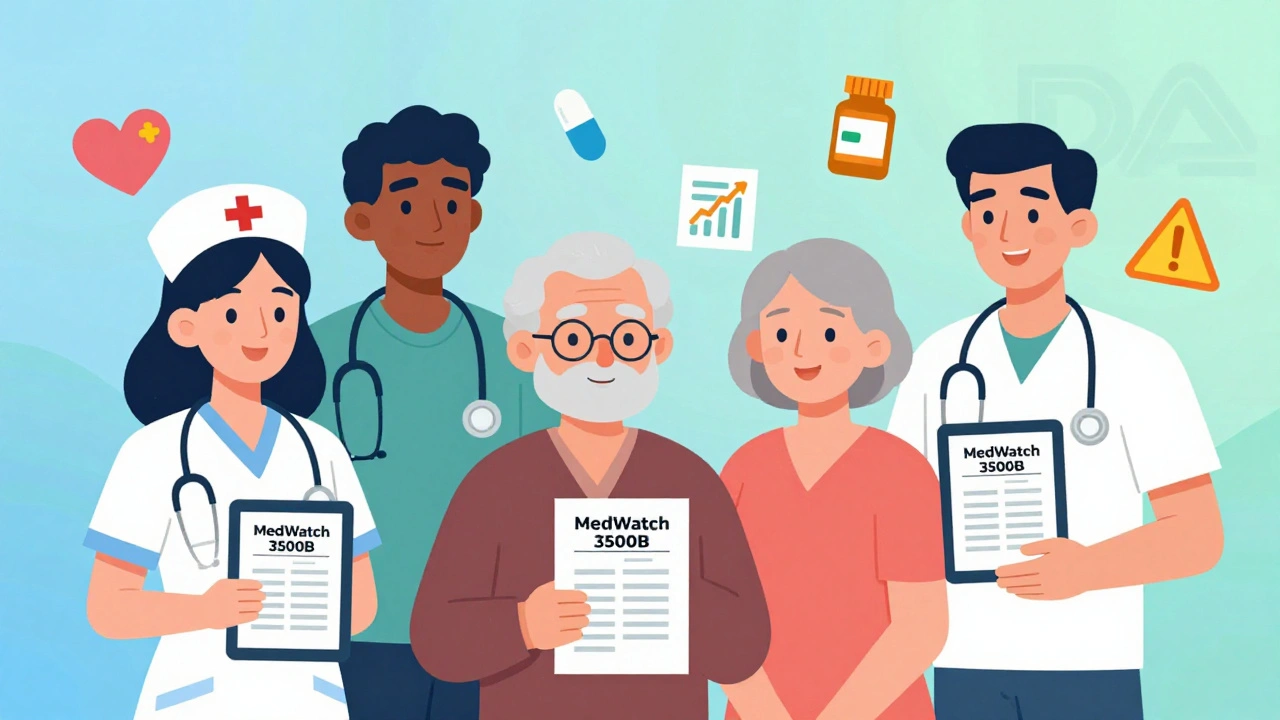
Every year, over 1.3 million adverse drug reactions are reported to the FDA through MedWatch. But experts estimate that only about 6% of serious reactions actually make it into the system. That means tens of thousands of dangerous side effects go unnoticed-until it’s too late for someone else.
If you’ve had a bad reaction to a medication-whether it’s a prescription, over-the-counter pill, supplement, or even a medical device-you’re not just a patient. You’re part of a safety net. Reporting it to MedWatch isn’t just helpful. It could save a life.
What Is MedWatch, Really?
MedWatch is the FDA’s official system for collecting reports about harmful side effects from drugs, medical devices, dietary supplements, and even some foods and cosmetics. It’s not a research study. It’s not a hotline. It’s a real-time alarm system.
When a doctor, pharmacist, patient, or manufacturer spots something unusual-a sudden heart rhythm problem after taking a new blood pressure pill, a rash that won’t go away after using a topical cream, or a diabetic meter giving wrong readings-they can report it. These reports don’t prove a drug caused the problem. But they give the FDA a red flag to investigate.
Since 1993, MedWatch has been the backbone of post-market drug safety in the U.S. Clinical trials can only catch side effects that show up in a few thousand people. Real-world use involves millions. That’s where MedWatch fills the gap.
Who Can Report? Everyone.
You don’t need to be a doctor. You don’t need to be a pharmacist. You don’t even need to be sure the drug caused the problem.
Three groups report to MedWatch:
- Healthcare professionals (doctors, nurses, pharmacists)
- Patients and consumers (you)
- Manufacturers (pharmaceutical and device companies-by law)
Manufacturers have to report serious events within 15 days. But if you’re a patient and you think a medication made you sick, you’re the first line of defense. Your report matters.
One nurse in Ohio reported a patient’s sudden loss of vision after starting a new cholesterol drug. The FDA reviewed dozens of similar reports and later added a new warning about eye damage to the label. That warning now protects thousands.
What Counts as a Reportable Reaction?
The FDA doesn’t want every little side effect. They want the serious ones. Here’s what qualifies:
- Death
- Hospitalization (or prolonging an existing hospital stay)
- Disability or permanent damage
- Life-threatening reaction
- Congenital anomaly (birth defect)
- Any event that requires medical intervention to prevent one of the above
Even if the reaction isn’t listed on the drug’s label, report it. That’s how new risks get discovered. A patient reported severe joint pain after taking a common antibiotic. It wasn’t on the label. Later, the FDA found over 200 similar cases-and updated the warning.
Don’t wait for proof. If you suspect a drug caused it, report it. The FDA doesn’t need certainty. They need signals.

How to Report: The Simple Steps
Reporting takes less than 20 minutes. Here’s how:
- Go to the MedWatch website at www.fda.gov/medwatch
- Choose your form:
- Form 3500 for healthcare professionals
- Form 3500B for patients and consumers (simple, plain language, available in English and Spanish)
- Form 3500A only for manufacturers and facilities - Fill out the form. You’ll need:
- Patient’s age and gender (no name or address needed)
- Name of the drug, supplement, or device
- Dose and how long you took it
- Description of the reaction: when it started, what happened, how it felt
- Any tests done (like blood work or imaging)
- Outcome: Did you recover? Are you still affected?
- Other medications or conditions you have - Submit it. You can do it online, by fax, or by mail. Online is fastest.
Patients often say the 3500B form feels less intimidating. One pharmacy tech in Texas walks patients through it during their refill visit. She says, “Most people are surprised they can do it themselves. And they feel better afterward-like they did something right.”
What Happens After You Submit?
You won’t get a call back. You won’t get an email saying “we fixed it.” That’s frustrating. But here’s what actually happens:
- Your report joins over a million others in the FDA Adverse Event Reporting System (FAERS)
- FDA analysts look for patterns: Are 10 other people reporting the same issue with the same drug?
- If a signal emerges, they dig deeper-review medical records, run statistical analyses, contact the manufacturer
- If they find enough evidence, they may issue a safety alert, update the drug label, or even pull the drug from the market
Remember: one report is just a whisper. But 100 reports? That’s a shout.
Take the case of a popular weight-loss supplement. Five people reported liver failure. All five had taken the same product. The FDA reviewed the reports, tested the ingredients, and found a hidden toxic chemical. The product was pulled. Without those five reports, it might have kept selling.

Why Don’t More People Report?
A 2023 survey of 1,200 U.S. doctors found that 68% rarely or never report adverse events. Why?
- “I don’t know if it was the drug.” The FDA says: you don’t have to be sure. Report the suspicion.
- “It takes too long.” The average report takes 12-15 minutes. That’s less than a coffee break.
- “No one ever follows up.” True. But that’s not the point. The system doesn’t reward individuals. It rewards public safety.
Underreporting is the biggest weakness in MedWatch. Studies show only 1-10% of serious reactions are reported. That means the FDA is working with a fraction of the real data.
But here’s the flip side: every report you submit helps close that gap. You’re not just reporting a side effect. You’re helping fix a broken system.
What’s Changing in MedWatch?
The FDA is trying to fix the reporting gap. In 2023, they launched “MedWatch Plus”-a push to make reporting easier.
- Mobile-friendly forms you can fill out on your phone
- Integration with electronic health records (so doctors can click a button to report)
- More public awareness campaigns targeting patients
By 2025, they aim to increase healthcare professional reporting by 30%. That’s ambitious. But it won’t work unless patients start reporting too.
Drug approvals are at record levels. In 2022 alone, the FDA approved 37 new drugs. More drugs mean more unknown risks. More reports mean better safety.
What You Can Do Today
You don’t need to be a scientist. You don’t need to be a doctor. You just need to care.
If you’ve had a strange or scary reaction to a medication:
- Write down what happened-date, symptoms, dose
- Go to www.fda.gov/medwatch
- Click on Form 3500B
- Answer the questions honestly
- Hit submit
It’s not about blame. It’s about awareness. That drug might be safe for 99% of people. But if you’re in the 1%, your report helps the next person avoid the same fate.
And if you’re a healthcare provider? Make reporting part of your routine. Add it to your checklist after a new prescription. Talk to your patients about it. One conversation could change a life.
The system isn’t perfect. But it’s the best tool we have. And it only works if people use it.


Iris Carmen
December 8, 2025 AT 16:47Rich Paul
December 10, 2025 AT 04:22Ruth Witte
December 11, 2025 AT 09:04Noah Raines
December 12, 2025 AT 08:27Katherine Rodgers
December 13, 2025 AT 16:50