
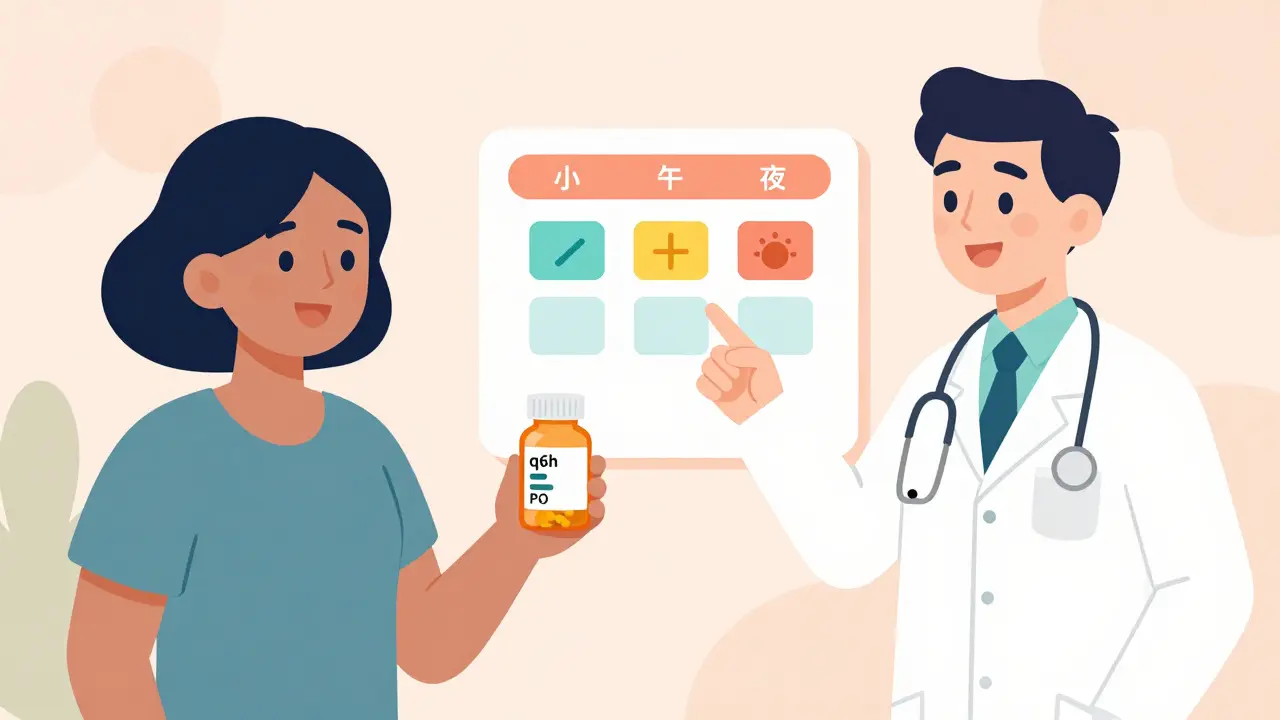
Getting a prescription filled shouldn’t feel like solving a puzzle in a language you don’t speak. Yet millions of people leave the pharmacy with a tiny paper label full of medical jargon-take q6h, PO, PRN-and have no idea what it means. If you’ve ever stared at your pill bottle wondering if you’re supposed to take it before breakfast or after, you’re not alone. And you’re not wrong to ask for better.
Why Clear Medication Instructions Matter
Poorly written medication instructions aren’t just confusing-they’re dangerous. A 2022 report from the Institute for Safe Medication Practices found that 63% of medication errors happen because patients didn’t understand how to take their drugs. That’s not a small number. That’s over 125,000 preventable adverse events every year in the U.S. alone. Many of these lead to hospital visits, ER trips, or worse. The cost? Over $528 billion a year in avoidable healthcare spending. It’s not about being “bad at reading.” It’s about systems that assume everyone speaks medical. Even people with strong reading skills get tripped up by terms like “bid” or “t.i.d.” That’s why clear, plain-language instructions aren’t a luxury-they’re a safety requirement.You Have the Right to Understand Your Medications
You don’t have to beg. You don’t have to wait until you feel sick to speak up. You have a legal and ethical right to clear medication instructions. This isn’t just a nice thing to ask for-it’s a right backed by multiple organizations. The American Medical Association says you have the right to ask questions and get answers you understand. The Patient Bill of Rights adopted by hospitals nationwide says you can receive information in a way you can understand. The federal government’s Office of Personnel Management confirms you’re entitled to “accurate, easily understood information.” And if English isn’t your first language? Title VI of the Civil Rights Act of 1964 requires pharmacies to provide translated instructions when you ask. No excuses. No delays.What Good Instructions Look Like
Not all written instructions are created equal. Here’s what to look for:- Plain language: “Take one pill every 8 hours” instead of “Take 1 tab PO q8h”
- Clear timing: “Take with breakfast” or “Take at bedtime” instead of “q.d.” or “q6h”
- Purpose: “This is for high blood pressure” or “This helps with pain”
- Warnings: “Avoid alcohol” or “May cause dizziness” in bold or highlighted
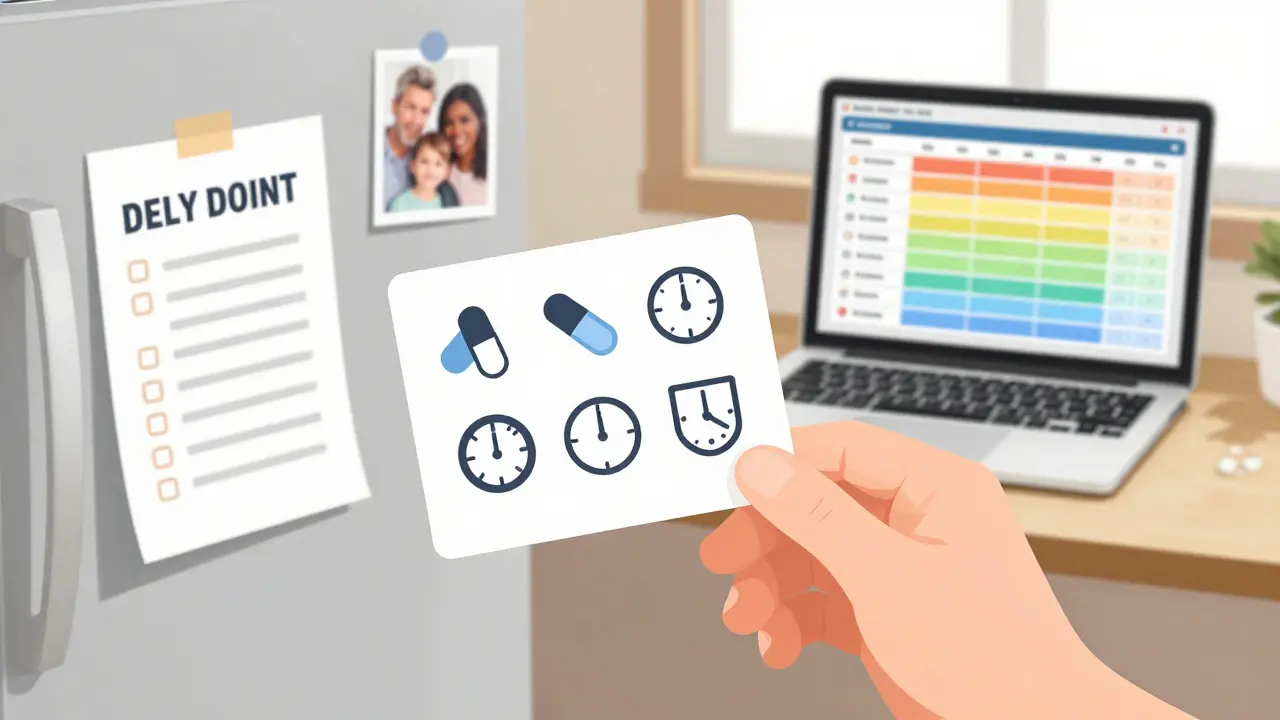
- Visuals: Icons showing morning, noon, night, or a simple calendar with checkmarks
- Pharmacist contact info: So you know who to call if something doesn’t make sense
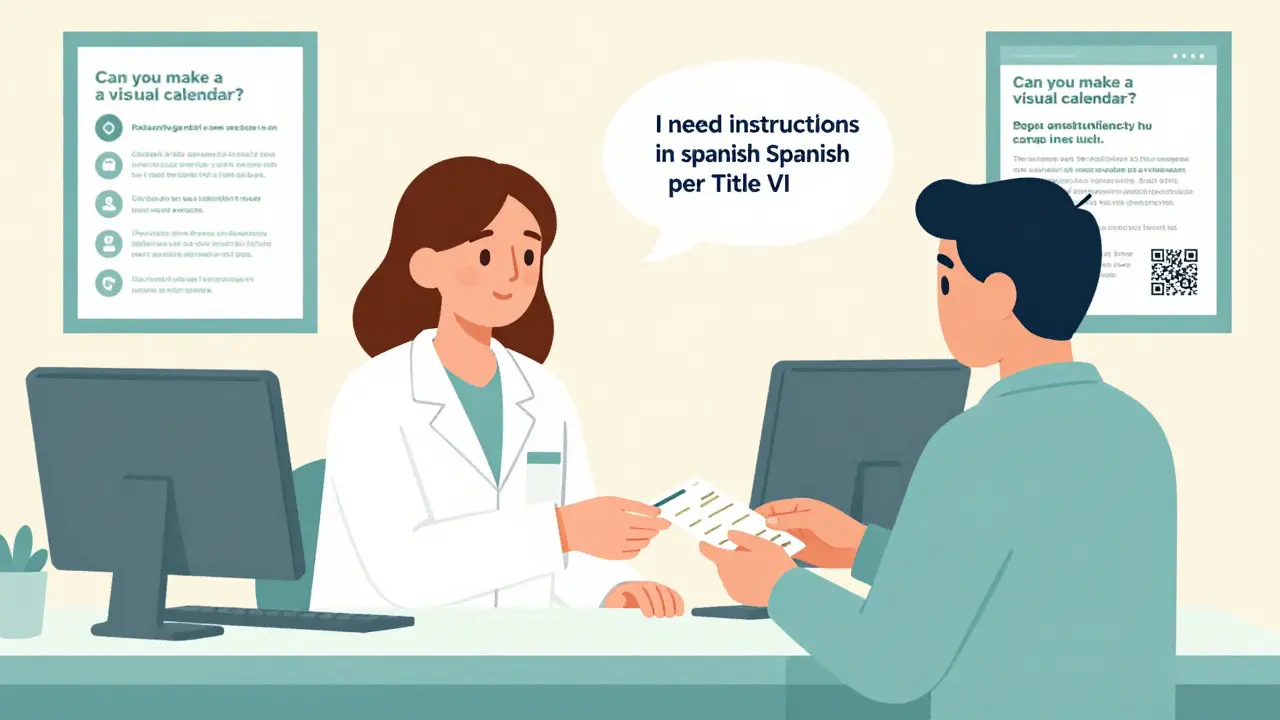
How to Ask-The 5-Step Method That Works
Asking for better instructions sounds simple. But most people just say, “Can you explain this?” and get a repeat of the same confusing label. Here’s what actually works, based on real patient success stories and pharmacy research:- Ask to speak with the pharmacist-not the technician. Technicians are trained to fill prescriptions, not explain them. Pharmacists are trained to educate patients. In 73% of chain pharmacies, technicians are required to hand off these requests to a pharmacist.
- Use specific language-don’t say “I don’t understand.” Say: “I’m exercising my right under the AmerisourceBergen Patient Rights document to receive education in a language I understand.” Or: “I need instructions that meet the National Action Plan to Improve Health Literacy standards.” Mentioning these exact phrases increases your chances of getting help by nearly 4 times.
- Request a visual schedule-ask for a chart with pictures of pills and times of day. Studies show this improves adherence by 42% for people on multiple medications.
- Do a read-back-after they explain, say: “Let me repeat it back to make sure I got it right.” Then say what you think you’re supposed to do. If you’re wrong, they’ll correct you. If you’re right, you’re confident. This cuts errors by 63%.
- Document it-say: “I’m writing this down for my medical records.” Pharmacies are more likely to give you a printed copy if they know you’re keeping it. Some even have digital versions you can email or text to yourself.
Timing Matters: Ask at the Right Moment
Don’t wait until you’re picking up a refill. The best time to ask is when you’re getting a new prescription. Pharmacists have more time during first-time fills. A 2022 study found that 87% of pharmacists say they can spend more time explaining during initial dispensing. Refills? They’re rushed. New scripts? They’re an opportunity. If you’re switching pharmacies or starting a new drug, bring your list of meds with you. Ask: “Can you help me set up a clear written schedule for all of these?” That way, you get one cohesive plan instead of five confusing labels.What to Do If They Say No
Sometimes, you’ll get pushback. “We don’t do that here.” “That’s not our policy.” Here’s what to do:- Stay calm. You’re not being difficult-you’re being safe.
- Ask: “Can you give me the name of your pharmacy’s patient services manager?”
- Call the corporate office. Chain pharmacies like CVS, Walgreens, and Rite Aid have national patient advocacy lines. They often override local staff to fix issues.
- File a complaint with your state pharmacy board. Every state has one. They track complaints about patient communication.
- Use your doctor’s office. Ask your provider to write “Please provide plain-language instructions” on the prescription. Many prescribers will do this if you ask.
What’s Changing-and What’s Coming
The system is slowly improving. In April 2024, the FDA released draft guidance saying all prescription labels should include plain-language instructions and standardized icons. Walgreens announced in March 2024 that by the end of 2024, every prescription will have a QR code linking to video instructions in 20 languages. CVS is already using a system called “Medi-Simplify” that turns complex regimens into color-coded visual schedules. There’s also a federal bill in Congress-H.R. 1173, the Patients’ Right to Know Their Medication Act-that would make clear, one-page instructions mandatory for every prescription in the U.S. It has 147 bipartisan co-sponsors. If it passes, you won’t have to ask anymore. You’ll just get it. Until then, you’re the best advocate you’ve got.Real Stories: What Worked
One woman in Tennessee asked her pharmacist for instructions “in a manner that is easily understood,” citing her rights under Tennessee Oncology’s Patient Bill of Rights. The pharmacist immediately gave her a laminated card with pictures of her pills and times of day. She still uses it. A man in Ohio with diabetes asked for his insulin instructions in Spanish. He was told no-until he mentioned Title VI. Within minutes, he got a translated sheet with photos. A retired teacher in Florida asked for a visual calendar. The pharmacist didn’t have one, so he printed one on the spot and taped it to the bag. “I didn’t know I could do that,” she said. “Now I tell everyone.”Next Steps: What You Can Do Today
1. Check your last prescription. Is it clear? If not, write down what’s confusing. 2. Next time you get a new med, go to the pharmacy early. Ask to speak with the pharmacist before they start filling. 3. Use the 5-step method. Say exactly what you need. Don’t apologize for asking. 4. Ask for a copy. Keep it in your wallet or phone. Share it with family members who help you. 5. Tell your doctor. Say: “I had trouble understanding my last prescription. Can you ask the pharmacy to give me clear instructions next time?” You don’t need to be an expert. You don’t need to memorize laws. You just need to speak up. Your health depends on it.Can I ask for medication instructions in my native language?
Yes. Under Title VI of the Civil Rights Act of 1964, pharmacies receiving federal funds (which includes almost all U.S. pharmacies) must provide language assistance services at no cost. You can say: “I need my medication instructions in [language] per federal law.” Most pharmacies will provide a translated sheet or arrange for an interpreter. Some even offer phone or video interpretation.
What if the pharmacy gives me a long, confusing sheet?
Don’t accept it. Say: “This is too hard to read. Can you give me a simplified version with plain language and pictures?” If they say no, ask to speak with the pharmacist or manager. You can also ask your doctor to write “Please provide plain-language instructions” on the prescription. Many prescribers will do this if asked.
Do I have to pay for better instructions?
No. Clear, understandable medication instructions are part of your right to safe care. You should never be charged extra for a simplified label, visual schedule, or translated sheet. If a pharmacy tries to charge you, file a complaint with your state pharmacy board or the pharmacy’s corporate customer service line.
Can I get instructions for all my medications on one page?
Yes. Ask the pharmacist: “Can you create a single, easy-to-read schedule for all my medications?” Many pharmacies now offer this, especially if you’re on multiple drugs. If they don’t have a template, they can often print one out manually or use digital tools. This is especially helpful for older adults or people with chronic conditions.
What if I’m not sure if I’m taking my meds right?
Call the pharmacy or your doctor. Don’t guess. If you’re unsure, you can say: “I want to make sure I’m taking this correctly. Can we go over it?” Pharmacists are trained to review your entire medication list. Many offer free medication therapy management (MTM) services, especially if you’re on Medicare Part D. Use it.

Bradly Draper
December 28, 2025 AT 22:25Man, I used to just swallow pills and hope for the best. Then my grandma almost went to the ER because she thought 'q4h' meant four times a day after meals. Turns out it meant every four hours, no matter what. I wish someone had told me this stuff sooner.
Nicole Beasley
December 29, 2025 AT 12:19This is literally the most important post I’ve read all year 🙏 I’ve been too scared to ask for plain language because I didn’t want to seem 'stupid.' Turns out, I just needed to know I had a RIGHT to ask. Thank you.
Debra Cagwin
December 29, 2025 AT 21:19Thank you for writing this with such clarity and heart. I’ve trained pharmacy techs for over 15 years, and I can tell you - most of them don’t even know the difference between 'bid' and 'q12h.' This isn’t just about language, it’s about dignity. Every patient deserves to walk out knowing exactly what they’re taking and why. Keep pushing for change.
Teresa Marzo Lostalé
December 31, 2025 AT 19:44Wow. I read this while sitting in my car after picking up my dad’s new blood pressure med. He’s 82, speaks mostly Spanish, and the label looked like ancient hieroglyphics. I asked for the pictogram sheet - the pharmacist actually pulled one out from a drawer like it was normal. I cried a little. Not because I was sad - because someone finally *saw* us.
Ellen-Cathryn Nash
January 2, 2026 AT 17:09Let me just say - if your pharmacy gives you a tiny label with 'PO q6h' and calls it 'professional service,' they’re not being helpful, they’re being negligent. And if you don’t call them out? You’re enabling the system that treats people like dumb robots. I’ve filed complaints. I’ve emailed CEOs. I’ve posted screenshots on Twitter. This isn’t a favor - it’s a civil right. And I’m not done.
Gran Badshah
January 3, 2026 AT 06:53bro i live in india and we got this crazy system where the pharmacist just yells the instructions across the counter like it’s a market stall. '2 pill 2 times, after roti, no beer!' no paper, no nothing. i had to google 'what does t.i.d mean' and then argue with the guy for 20 mins. why is this so hard everywhere??
Samantha Hobbs
January 5, 2026 AT 06:43So I asked my pharmacist for a visual chart for my 7 meds. She looked at me like I asked for a unicorn. Then she said, 'We don’t do that.' I said, 'OK, can you give me your manager’s name?' She gave it to me. I emailed the corporate office. Two days later, I got a laminated schedule in the mail. I framed it. I’m not sorry.
oluwarotimi w alaka
January 7, 2026 AT 03:20you think this is bad? wait till you find out the FDA is working with big pharma to hide the real side effects behind 'easy-to-read' labels so you don't panic and stop taking your pills. plain language? yeah right. it's just another way to control you. they want you confused so you keep buying. trust no one. even your pharmacist. i saw a video once - they're all trained to say 'it's fine' even when it's not. i'm not taking another pill until congress passes H.R. 1173. and even then... i'll still be watching.
ANA MARIE VALENZUELA
January 7, 2026 AT 10:10Let’s be real - if you can’t read a prescription label, you shouldn’t be managing your own meds. This isn’t a rights issue, it’s a responsibility issue. People who need pictograms and translators should have a caregiver handling their prescriptions. This post romanticizes incompetence. You don’t get a gold star for being confused - you get a hospital bill. Stop asking for hand-holding and start asking for help from someone who can actually help you.