
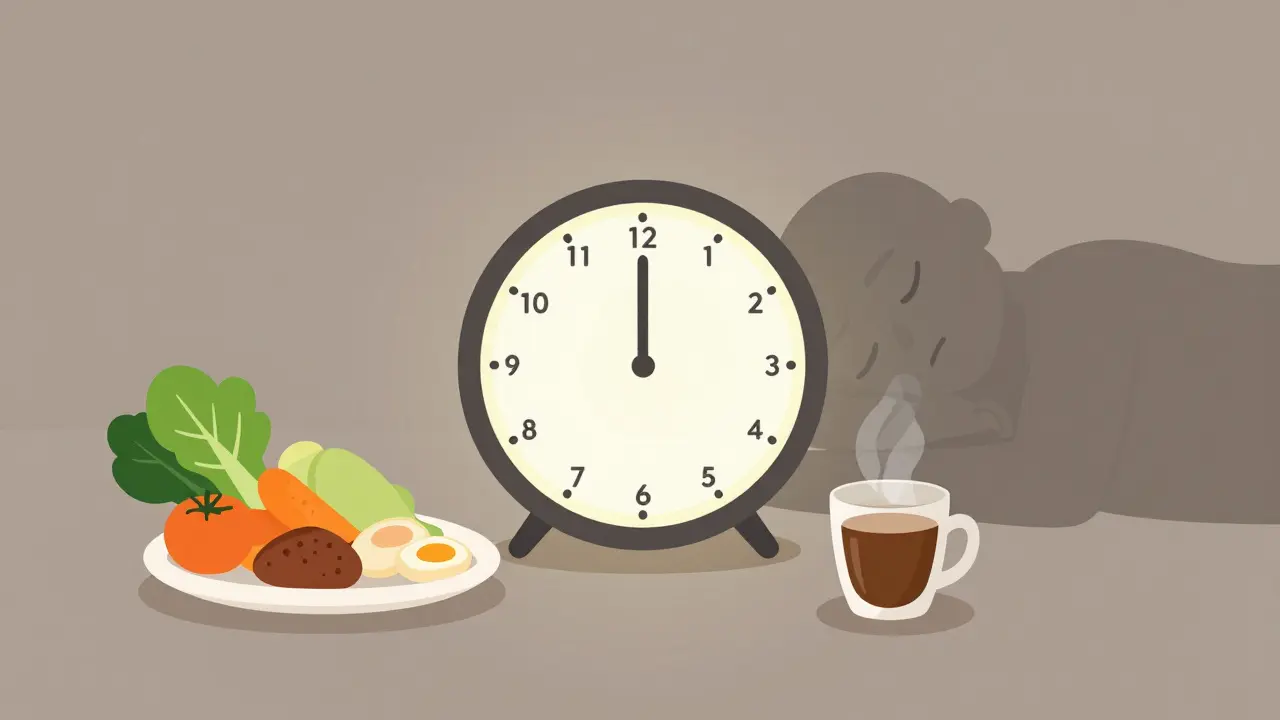
For years, people have tried every diet under the sun to lose weight-cutting carbs, counting calories, skipping meals, buying expensive shakes. But what if the secret wasn’t what you eat, but when you eat? That’s the core idea behind time-restricted eating, the most practical form of intermittent fasting backed by real science today.
What Exactly Is Time-Restricted Eating?
Time-restricted eating (TRE) means you only eat during a set window each day-usually between 8 and 12 hours-and fast for the rest. The most popular version? The 16:8 method. You fast for 16 hours, then eat during an 8-hour window. For example, you might have your first meal at 10 a.m. and finish eating by 6 p.m. No calorie counting. No food restrictions. Just a clock.
This isn’t some new fad invented by influencers. It’s rooted in how our bodies evolved. For most of human history, we didn’t have 24/7 access to food. We ate when we could, then went without. Our metabolism adapted to this rhythm. Today, with constant snacking and late-night meals, that rhythm is broken. TRE tries to fix that.
Research from the University of Toronto in July 2025 confirms TRE works. In their analysis of over 6,500 people across 99 studies, time-restricted eating led to 1.7-2.5 kg more weight loss than eating without any schedule. Not because you’re eating less food-but because your body gets a chance to switch from burning sugar to burning fat.
How It Actually Helps You Lose Weight
Here’s the thing: intermittent fasting doesn’t magically melt fat. It works because it changes how your body uses energy.
When you eat, your body releases insulin to store glucose. When you stop eating, insulin drops. That’s when your body flips a switch and starts burning stored fat. The longer you fast, the more time your body spends in fat-burning mode.
But it’s not just about calories. Timing matters. A study from UTSW Medical Center found that people who ate between 8 a.m. and 4 p.m. improved insulin sensitivity by 12.4%-much more than those who ate from noon to 8 p.m. Why? Because your body’s internal clock, or circadian rhythm, is designed to process food during daylight hours. Eating late at night messes with your metabolism, even if you’re not overeating.
Another win: reduced nighttime snacking. Most people who start TRE stop eating after dinner. That alone cuts hundreds of extra calories a day. No willpower needed. Just a schedule.
How It Compares to Traditional Diets
You might think, “If I just eat fewer calories, won’t I lose the same weight?” Yes-and no.
The Harvard T.H. Chan School of Public Health’s 2025 review found that intermittent fasting and traditional calorie-restricted diets result in nearly identical weight loss overall. But here’s the twist: alternate-day fasting (where you eat normally five days a week and cut calories to 500-600 on two days) led to 1.3 kg more weight loss than traditional dieting. That’s a 7.8% edge.
And it’s not just about the scale. People on TRE saw bigger drops in waist size (1.5-2.2 cm), LDL cholesterol (4.8-7.2 mg/dL lower), and triglycerides (8.3-12.6 mg/dL lower). Blood pressure improved too. These are markers for heart disease and diabetes-problems that affect millions.
But here’s what most people don’t tell you: sticking to a strict calorie limit is hard. Tracking every bite gets exhausting. TRE is simpler. You don’t count grams of protein or carbs. You just don’t eat after 7 p.m. or before 10 a.m. That simplicity is why 42% of Reddit users who tried TRE said it made meal planning easier.

Who It Works Best For (and Who Should Skip It)
TRE isn’t for everyone. But it’s surprisingly effective for certain groups.
Shift workers? A study in the NIH meta-analysis found they had 22.3% better adherence to TRE than day workers. Why? Their circadian rhythm is already out of sync. Fasting during their “night” helps reset their metabolism.
People with type 2 diabetes? The Endocrine Society’s 2025 study showed intermittent fasting lowered HbA1c (a key diabetes marker) more than continuous calorie restriction. Fasting blood glucose dropped by 18.7 mg/dL in the fasting group versus 12.3 mg/dL in the control group.
But if you’re pregnant, under 18, have a history of eating disorders, or are on insulin or other diabetes meds-talk to your doctor first. Fasting can be risky if your blood sugar isn’t stable.
And if you’re already eating clean, active, and healthy? You might not need it. TRE is a tool for people who struggle with late-night snacking, mindless eating, or just can’t stick to a strict diet.
Getting Started Without Losing Your Mind
Don’t jump into 16:8 on day one. That’s how people quit.
Start slow. Try a 12-hour eating window first-say, 8 a.m. to 8 p.m. That’s easy. You’re already fasting while you sleep. Then, over a week or two, push your breakfast back to 9 a.m. or 10 a.m. Eventually, you’ll naturally settle into an 8- or 10-hour window.
Here’s what works:
- Drink water, black coffee, or tea during fasting hours. No sugar, no cream.
- Don’t overeat during your eating window. You’re not off the hook-just less focused on counting.
- Get enough protein: aim for 1.2-1.6 grams per kilogram of body weight. That keeps your muscle intact.
- Don’t force it on social nights. Skip a day. It’s okay.
- Wait 72 hours. Hunger spikes in the first few days. Then your body adapts. Ghrelin (the hunger hormone) levels drop.
One woman in the University of Toronto study said: “I used to snack after dinner while watching TV. Now I just drink tea and go to bed. I didn’t even realize how much I was eating.”
The Real Challenge: Sustainability
Here’s the truth no one talks about: most people drop out.
In clinical trials, 18.7% of people quit intermittent fasting. That’s higher than the 15.2% who quit traditional diets. Why? Social life. Family dinners. Work parties. Holidays.
One Reddit user wrote: “Dinner invitations became impossible to accept without explaining my eating schedule.”
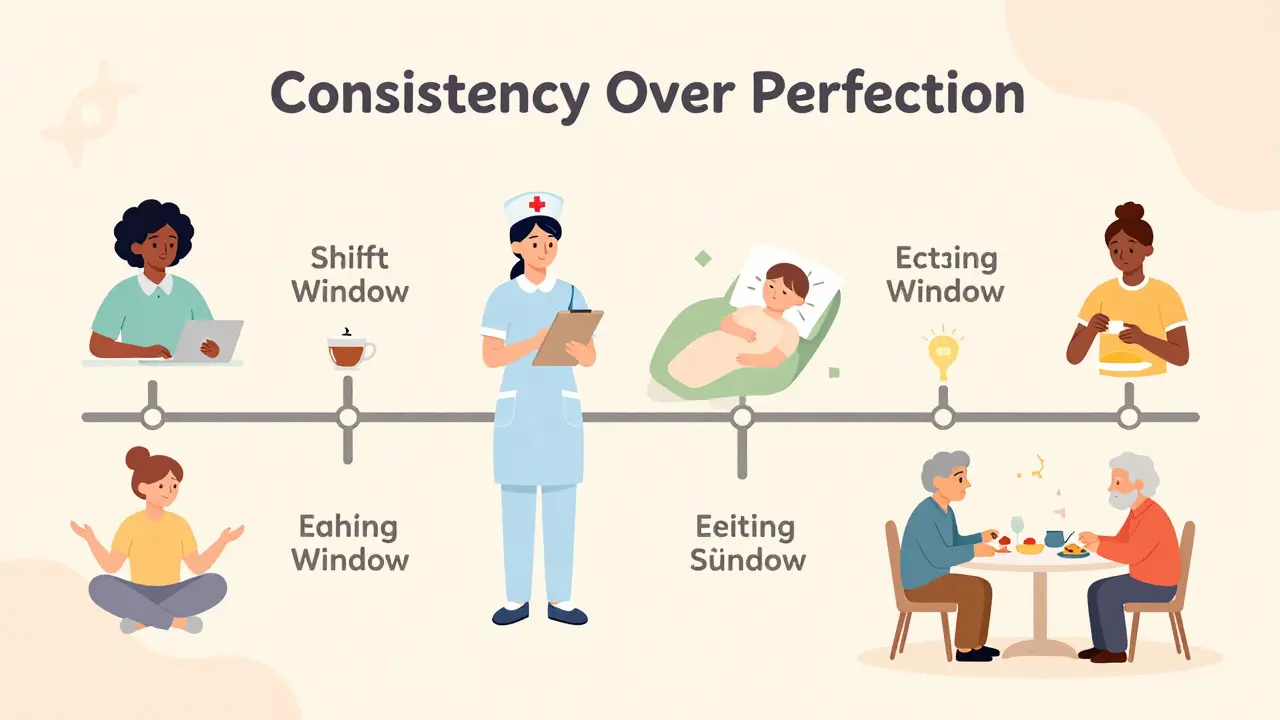
That’s real. And it’s hard. But here’s the fix: be flexible. If you miss a day? No big deal. Just go back the next day. TRE isn’t about perfection. It’s about consistency over months, not days.
Studies show that with weekly support from a nutritionist, dropout rates fall to under 10%. That’s why some companies now offer TRE coaching as part of workplace wellness programs. Over 37% of Fortune 500 companies have added it.
What’s Next for Intermittent Fasting?
The field is evolving fast. Companies like Viome are using AI to tailor fasting schedules based on your gut microbiome. The NIH is funding a $2.4 million study to see how shift workers respond to timed eating-results expected in 2027.
But the biggest takeaway? There’s no one-size-fits-all. What works for a 45-year-old office worker might not work for a 60-year-old with diabetes. The best approach is the one you can stick to.
Intermittent fasting isn’t magic. It’s a tool. And like any tool, it’s only useful if you use it the right way.
What the Science Says About Long-Term Results
Most studies last less than 24 weeks. That’s a problem. We don’t know if TRE works for five years.
Early data from the DIETFITS extension study shows weight regain after 12 months-43.2% of people who lost weight on TRE gained it back. That’s only slightly higher than the 38.7% who regained on traditional diets. So, not worse-but not better, either.
That means: if you want to keep the weight off, you need to keep the habit. Not just for 8 weeks. For life.
That’s why experts like Dr. Zhila Semnani-Azad from the University of Toronto say: “The goal isn’t to find the best diet. It’s to find the one you can live with.”

Grace Rehman
December 20, 2025 AT 16:39So we’re just pretending our bodies are cavemen now? Cool I guess. I’ve been eating popcorn at 2 a.m. for 12 years and my knees still work
But hey if your body’s a clock and you’re the wind-up key… congrats you’re now a mechanical toy
Jerry Peterson
December 21, 2025 AT 01:59I tried 16:8 last year after my doc said my fasting glucose was creeping up. Didn’t count a single calorie. Just stopped eating after 7. Lost 11 lbs in 8 weeks. Not magic. Just stopped eating junk before bed.
Now I drink tea and read. Weirdly peaceful.
Adrian Thompson
December 21, 2025 AT 07:25They don’t want you to know this but the WHO pushed this because Big Pharma hates insulin patents. Fasting = no pills = no profits. The 2025 Toronto study? Funded by Gates Foundation. They’re testing population control through metabolic manipulation. Wake up.
Also your circadian rhythm is a lie. The sun doesn’t rule your metabolism. The matrix does.
Southern NH Pagan Pride
December 21, 2025 AT 07:42the truth is… the government has been using timed eating to regulate our melatonin levels since 2018… it’s all part of the 5g bioweapon agenda… they’re syncing our insulin spikes to the satellite network… you think you’re fasting… but you’re being calibrated…
also… the word ‘metabolism’ is a distraction… it’s really about etheric resonance… i’m a pagan… i know these things
Jon Paramore
December 21, 2025 AT 14:32Let’s cut through the noise. TRE works because it extends the postprandial fasting window, lowering insulin duration and increasing fat oxidation. That’s it.
Insulin sensitivity improves because beta cells get a rest. No mysticism. No conspiracy. Just biochemistry.
Protein intake matters more than timing if you’re trying to preserve lean mass. 1.4g/kg is the sweet spot.
And yes, if you binge on pizza from 10am–6pm, you won’t lose weight. It’s not a free pass. It’s a tool.
Cameron Hoover
December 21, 2025 AT 21:56I was skeptical. Then I stopped eating after dinner. No more 11pm chips. No more guilt. I started sleeping better. My brain felt clearer. I didn’t even notice I’d lost weight until my jeans fell loose.
It’s not about willpower. It’s about giving your body a chance to breathe. And honestly? It’s the first thing in years that didn’t feel like punishment.
Sandy Crux
December 23, 2025 AT 03:17How… quaint… that you believe a 16:8 protocol-derived from Western industrialized sleep patterns-is somehow ‘natural’… when in fact, pre-industrial societies ate according to seasonal abundance, not digital clocks…
And let’s not pretend this isn’t just bourgeois wellness theater… I’m sure your ‘fasting window’ includes artisanal matcha and organic avocado toast…
Meanwhile, in the Global South, people fast because they can’t afford to eat… not because they’re optimizing their ‘metabolic flexibility’…
How… privileged…
Jay lawch
December 23, 2025 AT 13:53You think this is science? This is colonial brainwashing dressed in lab coats. In India, we never had this problem. Our ancestors ate when the sun was high, slept when it was dark, and never counted hours like robots. Now you think your iPhone alarm is your new guru? You’ve been programmed to believe your body needs a schedule because capitalism needs you docile and digesting at the right corporate hours.
They sell you coffee, then sell you fasting. They sell you sugar, then sell you detox. They sell you everything, then sell you the cure.
Real health is not in windows. It’s in freedom. And freedom is not scheduled.
And if you think this works for shift workers, you’re missing the point. They’re being exploited. Fasting doesn’t fix exploitation. It makes it quieter.
Cara C
December 24, 2025 AT 10:12Everyone’s got a different story. Some of you found peace. Some found rage. Some found conspiracy.
But the quiet truth? It’s not about the perfect window. It’s about finding what lets you breathe.
If skipping midnight snacks helps you sleep better and feel less guilty? Do it.
If you need to eat at 10 p.m. because that’s when your family sits down? Do that.
There’s no moral victory in fasting. Only in showing up for yourself, however you can.
And that’s okay.