

Imagine waking up one day and realizing your kidneys have quit working. That is the harsh reality of end-stage renal disease. While dialysis keeps people alive, a Kidney Transplant is often the better path forward. With a five-year survival rate reaching approximately 85% compared to 50% for those staying on dialysis, this procedure changes everything. But getting there isn't simple. It involves rigorous checks, complex surgery, and a lifetime of care. Here is exactly what you need to know about qualifying, the operation itself, and living well after the new kidney starts working.
Who Actually Qualifies for a Transplant?
The dream of a new kidney comes with strict rules. You aren't automatically eligible just because your kidneys failed. Doctors look at specific numbers to decide if you are healthy enough to handle the stress of surgery and recovery. First and foremost, you usually need to be diagnosed with End-Stage Renal Disease (ESRD).
ESRD occurs when kidney function falls below 15% of normal capacity. In practical terms, this means your Glomerular Filtration Rate (GFR) drops to about 15 mL/min/1.73m² or lower. Most centers will start looking at transplantation when GFR hits around 20 mL/min. Some places, like Vanderbilt University Medical Center, will consider patients earlier if their condition is rapidly declining-dropping by at least 10 points each year-or if you have a willing living donor ready to step up.
Your body mass matters significantly here. Obesity complicates the surgery and recovery. Many centers set limits. For instance, extreme obesity with a Body Mass Index (BMI) above 45 often disqualifies you entirely. A BMI between 35 and 45 might make you "high risk," requiring weight loss before being approved. This isn't just about vanity; studies show obesity increases surgical complications by 35% and raises the risk of graft failure by 20% compared to non-obese recipients.
Heart and lung health play equally big roles. If your heart cannot pump blood effectively, the strain of surgery could be fatal. Severe pulmonary hypertension, specifically where right ventricle systolic pressure exceeds 50 mm Hg, typically bars you from receiving a transplant. Centers also check your ability to breathe without help; long-term oxygen dependence is generally considered a hard stop. Your doctors will run stress tests and echocardiograms to ensure your heart can handle the new load.
The Evaluation Phase: What to Expect
Once your doctor refers you to a transplant center, the real vetting begins. Think of this evaluation as a full-body audit spanning several months. They need to be certain you can survive the procedure and manage medications afterward. Penn Medicine's protocol highlights that this includes standard blood work, cancer screening, chest x-rays, and tissue typing to see how well your immune system matches a potential donor.
It isn't just physical. Centers like Nebraska Medicine require every recipient to name a "care partner." This is the person who drives you to appointments, helps manage your medication schedule, and answers the phone when the hospital calls. They assess your social support system because isolation post-transplant is dangerous. If you lack a reliable safety net, some centers may hesitate to proceed.
Mental readiness is scrutinized too. Mayo Clinic notes that history of substance abuse or severe untreated psychiatric conditions can rule out eligibility. They want to see a track record of compliance. If you haven't shown you can take daily dialysis treatments consistently, will you stick to the even stricter regimen of anti-rejection drugs later? The answer determines your fate.
The Surgery: How It Works
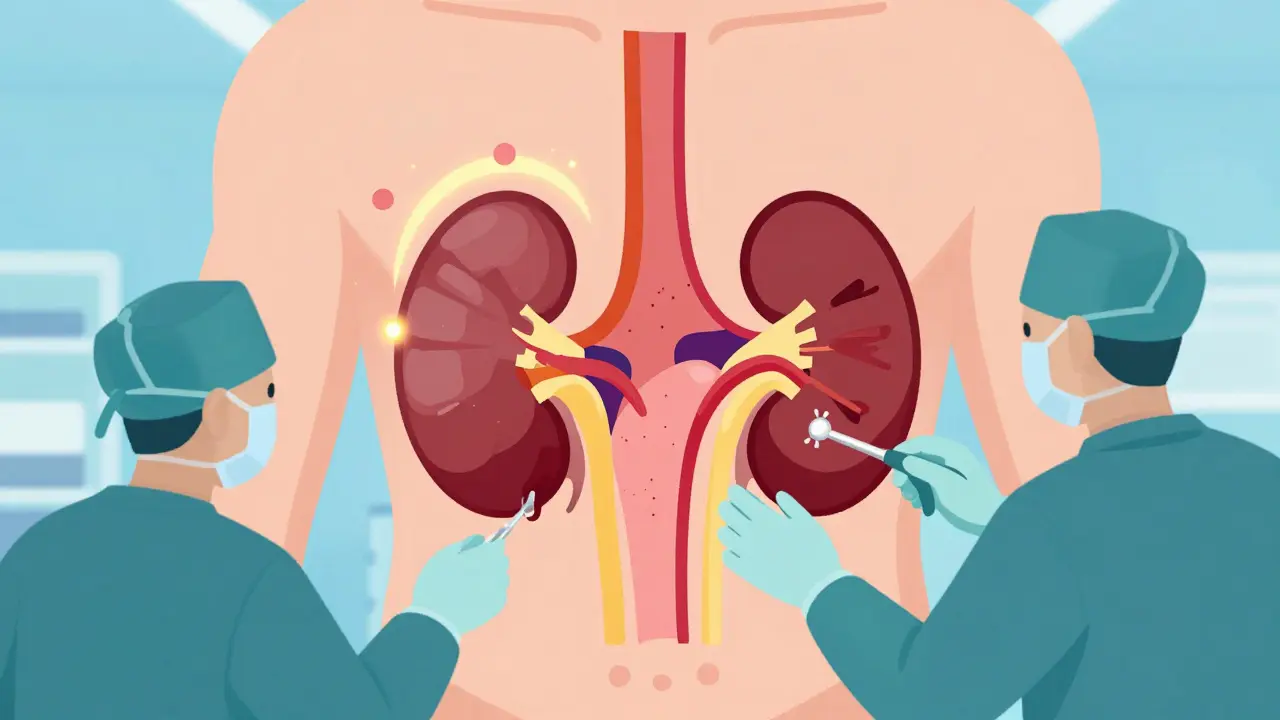
When the call finally comes, you're rushed to the operating room. The surgery typically takes three to four hours under general anesthesia. Contrary to what many believe, surgeons do not remove your old, failed kidneys. They leave them alone unless they are causing pain or infection. Instead, they place the new Donor Kidney in your lower abdomen, usually on the opposite side of your navel.
Connectivity is key. The surgeon attaches the kidney's arteries and veins to your own blood vessels. Then they connect the ureter-the tube draining urine-to your bladder. UCLA Medical School protocols note that the new organ often starts working immediately, producing urine as soon as blood flow is restored. However, about 20% of deceased donor transplants experience "delayed graft function." This means the kidney wakes up slowly, requiring temporary dialysis for a few weeks while it recovers.
Living donations generally skip this delay phase. Because the organ hasn't spent time dead outside the body, immediate function rates are much higher. The donor surgery happens separately, allowing the kidney to go straight from one warm body to another.
Navigating Donor Options
Choosing between a living or deceased donor is the biggest decision you'll face. Living donation offers significant advantages. According to the National Kidney Registry, living donor kidneys boast a 97% one-year survival rate compared to 93% for deceased donors. You control the timing, avoiding the uncertainty of the waitlist.
| Feature | Living Donor | Deceased Donor |
|---|---|---|
| 1-Year Survival Rate | 97% | 93% |
| Average Wait Time | Varies (often less than 1 year) | Years (can exceed 5-10 years) |
| Surgical Timing | Scheduled | Emergency/Urgent |
| Risk of Delayed Function | Low (< 5%) | Moderate (~20%) |
If you rely on a deceased donor, you get onto the national waiting list. As of 2023, over 100,000 people were waiting in the US alone, with only about 27,000 transplants happening annually. The system uses a scoring metric called the Kidney Donor Profile Index (KDPI). This score evaluates factors like donor age, cause of death, and height to predict how long the organ will last. It tries to match kidneys with the longest expected function to recipients who would benefit most, though geography plays a huge role here due to preservation time limits.

Life After Transplant: Managing the New Normal
Getting the kidney is half the battle. Keeping it requires discipline. You must take immunosuppressive therapy forever. These drugs prevent your immune system from attacking the new organ. A standard regimen usually mixes a calcineurin inhibitor like tacrolimus or cyclosporine with an antiproliferative agent such as mycophenolate mofetil. Sometimes corticosteroids are added to the mix.
These medications suppress the immune system's natural defense mechanisms. This makes you more susceptible to infections. You need to watch out for colds, flu, and even common household bacteria more carefully. Regular monitoring visits are mandatory. Initially, you might see your team weekly, then monthly, eventually settling into quarterly checkups. You will monitor creatinine levels and drug toxicity levels constantly.
Side effects vary. High blood sugar, high blood pressure, and osteoporosis are common risks associated with long-term steroid use. Cancer screening remains critical, especially for skin cancers, which occur at higher rates in transplant recipients. It's a trade-off: you sacrifice some immunity to gain back your kidney function.
Contraindications: When the Answer is No
Not everyone can receive a transplant, no matter how bad the need. There are absolute barriers. Active malignancy is a primary one; if you have untreated cancer or recently finished treatment, you must wait until the cure rate looks stable. Active systemic infections that cannot be treated are also a dealbreaker-you can't put someone with a raging infection through surgery safely.
Mental and behavioral health issues act as hurdles too. If a patient has a history of non-adherence to dialysis or missed doses, centers worry they won't take transplant meds correctly. Active alcohol or drug abuse is universally disqualifying. Centers also evaluate frailty. Older patients, say over 75, undergo extra scrutiny because frailty increases surgical mortality. Tools like the Fried Frailty Criteria check grip strength, walking speed, and exhaustion levels to predict outcomes.
What is the average life expectancy after a kidney transplant?
On average, a transplant extends life significantly compared to staying on dialysis. Living donor kidneys can last 15 to 20 years or more, while deceased donor kidneys typically function for 10 to 15 years. Overall patient survival is roughly 85% at 5 years post-surgery.
Can I live normally after the transplant?
Most recipients return to work and daily activities within 3 months. However, lifestyle adjustments are permanent, including lifelong medication adherence, diet restrictions to protect the kidney, and avoiding sun exposure due to skin cancer risks from immunosuppressants.
Do I need to wait for a deceased donor?
Not necessarily. About half of all kidney transplants come from living donors. If you have a friend, family member, or even a stranger willing to donate, you can bypass the multi-year waiting list associated with deceased organs.
What disqualifies someone from a kidney transplant?
Major disqualifiers include active uncontrolled infection, active cancer, severe cardiac or lung disease preventing surgery, BMI over 45, and history of non-compliance with medical regimens.
How long does the surgery take?
The actual placement of the kidney usually takes between 3 to 4 hours. Recovery time in the ICU is typically 2 to 3 days, followed by 5 to 7 days in a regular ward before discharge.
While the road to transplantation is filled with challenges, modern medicine has turned this procedure into a reliable solution for kidney failure. Research continues to evolve; trials are currently underway aiming to reduce the need for lifelong immunosuppression. Until those protocols hit the mainstream, following the strict guidelines established today ensures you give yourself the best chance at a longer, healthier life beyond dialysis.


Jordan Marx
March 28, 2026 AT 04:16The statistics mentioned regarding graft survival rely heavily on specific immunosuppressive regimens maintained by the team. Tacrolimus levels need tight monitoring because the therapeutic window is incredibly narrow for safety. Cyclosporine offers an alternative pathway but carries a higher risk of nephrotoxicity over time. Most clinical protocols prefer calcineurin inhibitors as the backbone of prevention strategies generally. Delayed graft function remains a significant variable affecting early outcomes significantly in patients. Living donors often bypass the ischemia time issues that plague deceased allocations completely though. Cold preservation time dictates how viable the organ remains during transport logistics specifically. You cannot ignore the cumulative toxicity effects on the new renal parenchyma structure fully. Chronic rejection manifests slowly through rising creatinine baselines over many months. Acute cellular rejection requires aggressive pulse steroids or antibody therapy intervention immediately upon detection. Antibody mediated rejection is harder to detect without serial biopsies performed regularly for certainty. BK virus nephropathy is another silent killer lurking in suppressed immune systems silently waiting. Surveillance PCR testing helps catch viral loads before they damage the graft function severely. Patients must understand that medication adherence is non-negotiable for longevity purposes always. Even minor missed doses can trigger an inflammatory cascade leading to graft loss rapidly unfortunately.
kendra 0712
March 29, 2026 AT 19:52This information really gives hope to families navigating the dialysis process daily!!!
walker texaxsranger
March 31, 2026 AT 10:42the data cited ignores the systemic failures in patient tracking after discharge which often leads to poor outcomes regardless of surgical success
Sophie Hallam
April 1, 2026 AT 06:48having a designated care partner is crucial for maintaining compliance throughout the recovery phase especially in the first month post op
Sarah Klingenberg
April 2, 2026 AT 02:39Glad to see the BMI guidelines laid out clearly so people know what to work toward :) getting healthy takes time though
Austin Oguche
April 3, 2026 AT 18:24The distinction between living and deceased donor outcomes highlights the importance of family donation initiatives in reducing waitlist pressure significantly
Shawn Sauve
April 4, 2026 AT 16:50Thanks for breaking down the evaluation criteria so thoroughly everyone deserves to understand the hurdles :))
Eva Maes
April 4, 2026 AT 23:31The system operates like a sieve filtering out anyone who does not fit the pristine mold of patient compliance and physical perfection standards required for approval