
When you take a pill for high blood pressure, you expect every tablet to be exactly the same. That’s because small-molecule drugs are made through chemical reactions - like baking a cake from a recipe. Every batch turns out nearly identical. But when it comes to biologics and biosimilars, that expectation doesn’t hold up. These medicines are made from living cells - not chemicals. And because they come from biology, not beakers, no two batches are ever perfectly the same. This isn’t a mistake. It’s normal. It’s called lot-to-lot variability.
What Is Lot-to-Lot Variability?
Every time a biologic drug is made, it’s grown inside living cells - usually yeast, bacteria, or mammalian cells. These cells are tiny factories. They don’t follow a blueprint like a robot. They react to their environment. A slight change in temperature, nutrient mix, or even the time of day the batch is harvested can cause tiny differences in the final product. These differences show up as small changes in sugar molecules attached to the protein (called glycosylation), or slight twists in the protein’s shape. Each lot of a biologic can contain millions of slightly different versions of the same protein. The FDA calls this "inherent variation." It’s not a flaw. It’s built into the process.
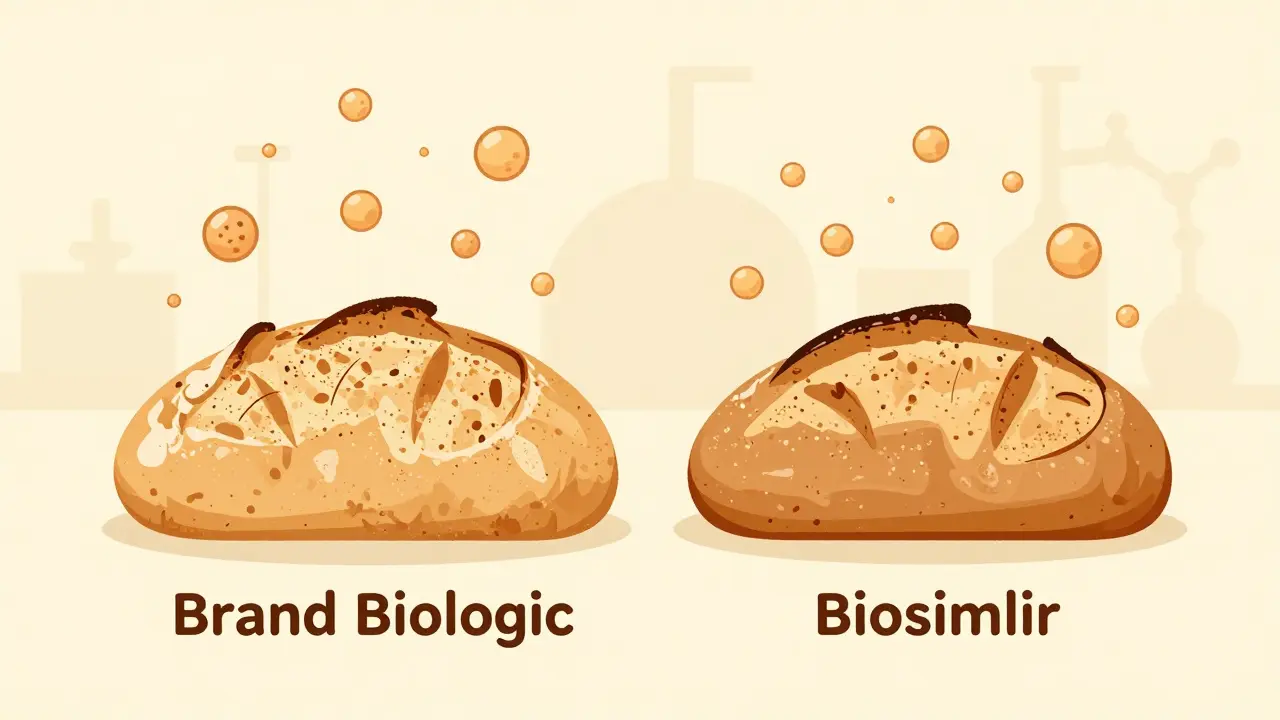
Think of it like two loaves of sourdough bread made by the same baker on two different days. Same recipe. Same flour. Same starter. But one loaf might be a bit chewier, the crust a little darker. That’s lot-to-lot variability. It doesn’t mean one loaf is bad. It just means nature isn’t perfectly repeatable.
Why Biosimilars Are Not Generics
Many people assume biosimilars are like generics - exact copies of brand-name drugs. They’re not. Generics are chemically identical to their brand-name counterparts. If you take a generic ibuprofen, you’re getting the same molecule as Advil. No variation. No guesswork.
Biosimilars are different. They’re highly similar, but not identical. The FDA is clear: "Biosimilars Are Not Generics." Why? Because you can’t chemically copy a protein made by a living cell. You can only make a very close copy. That’s why the approval path for biosimilars is much more complex. Instead of just proving bioequivalence (like generics do), biosimilar makers must show:
- Extensive analytical data proving their product matches the reference biologic in structure and function
- Similar patterns of lot-to-lot variation
- No clinically meaningful differences in safety or effectiveness
This means a biosimilar doesn’t need to be an exact copy - it just needs to behave the same way in the body. And that’s a big deal. It allows patients to access life-changing treatments at lower costs without sacrificing safety.
How Regulators Manage the Risk
The FDA doesn’t just accept variability. They demand control. Every biosimilar manufacturer must prove they can consistently produce batches within a narrow range of variation. They use advanced tools like mass spectrometry and high-throughput analytics to map out every possible version of the protein in each lot. These aren’t just lab tricks - they’re required parts of the approval process.
Manufacturers must show they have a "control strategy" - a set of steps to monitor and adjust their process so the product stays within safe limits. The FDA looks at this closely. If a new lot shows a shift in glycosylation patterns beyond what’s seen in the reference product, the application gets flagged. It’s not about perfection. It’s about predictability.
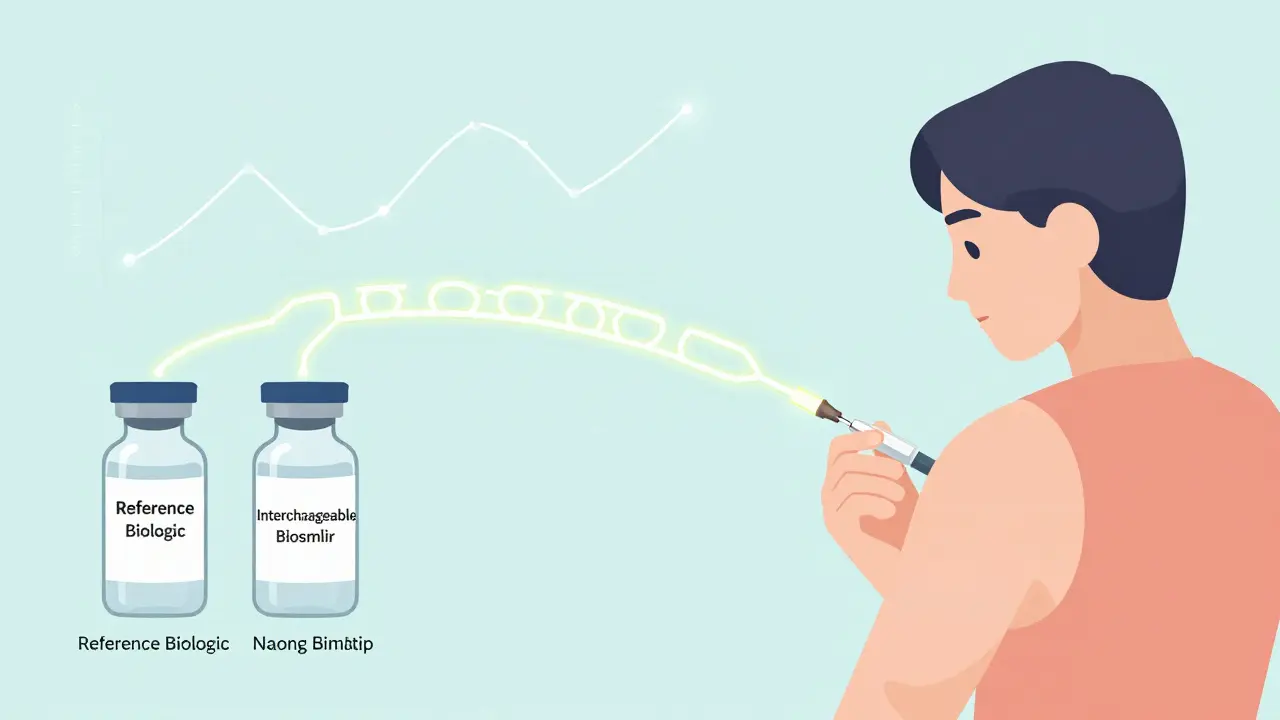
For a biosimilar to be labeled "interchangeable" - meaning a pharmacist can swap it for the brand-name drug without asking the doctor - the bar is even higher. The company must prove that switching back and forth between the biosimilar and the original doesn’t increase risk or reduce effectiveness. That means running clinical studies where patients alternate between the two products multiple times. Only 12 out of 53 approved biosimilars in the U.S. as of May 2024 have this designation. It’s rare for a reason.
What This Means for Labs and Testing
Lot-to-lot variability isn’t just a manufacturing issue. It hits the lab too. Many diagnostic tests rely on reagents made from biologics - antibodies, enzymes, proteins - all prone to variation. A 2022 survey found that 78% of lab directors consider reagent lot changes a "significant challenge." Why? Because a new lot might give slightly different results for the same patient sample.
Here’s a real example: A lab switches to a new lot of HbA1c reagent - the test used to track diabetes control. The quality control samples look fine. But when they test actual patient samples, the average result jumps by 0.5%. That might sound small. But in diabetes care, that could mean a patient is moved from "well-controlled" to "poorly controlled" - triggering unnecessary treatment changes.
That’s why labs don’t just swap reagent lots. They verify them. They run 20 or more patient samples on both the old and new lot, compare results, and make sure the difference stays within acceptable limits. Some labs use moving averages - tracking patient results over time to spot drift before it becomes a problem. It’s time-consuming. In smaller labs, this process can eat up 15-20% of staff time each quarter. But skipping it risks patient safety.
Why This Matters for Patients
Patients don’t need to understand glycosylation or mass spectrometry. But they do need to know this: the medicine they’re getting isn’t a carbon copy. It’s a very close cousin. And that’s okay - as long as the system works.
For patients with rheumatoid arthritis, Crohn’s disease, or cancer, biosimilars mean access to treatments that were once too expensive. Many now pay a fraction of the brand-name price. But if lot-to-lot variability isn’t managed well, it could lead to inconsistent results - a drop in effectiveness, or worse, unexpected side effects.
That’s why the FDA’s "totality of the evidence" approach matters. They don’t look at one test or one study. They look at everything: analytical data, clinical trials, real-world outcomes, manufacturing controls. And they’ve approved 53 biosimilars in the U.S. since 2015. Not one has been pulled for safety issues linked to variability.
Patients should feel confident. But they should also be informed. If you’re on a biosimilar and your doctor switches you to a different one, ask: "Is this interchangeable?" If it’s not, and you’re switching brands, your provider should monitor your response closely. Small changes in how you feel - fatigue, joint pain, flare-ups - could be signs the new lot is behaving differently.
The Future: More Complex, More Varied
Biologics are getting more complex. Next-generation drugs include antibody-drug conjugates, cell therapies, and gene therapies. These aren’t just proteins. They’re living cells, engineered viruses, or drug-loaded antibodies. Their variability? Even harder to control.
But technology is catching up. New tools can now detect changes at the molecular level that were invisible a decade ago. AI is being used to predict how small process changes will affect the final product. By 2026, experts predict 70% of new biosimilar applications will include data on interchangeability - up from 45% in 2023.
The goal isn’t to eliminate variability. That’s impossible with biology. The goal is to understand it, measure it, and control it so well that patients get safe, effective, affordable medicine - no matter which lot they get.
What You Can Do
- If you’re on a biosimilar, keep taking it. The system is designed to keep you safe.
- If your doctor switches your biosimilar, ask if it’s interchangeable. If not, ask whether monitoring is needed.
- If you’re a healthcare provider, verify new reagent lots before using them in patient testing.
- If you’re in the industry, invest in analytical tools. The future belongs to those who can measure the invisible.
Lot-to-lot variability isn’t a bug. It’s a feature of living systems. And with smart science and careful oversight, it’s a feature we’ve learned to live with - and even benefit from.

Shawn Raja
January 26, 2026 AT 12:46So let me get this straight - we’re okay with injecting people with slightly different versions of a protein every time, but we freak out if a smartphone battery lasts 5% less than last month? 🤔
Biologics are basically nature’s glitchy software update. You don’t get to choose the batch. You just hope the coder (aka the FDA) didn’t mess up the patch notes.
And yet, somehow, we’ve had 53 approved biosimilars and zero mass casualties. Wild, right?
Turns out biology doesn’t need perfection. It just needs to not kill you. That’s the whole bar.
Meanwhile, my microwave still doesn’t know how to heat leftovers evenly after 20 years. We’re all just guessing at this point.
Let’s just be grateful someone’s watching the sourdough starter.
Ryan W
January 28, 2026 AT 10:50Lot-to-lot variability is a regulatory loophole dressed up as science. The FDA’s ‘inherent variation’ is just corporate speak for ‘we can’t control it so we legalized it.’
Generics are chemically identical - that’s the standard. Biosimilars are ‘close enough’ - which means we’re gambling with patient outcomes under the guise of cost savings.
Mass spectrometry doesn’t fix bad manufacturing. It just makes it look fancy.
And don’t get me started on ‘interchangeable’ - that’s a marketing term, not a clinical one.
If your drug isn’t identical, it’s not interchangeable. Period. No jargon can paper over that.
Allie Lehto
January 28, 2026 AT 10:51okay so like… i just want to say that this whole thing makes me feel so vulnerable??
like i’m on a biosimilar for my RA and i just found out that each bottle is kinda… different??
and i’m like… is my body gonna be like ‘wait, this isn’t the same guy’ and start fighting it??
it’s scary to think that the thing keeping me alive is basically a living thing that can’t be replicated perfectly 😭
but also?? like… nature is messy and that’s kinda beautiful??
we’re just trying to tame chaos with spreadsheets and mass specs 🤷♀️
we’re all just fragile little proteins in a big messy world anyway 💖
TONY ADAMS
January 28, 2026 AT 13:36So you’re telling me my $10,000 shot isn’t the same every time? I’m out.
My dog gets the same kibble every day. Why can’t I?
Just give me a pill. I don’t want to be a lab rat.
Napoleon Huere
January 29, 2026 AT 14:21This is the most beautiful contradiction in modern medicine: we’re trying to control the uncontrollable.
Biology is inherently unpredictable - that’s why life exists. We didn’t evolve for perfect consistency. We evolved for adaptability.
So why do we treat medicine like a factory line when it’s more like a jazz improvisation?
The real breakthrough isn’t in making identical proteins - it’s in accepting that variation is part of the system, and building trust around it.
We don’t need to eliminate variability. We need to understand it like we understand weather.
You don’t control the rain. You carry an umbrella.
And the FDA? They’re the meteorologists with really good sensors.
That’s not failure. That’s wisdom.
Shweta Deshpande
January 30, 2026 AT 03:06Oh my goodness, this post made me so happy to read! 🌸
I work in a small lab in Pune, and we deal with reagent lot changes every month - it’s such a headache, but I love how much care we put into verifying each one.
We run those 20+ patient samples like it’s a sacred ritual - because it is.
It’s not just about numbers. It’s about the person whose HbA1c result might change their life.
And honestly? I think the fact that we even bother to check this much shows how much we care.
Even if the science is messy, the human side? That’s clean.
And that’s what matters most.
Thank you for writing this - it’s like a warm cup of chai for my tired lab heart ☕❤️
Aishah Bango
January 31, 2026 AT 00:40This is why we can’t have nice things. You’re normalizing biological chaos and calling it science.
Patients are not lab rats. They’re people who trust their doctors to give them safe, consistent medicine.
Letting manufacturers get away with ‘close enough’ is a betrayal of medical ethics.
There’s no excuse for inconsistency in life-saving drugs.
Either it’s the same - or it’s not medicine. It’s a gamble.
Simran Kaur
January 31, 2026 AT 10:52My heart just swelled reading this. 🙏
Back home in Punjab, my cousin got her biosimilar for psoriasis - it saved her from losing her job because she couldn’t afford the brand.
But she was terrified every time the pharmacist handed her a new box.
She didn’t know if it was the same.
And now, after reading this, she finally understands - it’s not about being identical.
It’s about being *reliable*. Like the way our grandmother’s chai tastes different every day… but still warms you the same.
Thank you for explaining it so gently.
She cried when she read it.
Not from fear.
From relief.
Neil Thorogood
February 1, 2026 AT 16:33So let me get this straight - we’re okay with a protein that changes like my mood on a Monday morning? 😂
And we call that ‘science’?
Bro.
The FDA is basically saying: ‘Hey, this biologic is like a TikTok dance - every version is slightly different, but as long as it’s still lit, we’re good.’
Meanwhile, my Fitbit knows my sleep cycles better than my doctor knows my biosimilar lot number.
But hey - at least we’re not using a horse’s spleen anymore. Progress? Maybe.
Still, I’d feel better if they gave me a QR code to scan and see which version I got. 🤖🧬
Jessica Knuteson
February 3, 2026 AT 02:46Interchangeable is a myth. The data is cherry-picked. Labs are overworked. Patients are collateral.
Cost savings don’t equal safety.
End of story.
Skye Kooyman
February 4, 2026 AT 13:32So… if I get a new lot and my joint pain flares up, is that me? Or the protein?
Just wondering. No big deal.
But kinda important.
James Nicoll
February 5, 2026 AT 11:41Let’s be real - this whole system is just a giant Rube Goldberg machine built on trust.
We’ve got scientists with pipettes and supercomputers trying to measure the unmeasurable.
And somehow, it works.
Not because biology is predictable.
But because humans are stubborn.
We refused to accept that life-saving drugs had to cost $200k a year.
So we built a system that says: ‘Close enough, if it saves lives.’
It’s not elegant.
It’s not perfect.
But it’s ours.
And right now? That’s enough.