
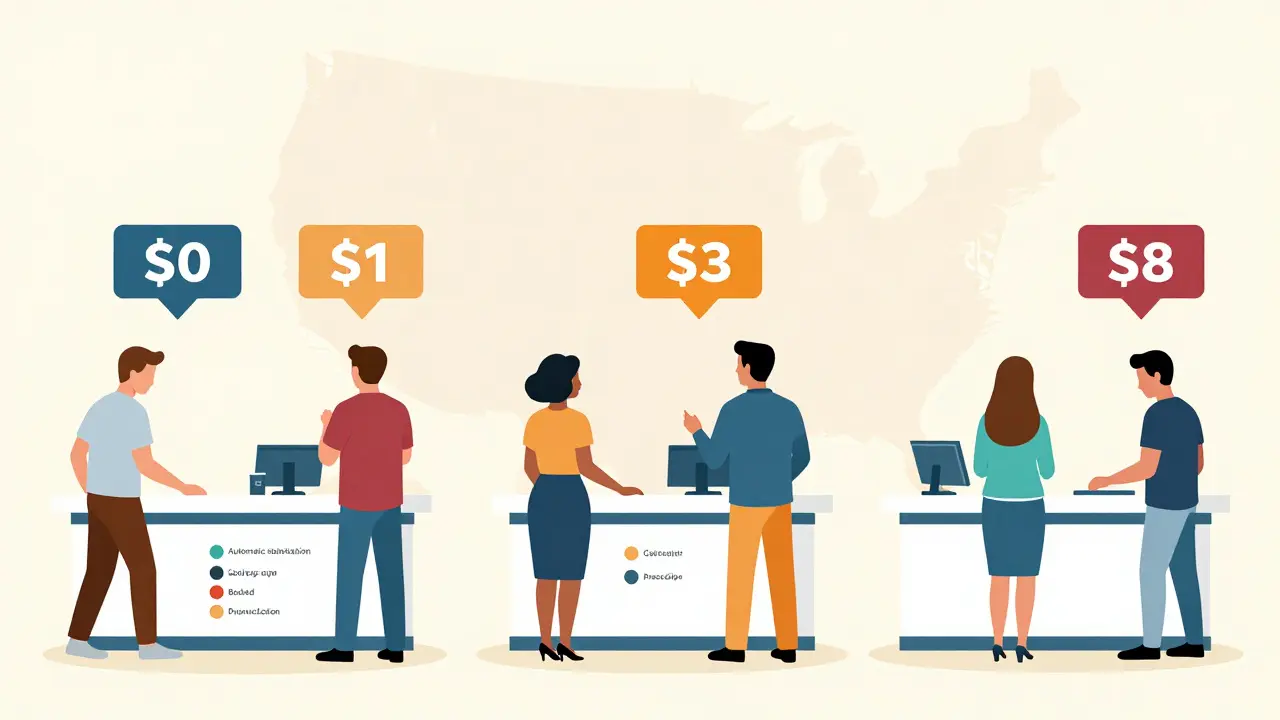
When you’re on Medicaid, getting your prescription filled shouldn’t be a maze. But for millions of Americans, it is. The federal government sets the floor for Medicaid drug coverage, but every state builds its own house on top of that floor. That means Medicaid generic coverage isn’t the same in Texas as it is in Vermont. Some states make it easy - automatic substitutions, low copays, fast approvals. Others? You might need to jump through hoops just to get a generic version of a drug you’ve been taking for years.
How Medicaid Covers Generics - The Federal Baseline
Under federal law, states aren’t required to cover prescription drugs at all. But every single state does. Why? Because it saves money. Generic drugs make up over 84% of all Medicaid prescription claims, yet they only cost about 28% of the total pharmacy budget. That’s the math that keeps states invested.
The Medicaid Drug Rebate Program (MDRP) is the engine behind this. Drug manufacturers agree to pay rebates to states in exchange for having their drugs covered. For generics, those rebates are based on a formula tied to the average manufacturer price. The Federal Upper Limit (FUL) sets the maximum amount states can reimburse pharmacies for each generic drug - currently 150% of the average price plus a small fee. But here’s the twist: states can set lower limits. And many do.
Automatic Generic Substitution - Not Guaranteed
Imagine your doctor writes a prescription for a brand-name drug. In some states, the pharmacist can swap it for the generic without asking anyone. In others, they can’t touch it unless you or your doctor says yes.
As of 2025, 41 states require pharmacists to substitute a generic when it’s available and therapeutically equivalent. Colorado, for example, mandates substitution unless the prescriber writes "Do Not Substitute" or the generic is actually more expensive than the brand. That last part is rare - but it happens. Some generics, especially older ones, have seen price spikes due to supply shortages or manufacturer consolidation.
But even in states with mandatory substitution, exceptions exist. If you’ve been on a brand-name drug for months and it’s working, you can usually stay on it. The system isn’t designed to disrupt stable care. Still, confusion is common. Many patients don’t know they have the right to refuse a switch - or that they can ask their doctor to write "Dispense as Written."
Copays: From Free to $8 - It Depends Where You Live
How much you pay out of pocket for a generic can vary wildly. For most Medicaid beneficiaries with income below 150% of the federal poverty level, states are allowed to charge up to $8 per prescription for non-preferred generics. But many don’t hit that max.
In California’s Medi-Cal program, copays for generics are often $1 or $0. In Ohio, they’re $3. In states like Alabama and Mississippi, the copay is $8 - the maximum allowed. And it’s not just about the amount. Some states charge more for brand-name drugs than generics. Others charge nothing at all for any prescription if you’re under 18 or pregnant.
Why the difference? It’s political. States with tighter budgets are more likely to use copays as a way to discourage unnecessary use. But research shows high copays can lead to skipped doses, especially for chronic conditions like diabetes or high blood pressure. A 2024 study found that for every $1 increase in generic copay, medication adherence dropped by 3.7% among low-income patients.
Formularies and Tiers - What’s Covered and What’s Not
Every state runs a formulary - a list of approved drugs. Think of it like a menu. Most use tiers:
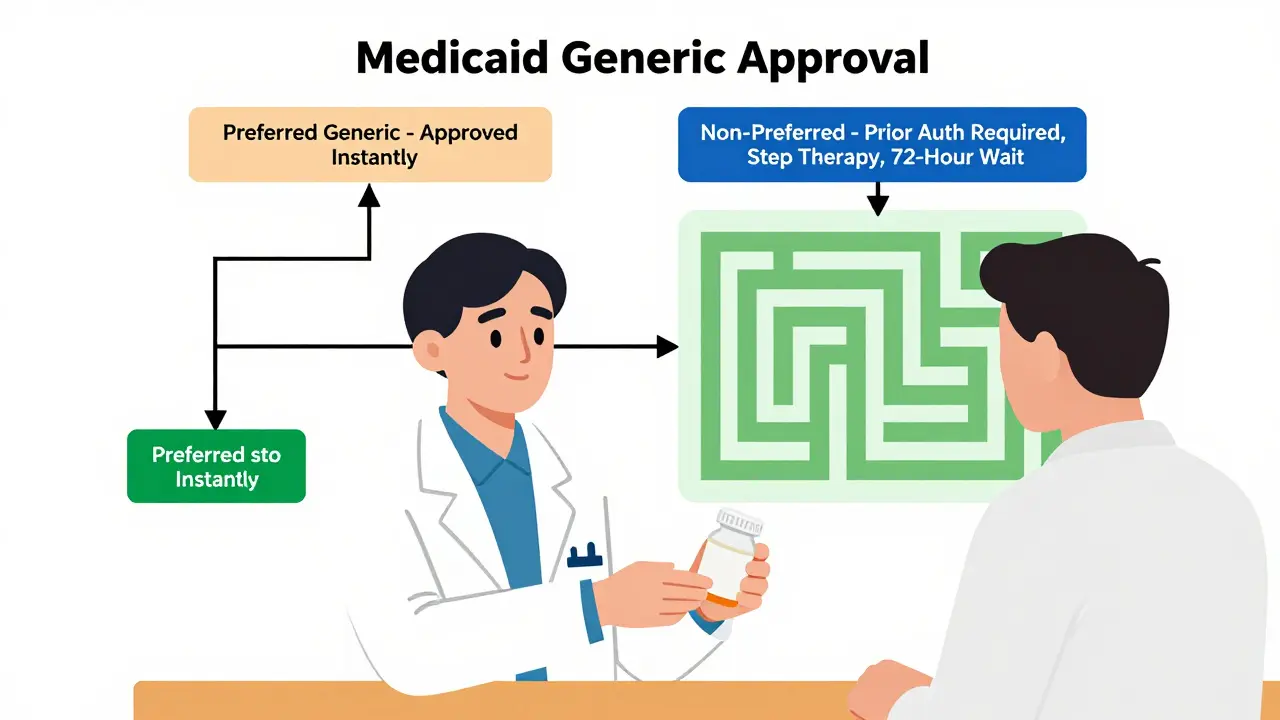
- Tier 1: Preferred generics - lowest cost, no prior authorization needed.
- Tier 2: Non-preferred generics or brand-name drugs - higher copay, may require prior authorization.
- Tier 3: Specialty drugs - often brand-name, high cost, strict rules.
But here’s where it gets messy. One state’s Tier 1 generic might be Tier 2 in another. A drug like metformin (for diabetes) is almost always covered. But what about a generic version of a heart drug that’s been around for 30 years? In some states, it’s on the preferred list. In others, it’s not covered at all because the state decided it’s "not cost-effective" - even though it’s been used safely for decades.
States like Colorado and New York publish detailed Preferred Drug Lists (PDLs) online. They include clinical criteria. For example, to get approval for a certain acid reflux drug, you might need to try three other preferred drugs first - and fail - before they’ll cover it. That’s called step therapy. And 32 states use it for some drug classes.
Prior Authorization: The Hidden Bureaucracy
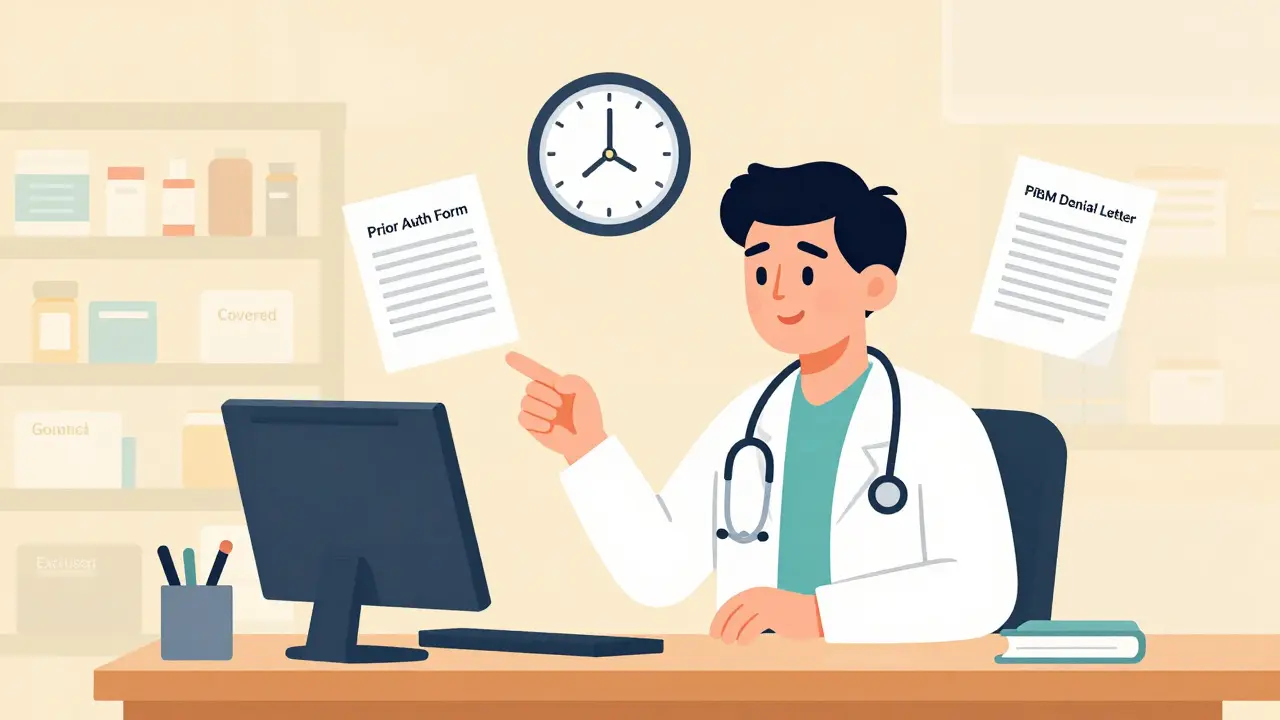
Prior authorization is the biggest pain point for patients and doctors alike. It’s when your prescriber has to prove to the state or its pharmacy benefit manager (PBM) that you need a specific drug - before you can get it.
For generics? It’s not always required. But it often is. In Colorado, most preferred generics don’t need it. But if your drug is on the "non-preferred" list - even if it’s generic - you’re likely stuck waiting. Some states require prior authorization for every single generic that’s not on their approved list. That’s over 1,000 drugs in some cases.
And the wait time? It varies. Health First Colorado (Colorado’s Medicaid program) promises a decision within 24 hours. In Texas, it can take up to 72 hours. For patients on chronic meds, that’s three days without their drug. In one case documented by the American Medical Association, a patient with epilepsy missed a dose during the wait - and had a seizure.
Doctors aren’t immune. On average, primary care physicians spend 15.3 minutes per patient just filling out prior auth forms for generic drugs. That’s over 8,000 hours a year per physician. And it’s not just time - it’s money. The AMA estimates that administrative costs for prior auths cost each doctor about $8,200 annually.
Who’s Running the Show? PBMs and State Contracts
Most states don’t manage their pharmacy benefits directly. They outsource it to Pharmacy Benefit Managers (PBMs) like CVS Caremark, Express Scripts, or OptumRx. These companies negotiate drug prices, set formularies, and handle prior auths on behalf of the state.
As of early 2025, these three PBMs manage Medicaid pharmacy benefits in 37 states. That means a lot of consistency - but also a lot of power concentrated in a few hands. One PBM might have a more generous formulary than another. One might approve generics faster. Another might have stricter step therapy rules.
And here’s the catch: states rarely disclose how these contracts are structured. Are PBMs incentivized to save money? Yes. But sometimes that means denying coverage, not negotiating lower prices. A 2024 University of Pennsylvania study found that when prior auths were denied for generic drugs, hospital admissions for Medicaid patients increased by 12.7%.
What’s Changing in 2026?
The landscape is shifting. In December 2024, CMS proposed a rule requiring all states to cover anti-obesity medications - a major expansion that could affect nearly 5 million Medicaid enrollees. That’s unprecedented. But it’s also a financial burden. States are worried they’ll get stuck paying for drugs that aren’t fully reimbursed by federal rebates.
Another looming change? A bill under discussion would remove most generic drugs from the Medicaid Drug Rebate Program’s inflationary rebate formula. If it passes, states could lose up to $1.2 billion in annual rebates. That could mean tighter formularies, higher copays, or even drug exclusions.
Meanwhile, the discontinued Medicare Two Dollar Drug List Model - which offered $2 copays for generics - showed promising results. In pilot states, medication adherence rose by nearly 18%. Medicaid programs are watching closely. Some are testing similar models.
What You Can Do
If you’re on Medicaid and confused about your drug coverage:
- Check your state’s Medicaid website. Look for the "Preferred Drug List" or "Formulary."
- Ask your pharmacist: "Is this the preferred generic?" If not, ask why.
- If you’re denied a drug, ask for a copy of the denial letter. It should explain why - and how to appeal.
- Request a therapeutic interchange. In 17 states, pharmacists can switch you to another drug in the same class if it’s cheaper and equally effective - even without a new prescription.
- Call your state’s Medicaid office. They’re required to answer questions about coverage.
And if you’re a provider? Document everything. Keep copies of prior auth requests, denials, and patient outcomes. Data like this is what drives policy change.
Can my pharmacist switch my brand-name drug to a generic without my doctor’s permission?
In 41 states, yes - as long as the generic is therapeutically equivalent and the doctor hasn’t written "Do Not Substitute." But in the remaining 9 states, the pharmacist must get approval from the prescriber first. Always ask your pharmacist what the rules are in your state.
Why is my generic drug not covered even though it’s cheaper than the brand?
Some states exclude certain generics from their formulary based on clinical guidelines, not price. A drug might be cheaper but not considered "first-line" for your condition. Or it may have been removed because of a supply shortage or safety concern. Check your state’s Preferred Drug List for details.
Do all states have prior authorization for generic drugs?
No. Most states only require prior authorization for non-preferred generics or brand-name drugs. Preferred generics - the ones on the state’s approved list - usually don’t need it. But if your drug isn’t on that list, even if it’s generic, you’ll likely need approval.
Can I appeal if my Medicaid claim for a generic drug is denied?
Yes. Every state has a formal appeals process. You or your doctor can submit a written appeal, often with supporting medical records. The timeline varies - some states respond in 7 days, others take up to 30. If you’re in crisis (like a life-threatening condition), you can request an expedited review.
Why do some states have higher copays for generics than others?
It comes down to budget priorities. States with higher Medicaid spending per person (like California or New York) often keep copays low to ensure adherence. States with tighter budgets may use higher copays as a cost-control tool. But research shows higher copays lead to more skipped doses - especially for chronic illnesses.
Final Thoughts
Medicaid generic coverage isn’t broken - it’s complicated. The system works because it saves money. But the complexity hurts access. Patients get caught in gaps between state rules, PBM policies, and provider confusion. The future may bring more standardization - but for now, knowing your state’s rules is your best defense.

Stephen Habegger
March 18, 2026 AT 08:16Justin Archuletta
March 18, 2026 AT 12:27Kendrick Heyward
March 20, 2026 AT 09:16lawanna major
March 21, 2026 AT 22:30Emily Hager
March 23, 2026 AT 09:19Lauren Volpi
March 24, 2026 AT 16:28Kal Lambert
March 26, 2026 AT 03:23Srividhya Srinivasan
March 26, 2026 AT 09:04Ayan Khan
March 28, 2026 AT 06:11Melissa Starks
March 29, 2026 AT 12:00Alexander Pitt
March 30, 2026 AT 02:14Manish Singh
March 31, 2026 AT 09:58