

Every year, tens of thousands of people develop dangerous blood clots not because of injury or illness, but because of a medication they were prescribed. These aren’t rare side effects-they’re predictable, preventable, and often missed until it’s too late. If you’re taking hormonal birth control, hormone therapy, chemotherapy, or even just sitting on a long flight after surgery, you could be at risk. The good news? You don’t have to wait for symptoms to appear. Knowing what to watch for and how to protect yourself can literally save your life.
What Medications Can Cause Blood Clots?
Not all medications cause clots, but some are well-documented triggers. The biggest culprits fall into three categories: hormones, cancer drugs, and certain antivirals or anti-inflammatories.Estrogen-containing birth control pills are the most common offender. Third-generation pills with desogestrel or gestodene raise your risk of deep vein thrombosis (DVT) by 3 to 5 times compared to not using them. Even second-generation pills with levonorgestrel carry a 2 to 3 times higher risk. The risk jumps even higher if you’re over 35, smoke, or have a family history of clots.
Hormone replacement therapy (HRT) for menopause carries similar risks. Women over 60 on combined estrogen-progesterone therapy have a 2 to 3 times greater chance of developing a clot than those not on hormones. The risk doesn’t just disappear after a few months-it builds over time.
Cancer treatments are another major concern. Chemotherapy drugs like cisplatin can increase clot risk by 4 to 7 times. Tamoxifen, used for breast cancer, raises the risk by 2 to 3 times. Even androgen deprivation therapy for prostate cancer increases the odds by 1.5 to 2 times. This isn’t just bad luck-it’s a direct biological effect. These drugs alter clotting proteins, damage blood vessel walls, and make platelets stickier.
Other drugs linked to clots include some antidepressants (like venlafaxine), certain antibiotics (like ciprofloxacin), and even over-the-counter painkillers like ibuprofen when used long-term in high doses. The FDA now requires black box warnings on all estrogen-based medications, making it clear: this isn’t theoretical. It’s a real, documented danger.
How to Spot a Medication-Induced Blood Clot
The biggest problem? Blood clots don’t always hurt. Or they hurt in ways you’d never connect to a pill you took last month.If you’re on a high-risk medication and notice any of these symptoms, don’t wait. Don’t assume it’s just muscle soreness or stress.
- Leg swelling-especially in one leg, often the calf
- Sharp pain or cramping in the leg that gets worse when standing or walking
- Red, warm, or discolored skin on the calf or thigh
- Sudden shortness of breath with no clear cause
- Chest pain that sharpens when you breathe deeply
- Rapid heartbeat or dizziness that comes out of nowhere
- Fainting or feeling lightheaded
These aren’t vague signs. They’re red flags for deep vein thrombosis (DVT) or pulmonary embolism (PE). About 60% of medication-related clots show up within the first 3 to 6 months of starting the drug. That’s your window to act.
Doctors use tools like the Wells’ Criteria to assess risk based on symptoms. But you don’t need a medical degree to recognize the pattern: if you started a new medication and then developed new, unexplained symptoms like leg swelling or breathing trouble-stop ignoring it.
How Doctors Diagnose These Clots
If you report these symptoms, your doctor won’t guess. They’ll test.The first step is often a D-dimer blood test. It measures a protein fragment released when clots break down. A negative result rules out clots in low-risk patients-but it’s not perfect. Up to 10% of clots can be missed if the test is done too early or if you’re on anticoagulants.
If the D-dimer is positive or symptoms are strong, imaging follows:
- Ultrasound for leg clots-fast, painless, and accurate for DVT
- CT pulmonary angiography for lung clots-uses contrast dye to show blockages in the lungs
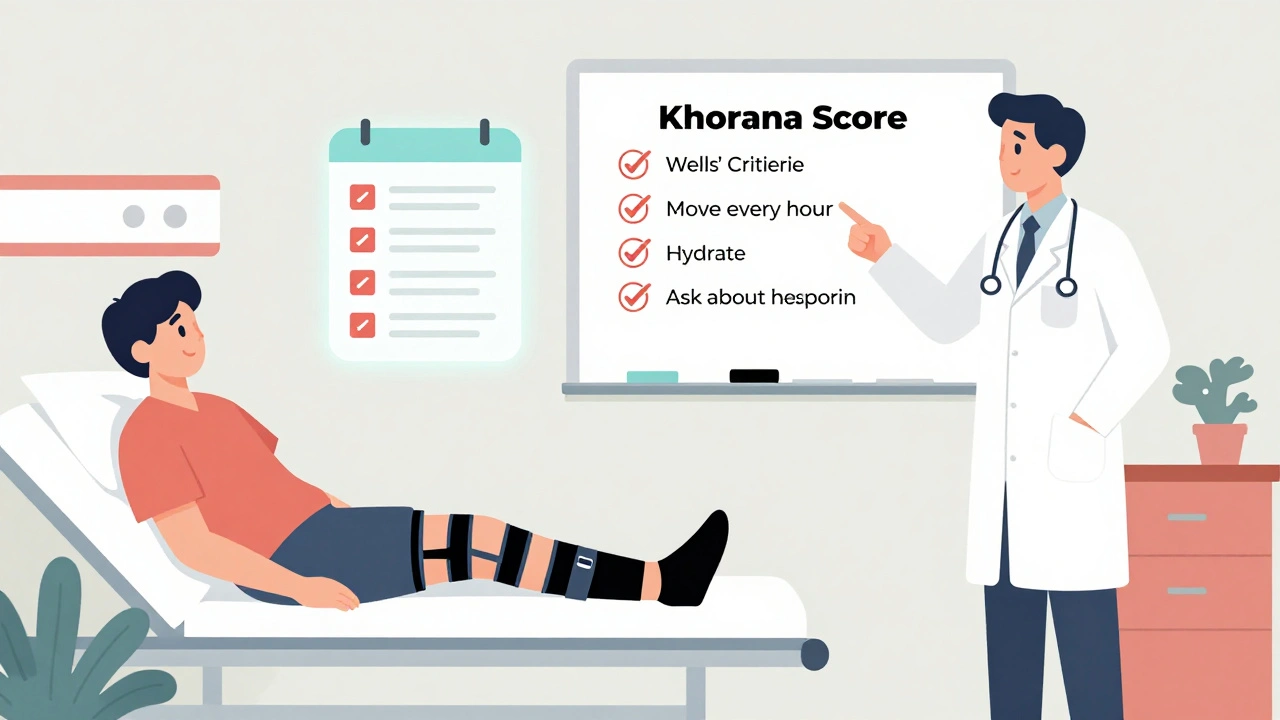
For cancer patients, the Khorana Score is used to predict clot risk before treatment even starts. It looks at cancer type, blood counts, weight, and other markers. If your score is 2 or higher, you’re considered high-risk and should get preventive treatment.
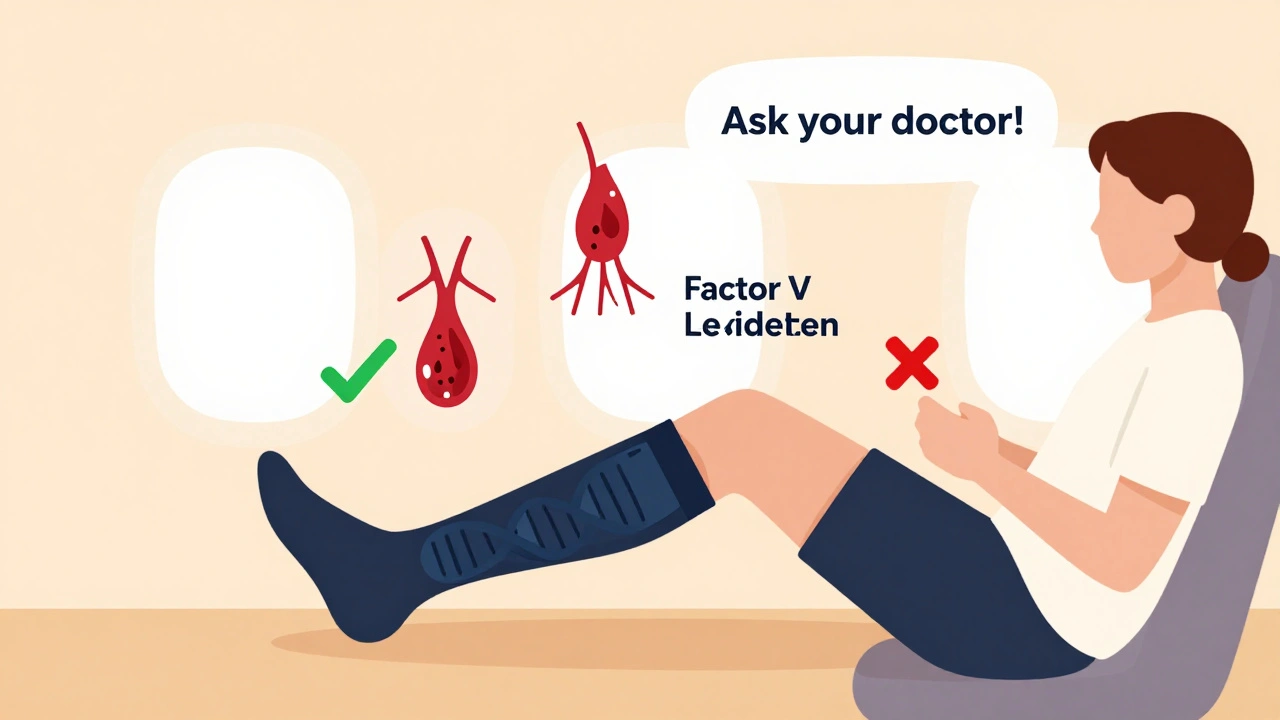
And yes-some people have genetic risks. If you’ve had a clot before age 50, or if close relatives have had them, you might carry Factor V Leiden or another inherited clotting disorder. These affect about 5% of Caucasians. If you have this, estrogen-based drugs are a hard no.
How to Prevent Medication-Related Clots
Prevention isn’t just about drugs. It’s about layers-movement, compression, and sometimes medication.1. Move constantly. If you’re sitting for long periods-on a flight, in the hospital, or working at a desk-get up every 60 to 120 minutes. Walk for 5 minutes. If you can’t get up, do seated calf raises: lift your heels 10 times every 30 minutes. This simple move keeps blood flowing in your legs. Studies show this reduces travel-related clots by 30%.
2. Wear compression stockings. Not just any socks-medical-grade ones that provide 15-20 mmHg of pressure at the ankle, tapering off toward the thigh. They must fit perfectly. If they’re too loose, they don’t work. Too tight, and they cut off circulation. Get measured properly. Replace them every 3 to 6 months. About 15-20% of people get them wrong-and end up with skin damage or no protection at all.
3. Stay hydrated. Dehydration thickens your blood. Drink 8-10 ounces of water every hour during long flights or hospital stays. Avoid alcohol and caffeine-they make you dehydrated.
4. Ask about anticoagulants. If you’re hospitalized, having surgery, or starting cancer treatment, ask: “Should I be on a blood thinner?” The gold standard is low molecular weight heparin (LMWH), like enoxaparin, given as a daily injection. It cuts clot risk by 60-70%. For outpatient use, direct oral anticoagulants (DOACs) like rivaroxaban or apixaban are easier-no injections, no regular blood tests. But they carry a slightly higher bleeding risk than LMWH. Your doctor should weigh your clot risk against your bleeding risk using tools like the Caprini Score.
For cancer patients, ASCO guidelines say: if your Khorana Score is 2 or above, you should get LMWH. Yet only 40% of high-risk patients actually get it. Why? Doctors often underestimate clot risk and overestimate bleeding risk. Don’t let that be you. Ask.
What You Can Do Right Now
You don’t need to wait for symptoms. If you’re on a high-risk medication, take action today:- Write down the name of your medication and when you started it.
- Check if it contains estrogen or is a chemotherapy drug.
- Review your personal and family history: have you or anyone in your family had a clot before age 50?
- Print out the Wells’ Criteria for DVT and keep it in your wallet.
- Set a phone reminder: every day for the first 6 months, ask yourself: “Do I have any new swelling, pain, or breathing trouble?”
- Call your doctor if you’re unsure. Don’t wait for an appointment-call now.
There’s no shame in asking questions. The fact that you’re reading this means you’re already ahead of most people. Medication-related clots are preventable. But only if you know what to look for-and you’re willing to speak up.
What’s Next in Treatment and Prevention
New drugs are on the horizon. Researchers are testing factor XI inhibitors like asundexian. In early trials, they cut clots by half without increasing bleeding. That’s a game-changer.Genetic testing is also getting faster. Right now, full thrombophilia panels take 5-7 days. But point-of-care tests are coming-some clinics already offer results in under 24 hours. Soon, before you even get a prescription for birth control or HRT, you might get a quick genetic screen.
The anticoagulant market is booming, expected to hit $22.7 billion by 2028. That’s because more people are surviving cancer, more women are using hormonal therapies, and more of us are living longer. With that comes responsibility-to know the risks, to ask the right questions, and to demand better protection.
You’re not just a patient. You’re your own best advocate. If a medication could cause a clot, you have the right to know. And you have the right to protect yourself.
Can birth control pills really cause blood clots?
Yes. Combined oral contraceptives containing estrogen increase the risk of deep vein thrombosis (DVT) by 3 to 5 times compared to non-users. Third-generation pills with desogestrel or gestodene carry an even higher risk-1.5 to 2 times greater than second-generation pills with levonorgestrel. The risk is highest in the first 3 to 6 months of use. Women over 35, smokers, or those with a family history of clots are at even greater risk. If you have Factor V Leiden or antiphospholipid syndrome, estrogen-containing birth control is strongly discouraged.
How do I know if my leg pain is a blood clot or just a muscle cramp?
Muscle cramps usually come and go quickly and improve with stretching or massage. A blood clot causes persistent swelling, warmth, and redness in one leg-often the calf. The pain feels deeper, like a cramp that won’t let go, and gets worse when standing or walking. If you’ve recently started a new medication, been immobile for hours, or had surgery, treat any leg pain as a possible clot until proven otherwise. Don’t wait-get an ultrasound if symptoms last more than a day.
Are compression stockings really necessary?
If you’re at high risk-like after surgery, during cancer treatment, or on long flights-yes. Medical-grade compression stockings (15-20 mmHg) improve blood flow and reduce clot risk by up to 60%. But they only work if they fit properly. Many people buy the wrong size or wear them incorrectly, making them useless or even harmful. Get measured at a medical supply store, wear them all day, and replace them every 3-6 months as the elastic wears out.
Can I take aspirin to prevent medication-related clots?
Aspirin is not effective for preventing deep vein thrombosis or pulmonary embolism caused by medications. It works on arterial clots (like heart attacks), not venous clots. For medication-related clots, you need anticoagulants like low molecular weight heparin or DOACs. Aspirin may be used in some cancer patients as an add-on, but it’s not a substitute for proper prophylaxis. Don’t rely on it alone.
How long should I stay on blood thinners after starting a high-risk medication?
It depends. For short-term risks like surgery, anticoagulants are usually given for 7-14 days. For cancer patients on long-term therapy, prophylaxis may continue for as long as the treatment lasts. Hormonal therapy users may only need prevention during the first 3-6 months, when risk is highest. Always follow your doctor’s plan. Stopping too soon can be dangerous. Never stop anticoagulants without medical advice-sudden withdrawal can trigger clots.
Can I still fly if I’m on a high-risk medication?
Yes-but you need to take extra steps. Walk every 60-120 minutes. Do seated calf exercises every 30 minutes. Drink 8-10 ounces of water per hour. Wear compression stockings. Avoid alcohol and sleeping pills. If you’ve had a clot before or have multiple risk factors, talk to your doctor about a short course of LMWH before your flight. Flying is safe with proper precautions.
What to Do If You Think You Have a Clot
If you have sudden shortness of breath, chest pain, or leg swelling with no clear cause-call emergency services immediately. Don’t wait for your doctor’s office to open. Don’t drive yourself. A pulmonary embolism can kill in minutes.Keep a list of all your medications in your wallet or phone. Include dosages and start dates. If you end up in the ER, this could be the key to a fast diagnosis.
Medication-related blood clots aren’t random. They’re predictable. And they’re preventable. You don’t need to live in fear. You just need to know the signs, ask the questions, and take simple steps to protect yourself. Your life depends on it.

Zed theMartian
December 3, 2025 AT 15:59Oh wow, another ‘knowledge is power’ pamphlet disguised as medical advice. Let me guess-you also recommend drinking celery juice and sleeping on a magnetic mattress? The FDA black box warning? Please. I’ve seen more legitimate warnings on energy drink cans. This whole thing reads like a pharmaceutical affiliate marketing blog written by someone who thinks ‘D-dimer’ is a new TikTok dance. I’ll stick with my 1987 copy of Harrison’s Principles of Internal Medicine, thank you very much.
Ella van Rij
December 3, 2025 AT 19:11lol at the ‘Wells’ Criteria’ like its some ancient scroll from the temple of medicine. i just googled ‘leg pain after birth control’ and 3 out of 4 results were from people who had PE and lived to tell the tale. also, compression stockings? more like ‘fashionable leg sausages’ for women who forgot they’re not in a 1950s hospital drama. btw, i typo’d ‘sausages’ as ‘sauages’ on purpose. you’re welcome.
ATUL BHARDWAJ
December 5, 2025 AT 03:45India has no estrogen birth control warnings. Many women take pills without screening. Clots happen but are rarely discussed. Movement is key. Water. No sugar drinks. Simple. No need for scans or injections. Life is not a hospital. Walk. Breathe. Live.
Steve World Shopping
December 5, 2025 AT 19:18Let’s be clear-this is a classic case of iatrogenic thromboembolic pathophysiology secondary to exogenous hormonal modulation and chemotherapeutic endothelial insult. The Khorana Score is underutilized in outpatient oncology, and the Caprini Risk Assessment Model remains grossly underimplemented in postoperative protocols. DOACs are superior to LMWH in non-cancer populations, but adherence is suboptimal due to cognitive dissonance around anticoagulant literacy. You’re not just a patient-you’re a data point in a failing healthcare algorithm.
Rebecca M.
December 7, 2025 AT 19:00I started birth control in 2021. Three weeks later, my left leg looked like a swollen sausage that got into a fight with a brick wall. I went to the ER. They said ‘it’s probably just water retention.’ I cried. Then I Googled ‘birth control leg pain’ and found THIS. I’m alive because I didn’t listen to the doctor. I listened to the internet. And now I’m screaming into the void so you don’t end up like me. You’re welcome.
Lynn Steiner
December 9, 2025 AT 18:33My sister died from a PE after her HRT started. They told her it was ‘just anxiety.’ I’m so angry I can’t even type properly. 🥺💔 I don’t care about scores or guidelines. I care that no one told her. No one warned her. Now I scream this into every thread I see. If you’re on hormones, check your legs. Check your lungs. Check your soul. Don’t wait. Please.
Alicia Marks
December 10, 2025 AT 14:20You’re doing great just by reading this. That’s half the battle. Keep asking questions. Keep moving. Keep hydrating. You’ve got this.
Paul Keller
December 11, 2025 AT 04:21While I appreciate the comprehensive nature of this article, I must offer a critical perspective grounded in clinical epidemiology and evidence-based practice. The conflation of relative risk with absolute risk is a persistent public health miscommunication that fuels unnecessary anxiety. The baseline incidence of VTE in healthy premenopausal women is approximately 1-2 per 10,000 person-years; even a 5-fold increase remains statistically low. Furthermore, the benefits of hormonal contraception in terms of reproductive autonomy, menstrual regulation, and endometrial cancer prevention are substantial and often underappreciated in fear-driven narratives. While prophylactic anticoagulation may be warranted in high-risk subgroups-particularly those with genetic thrombophilias or active malignancy-it is neither clinically indicated nor cost-effective for the general population. I urge readers to engage in shared decision-making with their providers rather than self-diagnosing based on internet content. The goal is not avoidance, but informed vigilance.