
Statins & Rhabdomyolysis Risk Calculator
Your Risk Assessment
This calculator helps you understand your personal risk of rhabdomyolysis while taking statins. Remember: true rhabdomyolysis is extremely rare (less than 1 in 20,000 statin users) but requires immediate medical attention if symptoms appear.
Click "Calculate Your Risk" to see your assessment.
Statins save lives. Millions of people take them every day to lower cholesterol and prevent heart attacks and strokes. But for a tiny fraction of users, these drugs can trigger something far more dangerous than mild muscle aches: rhabdomyolysis - a rapid, violent breakdown of skeletal muscle that can lead to kidney failure and even death.
What Exactly Is Rhabdomyolysis?
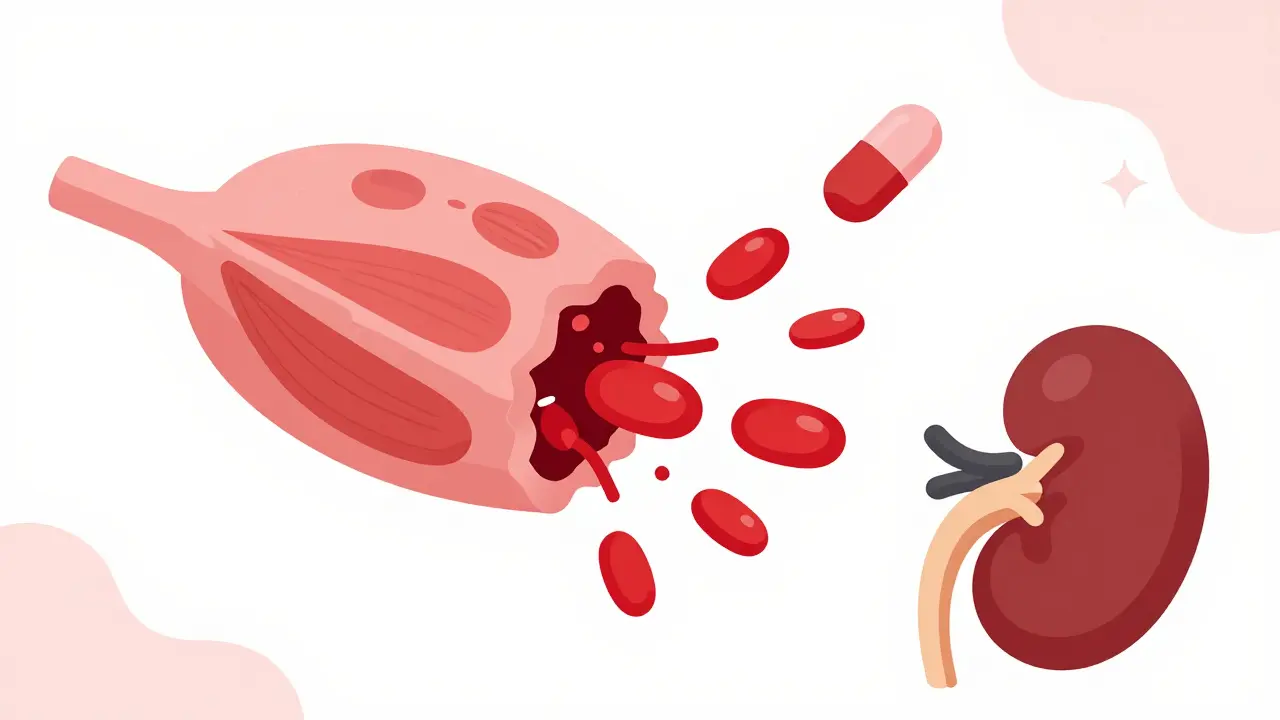
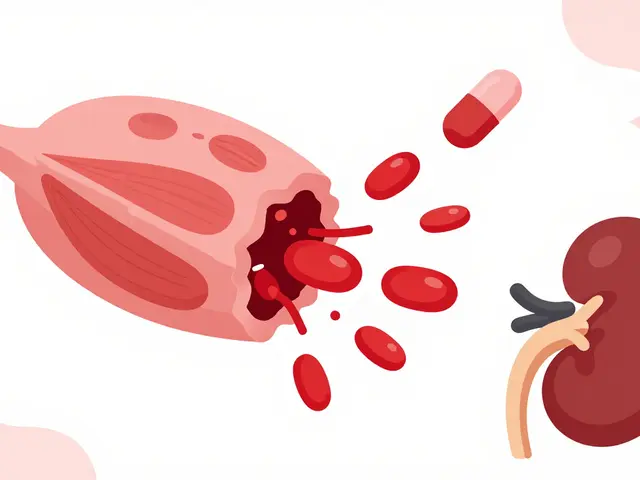
Rhabdomyolysis isn’t just sore muscles. It’s when muscle cells rupture and spill their contents - especially a protein called myoglobin - into the bloodstream. Myoglobin is toxic to the kidneys. When too much of it floods the system, it can clog the tiny filters in your kidneys, causing acute kidney injury. Symptoms often start with severe muscle pain, weakness, and dark urine that looks like cola. In extreme cases, people can’t stand up, lift their arms, or even walk without help. Without quick treatment, this can turn fatal.How Common Is It?
The short answer: extremely rare. About 1.5 to 5 cases happen per 100,000 people taking statins each year. That’s less than one in 20,000. But while the odds are low, the consequences are high. And that’s why doctors take it seriously. Most people who take statins never have this problem. In fact, up to 30% report mild muscle discomfort - soreness, fatigue, cramps - but that’s not rhabdomyolysis. That’s statin-associated muscle symptoms (SAMS), which often go away with dose changes or switching drugs. True rhabdomyolysis is a medical emergency. It doesn’t just hurt. It breaks your body down from the inside.Why Do Statins Cause This?
Statins work by blocking an enzyme called HMG-CoA reductase, which your liver uses to make cholesterol. But that same enzyme is part of a bigger pathway that also produces other vital compounds - like coenzyme Q10 (CoQ10) and isoprenoids. These help your muscles produce energy and stay healthy. When statins cut off these compounds, muscles start to suffer. One theory is that without enough CoQ10, muscle cells run out of fuel. Another is that statins trigger a system in muscle cells that breaks down proteins - the ubiquitin-proteasome pathway - turning your own muscles into food for your body. A third idea suggests statins, especially the more fat-soluble ones like simvastatin, get stuck in muscle cell membranes and make them unstable. Throw in a hard workout, and the membrane tears. Muscle cells leak. Inflammation follows. Damage spreads. It’s not just one thing. Most experts agree it’s a mix of factors: the type of statin, your dose, your genes, what other drugs you’re taking, and even how active you are.Not All Statins Are the Same
Some statins are much riskier than others. Simvastatin, especially at the 80 mg dose, has the highest known risk. In 2011, the FDA warned doctors not to prescribe 80 mg simvastatin to new patients because it increased muscle damage risk by more than 10 times compared to lower doses. Pravastatin and fluvastatin are much gentler on muscles. Rosuvastatin and atorvastatin fall somewhere in the middle. Why the difference? It comes down to how the body processes them. Simvastatin, lovastatin, and atorvastatin are broken down by a liver enzyme called CYP3A4. If you’re taking another drug that blocks this enzyme - like the antibiotic clarithromycin, the antifungal ketoconazole, or even grapefruit juice in large amounts - your statin builds up in your blood. That raises the risk of muscle damage. Pravastatin and rosuvastatin use different pathways, so they’re less likely to interact dangerously.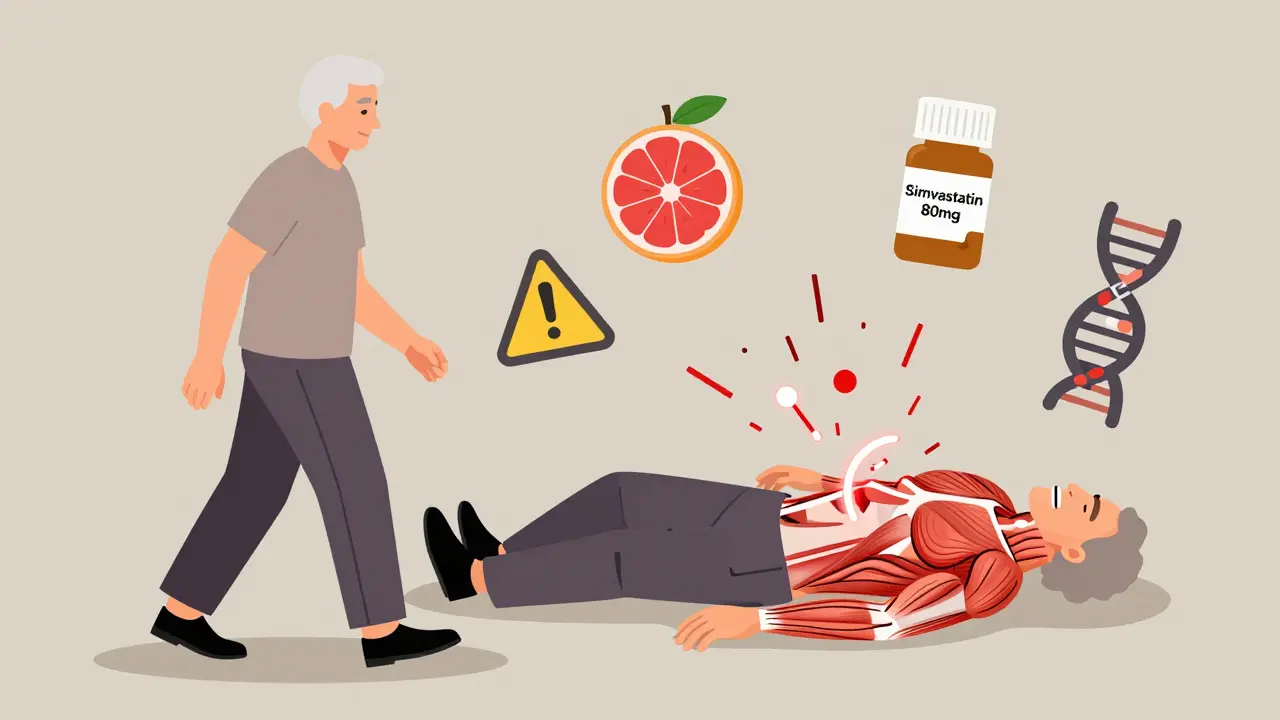
Your Genes Matter More Than You Think
Some people are genetically wired to be more sensitive. A gene called SLCO1B1 controls how well your liver pulls statins out of your blood. If you have a specific variation - c.521T>C - your liver can’t clear the drug efficiently. That means higher levels hang around longer, increasing muscle exposure. People with two copies of this variant (homozygous) have a 4.5 times higher risk of muscle injury. That’s not a small risk. In 2008, a major study found this single gene change explained why some people got sick on statins while others didn’t. Today, genetic tests like OneOme RightMed can check for this variant. It costs around $250, and while insurance rarely covers it unless you’ve already had muscle problems, it’s becoming more common in high-risk cases.Who’s Most at Risk?
It’s not random. Certain groups are more likely to develop rhabdomyolysis:- People over 65 - muscle mass declines with age, and liver/kidney function slows down.
- Women - 62% of reported cases are in women, though the reasons aren’t fully clear.
- Those with kidney or liver disease - their bodies can’t clear statins properly.
- People taking multiple medications - especially those that interfere with statin metabolism.
- Those who do intense or unusual exercise - especially downhill hiking, heavy lifting, or long-distance running.
What Should You Do If You Feel Something’s Wrong?
Don’t ignore persistent muscle pain, especially if it’s new, severe, or getting worse. If you’re on a statin and you feel:- Unusual muscle soreness that doesn’t go away after a few days
- Weakness that makes daily tasks hard
- Dark, tea-colored urine
Can You Still Take Statins After a Muscle Problem?
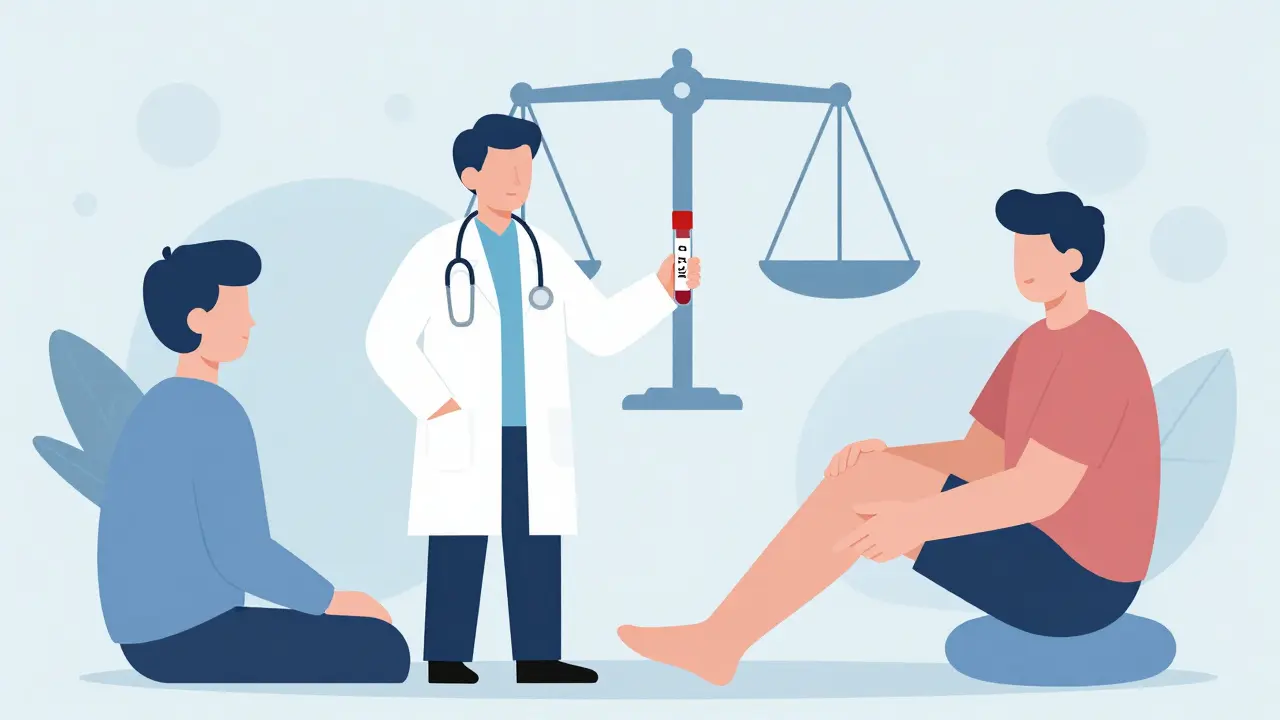
Yes - but carefully. Many people who think they’re “statin intolerant” actually aren’t. A 2023 American College of Cardiology report found that 78% of patients who stopped statins due to muscle symptoms could restart them successfully after switching to a different statin, lowering the dose, or taking breaks. Switching from simvastatin to pravastatin or fluvastatin often helps. Some patients do well on alternate-day dosing. Others benefit from coenzyme Q10 supplements - though evidence is mixed, many report less discomfort. If you truly can’t tolerate any statin, PCSK9 inhibitors like evolocumab are an option. But they cost over $5,800 a year and require injections, so they’re not for everyone.What About Exercise?
Don’t stop moving. But be smart. Avoid sudden, intense workouts - especially downhill walking, heavy weightlifting, or long-distance running. Stick to gentle, steady activity: walking, swimming, cycling at a moderate pace. If you feel pain during or after exercise, stop. Don’t push through it. Muscle damage can happen fast, and recovery takes time.The Bigger Picture: Benefits Still Outweigh Risks
Statins prevent about 500,000 heart attacks and strokes in the U.S. every year. For someone with high cholesterol, diabetes, or a history of heart disease, the benefit is massive. The risk of rhabdomyolysis? Less than 1 in 20,000. That’s like being struck by lightning while standing in a field - possible, but astronomically unlikely. The real danger isn’t the drug. It’s fear. Too many people quit statins because of vague muscle aches, not knowing the difference between normal side effects and true danger. That’s why doctors now focus on helping patients distinguish between nocebo effects - where fear of side effects causes real symptoms - and actual toxicity.What’s Next?
Science is moving fast. In 2023, a study published in Nature Communications found 17 blood proteins that predict statin muscle damage with over 85% accuracy. That could one day mean a simple blood test before you even start a statin - telling you if you’re at high risk. Researchers are also working on “muscle-sparing” statins - drugs that keep lowering cholesterol without hurting muscles. Early trials are promising. For now, the best advice is simple: don’t panic. Statins are safe for most. But if you feel something off, speak up. Get tested. Don’t assume it’s just aging or overexertion. Muscle breakdown doesn’t always announce itself with a scream - sometimes, it’s just a quiet weakness you can’t explain.Can statins cause permanent muscle damage?
In most cases, no. Muscle damage from statins usually reverses once the drug is stopped. Recovery can take weeks to months, depending on severity. But if rhabdomyolysis leads to severe kidney injury or compartment syndrome, there can be lasting effects. That’s why early detection and stopping the statin quickly is critical.
Does taking CoQ10 supplements help prevent statin muscle pain?
Some people report feeling better when they take CoQ10, and it makes biological sense - statins lower CoQ10 levels, which muscles need for energy. But large studies haven’t proven it works consistently. It’s not a cure, but it’s safe to try if you’re having mild discomfort. Talk to your doctor first, especially if you’re on blood thinners.
Is it safe to restart a statin after stopping due to muscle pain?
Yes, for most people. About 78% of those who stop statins due to muscle symptoms can tolerate a different statin or a lower dose after a break. Switching from simvastatin to pravastatin or rosuvastatin often helps. Never restart on your own - always work with your doctor to choose a safer option.
Can grapefruit juice increase the risk of rhabdomyolysis?
Yes - especially with simvastatin, lovastatin, or atorvastatin. Grapefruit juice blocks the liver enzyme that breaks down these statins, causing levels to spike in your blood. Even one glass can have an effect that lasts over 24 hours. If you take one of these statins, avoid grapefruit entirely. Other statins like pravastatin and rosuvastatin are safe with grapefruit.
What should I do if I notice dark urine while on a statin?
Stop taking the statin immediately and seek medical care. Dark urine is a red flag for myoglobin in your blood - a sign of muscle breakdown. This can lead to kidney damage within hours. Go to an urgent care center or ER. Don’t wait. Get a creatine kinase test and kidney function checked right away.

Chris & Kara Cutler
February 2, 2026 AT 03:00Statins saved my dad’s life after his heart attack 😊 But I saw him go from hiking trails to barely climbing stairs - then we found out it was the simvastatin. Switched to pravastatin and he’s back to gardening like a champ. Don’t panic, but don’t ignore those aches either!
Rachel Liew
February 3, 2026 AT 19:55i had no idea grapefruit juice could be so dangerous with statins. i drink it every morning… now im scared. my doctor never mentioned this. thanks for the warning. i’ll switch to orange juice now 😅
Jamie Allan Brown
February 4, 2026 AT 19:39It’s wild how something so common can have such rare but devastating side effects. I’ve seen patients on statins come in with muscle weakness and assume it’s just aging - until their CK levels spike. Early detection is everything. Please, if you feel off, get tested. Don’t wait for the dark urine.
Lisa Rodriguez
February 4, 2026 AT 21:17My mom took simvastatin for years and never had issues until she started doing Zumba every day. Then boom - couldn’t get out of a chair. Doctor said it was the combo of high dose + eccentric exercise. Switched to rosuvastatin and cut back on the dancing. Now she’s fine. Point is - it’s not just the drug. It’s the whole picture. Don’t blame the pill, blame the perfect storm.
Ed Di Cristofaro
February 5, 2026 AT 21:31People quit statins because they’re lazy. If your legs hurt, you’re just out of shape. Stop blaming Big Pharma and start lifting weights. I’ve been on 80mg simva for 12 years and my muscles are stronger than yours.
Lilliana Lowe
February 6, 2026 AT 16:20While the article is broadly accurate, it fails to adequately distinguish between statin-associated muscle symptoms (SAMS) and true rhabdomyolysis. The conflation of these entities in public discourse perpetuates therapeutic nihilism. Furthermore, the reference to OneOme RightMed as a "common" test is misleading - its clinical utility remains confined to specialized lipid clinics, and its cost-benefit ratio is not yet established in primary prevention cohorts.
vivian papadatu
February 8, 2026 AT 07:00My brother-in-law is a physical therapist in Oregon. He sees this all the time - older patients on statins who think their muscle pain is "just getting old." Then they do a hike, and boom - can’t walk. He always tells them: "If you feel like you’ve been hit by a truck after walking downhill, stop. Get a blood test. Don’t wait for your urine to turn brown." It’s not fear-mongering. It’s prevention.
Deep Rank
February 8, 2026 AT 14:37ok but like… why are we even taking these drugs in the first place? i mean, cholesterol is natural right? and dont we need it for our brains and hormones? and why is it always the poor people who get prescribed statins while rich people eat avocado toast and yoga and say they "balance their lifestyle"? i think the whole system is rigged. also my cousin took a statin and got diabetes and now he’s on insulin and i think it was the statin. also i read on a forum that statins cause dementia but no one talks about it because the pharma companies own the doctors. also i heard that the FDA is corrupt and they just approve everything for money. like… why are we trusting them? i just dont get it anymore.
Jaden Green
February 9, 2026 AT 20:28Look, I’ve read every peer-reviewed paper on this. The real risk isn’t rhabdomyolysis - it’s the placebo effect and the nocebo effect. People read articles like this, panic, and then feel muscle pain because they’re convinced they’re going to die. Meanwhile, the actual incidence of rhabdomyolysis is lower than being struck by lightning in a bathtub. The real epidemic here is medical anxiety. Stop Googling. Stop self-diagnosing. Take your damn pill and go for a walk.
Angel Fitzpatrick
February 11, 2026 AT 13:19They don’t want you to know this - but statins are designed to make you weak. That’s why they lower CoQ10. Why? So you’ll need more drugs. More doctor visits. More pills. The whole system is built on chronic illness. And the dark urine? That’s your body screaming. They call it "rare" because they don’t track it properly. The real number? 1 in 500. They bury it in the fine print. I’ve seen it. My uncle died after his kidneys gave out. They said "statins." No one else would admit it. Wake up. They’re not saving lives - they’re selling lifetimes.